Rare defect behind deaths
About the article
This is a digitised version of an article from The Cayman Compass's print archive. Occasionally, the digitisation process introduces transcription errors, or other problems.
See the article in its original context from November 1993.
Brought to you by

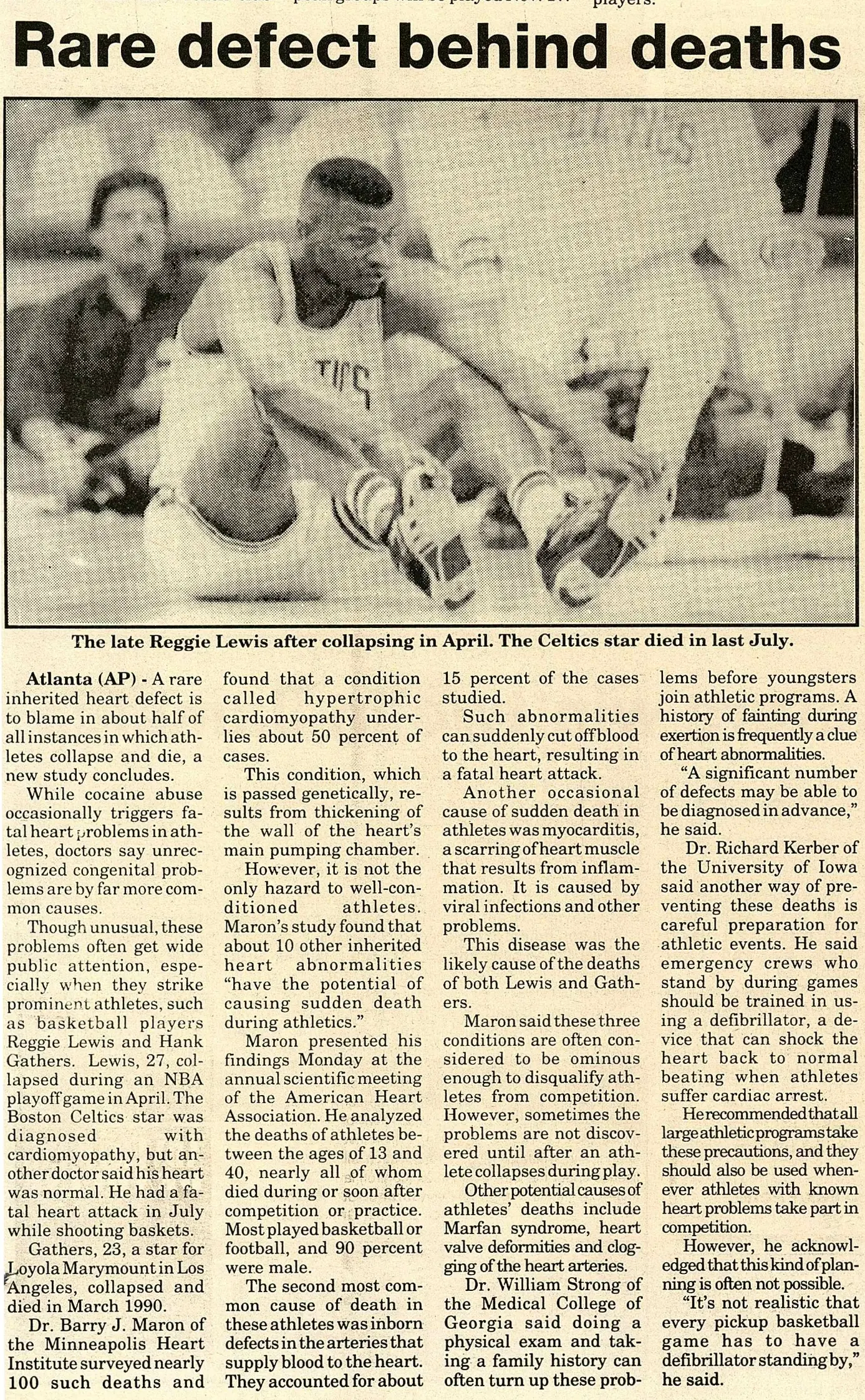
While cocaine abuse occasionally triggers fatal heart problems in athletes, doctors say unrecognized congenital problems are by far more common causes.
Though unusual, these problems often get wide public attention, especially when they strike prominent athletes, such as basketball players Reggie Lewis and Hank Gathers. Lewis, 27, collapsed during an NBA playoffgame in April. The Boston Celtics star was diagnosed with cardiomyopathy, but another doctor said his heart was normal. He had a fatal heart attack in July while shooting baskets.
Gathers, 23, a star for Loyola Marymount in Los Angeles, collapsed and died in March 1990.
Dr. Barry J. Maron of the Minneapolis Heart Institute surveyed nearly 100 such deaths and found that a condition called hypertrophic cardiomyopathy underlies about 50 percent of This condition, which is passed genetically, results from thickening of the wall of the heart's main pumping chamber. However, it is not the only hazard to well-conditioned athletes.
Maron's study found that about 10 other inherited heart abnormalities "have the potential of causing sudden death during athletics."
Maron presented his findings Monday at the annual scientific meeting of the American Heart Association. He analyzed the deaths of athletes between the ages of 13 and 40, nearly all of whom died during or soon after competition or practice. Most played basketball or football, and 90 percent were male.
The second most common cause of death in these athletes was inborn defects in the arteries that supply blood to the heart. They accounted for about 15 percent of the cases studied.
Such abnormalities can suddenly cut off blood to the heart, resulting in a fatal heart attack.
Another occasional cause of sudden death in athletes was myocarditis, a scarring of heart muscle that results from inflammation. It is caused by viral infections and other problems.
This disease was the likely cause of the deaths of both Lewis and Gathers. Maron said these three conditions are often considered to be ominous enough to disqualify athletes from competition. However, sometimes the problems are not discovered until after an athlete collapses during play.
Other potential causes of athletes' deaths include Marfan syndrome, heart valve deformities and clogging of the heart arteries.
Dr. William Strong of the Medical College of Georgia said doing a physical exam and taking a family history can often turn up these problems before youngsters join athletic programs. A history of fainting during exertion is frequently a clue of heart abnormalities. "A significant number of defects may be able to be diagnosed in advance," he said.
Dr. Richard Kerber of the University of Iowa said another way of preventing these deaths is careful preparation for athletic events. He said emergency crews who stand by during games should be trained in using a defibrillator, a device that can shock the heart back to normal beating when athletes suffer cardiac arrest. Herecommended that all large athletic programs take these precautions, and they should also be used whenever athletes with known heart problems take part in competition.
However, he acknowledged that this kind of planning is often not possible. "It's not realistic that every pickup basketball game has to have a defibrillator standing by," he said.