Missing man's body found
About the article
This is a digitised version of an article from The Cayman Compass's print archive. Occasionally, the digitisation process introduces transcription errors, or other problems.
See the article in its original context from April 1994.
Brought to you by

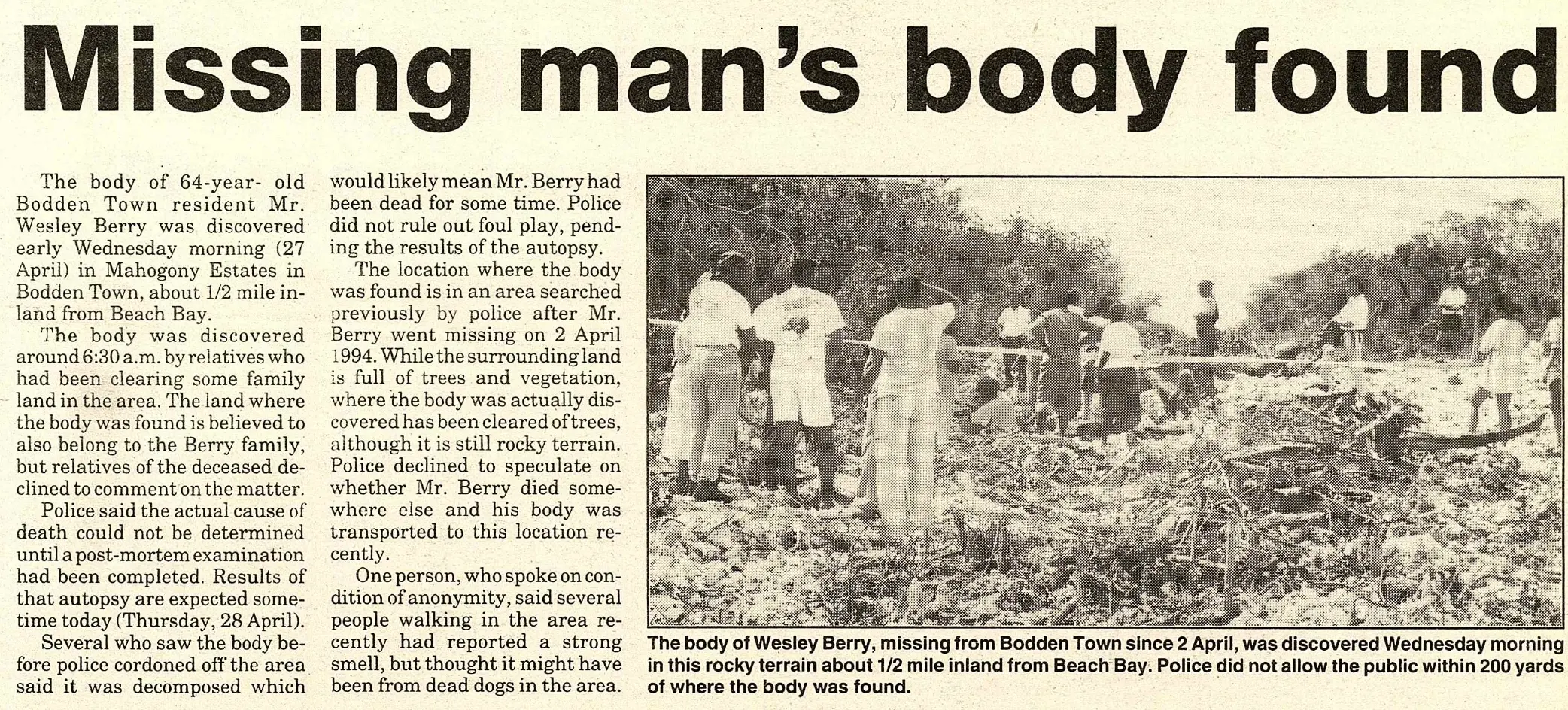
The body was discovered around 6:30 a.m. by relatives who had been clearing some family land in the area. The land where the body was found is believed to also belong to the Berry family, but relatives of the deceased declined to comment on the matter.
Police said the actual cause of death could not be determined until a post-mortemexamination had been completed. Results of that autopsy are expected sometime today (Thursday, 28 April).
Several who saw the body before police cordoned off the area said it was decomposed which would likely mean Mr. Berry had been dead for some time. Police did not rule out foul play, pending the results of the autopsy.
The location where the body was found is in an area searched previously by police after Mr. Berry went missing on 2 April 1994. While the surrounding land is full of trees and vegetation, where the body was actually discovered has been cleared of trees, although it is still rocky terrain. Police declined to speculate on whether Mr. Berry died somewhere else and his body was transported to this location recently.
One person, who spoke on condition of anonymity, said several people walking in the area recently had reported a strong smell, but thought it might have been from dead dogs in the area. from page 1
In what is believed to be the first case of its kind locally, a private individual is suing a police officer, the Commissioner of Police and the Cayman Islands Government.
Civil trial began in Grand Court last week before Chief Justice George Harre. The matter was set down for six or seven days, but was still continuing on Wednesday, 27 April.
Mr. John Mitchell Rea is claiming damages for injury and loss suffered since October, 1991, when the police officer obtained search warrants for Mr. Rea's home and office.
The first defendant, Inspector Brian Gibbs, is in charge of the Drug Profits Confiscation Unit of the Royal Cayman Islands Police. Attorneys for Mr. Rae - Mr. Ramon Alberga QC and Mr. Shaun McCann - allege that Mr. Gibbs "wrongfully, falsely and maliciously" invoked the process of the court to procure the search warrants. They say Mr. Gibbs had no reasonable grounds for invoking the process or suspecting that Mr. Rea had carried on or benefitted from any drug trafficking.
Despite prolonged investigations alleged by police, no charges have ever been brought against Mr. Rea, his attorneys have pointed out. But as a result, he has suffered mental anguish and loss of his professional reputation, according to his claim.
Mr. Rea was the managing director of Pierson, Heldring and Pierson for over six years, but was asked to resign that post after his office was searched.
His financial losses, including salary, profit sharing and benefits, total over US$220,000, according to a statement of claim.
After Mr. Alberga opened his arguments last week, he called on Mr. Rea to give evidence. He also called Mrs. Jennifer Dilbert, Inspector of Financial Services. Appearing on behalf of the defendants are Mr. Pierre Lamontagne QC and Senior Crown Counsel Ivor Archie.
Mr. Lamontagne argued points of law and cases used as precedents, but did not call any witnesses. He asserted that the timing of the police investigation and the request for Mr. Rea's resignation was coincidental. He argued that the warrants obtained "stick to the formula of the law and cannot possibly be invalid".
Mr. Gibbs applied for the warrants, but it was the Grand Court judge [Mr. Derek Schofield] who had to be satisfied before he issued them, the attorney argued.
In reply, Mr. Alberga expressed surprise that Mr. Gibbs was not called as a witness. The inspector had not come to challenge anything Mr. Rea had said in evidence; the Defence had made no excuse, no claim of privilege. There was not one shred of evidence to indicate what it was that prompted Mr. Gibbs to invoke the judicial process or what he told Mr. Schofield.
Mr. Alberga asked the Chief Justice to draw the inference that Mr. Gibbs had not come forward because he had deceived the judge and knew he had nothing to back up his alleged suspicion that Mr. Rea was profiting from drug trafficking and those warrants were obtained "on nothing".
Mr. Alberga accused Mr. Gibbs of deceiving the court into concluding that there were reasonable grounds to suspect Mr. Rea and there were reasonable grounds to suspect that incriminating materials would be found at Mr. Rea's premises.
Nothing was found and Mr. Rea now seeks, in addition to damages, a declaration that the search warrants were falsely procured.