A weighty subject: watch it!
About the article
This is a digitised version of an article from The Cayman Compass's print archive. Occasionally, the digitisation process introduces transcription errors, or other problems.
See the article in its original context from July 1994.
Brought to you by

The medical profession on the whole takes a very poor view of crash diets. They are regarded as damaging to the average person's health, and potentially dangerous to some individuals. While the scales may initially have joyful messages for many crash dieters, once the ordeal is concluded and forbidden foods reintroduced, the vast majority tend to regain pounds lost quite quickly. Some even gain more than they lost in the first place.
Dr. Joe Marzouca of Cayman Medical Centre comments: "A crash diet is anything below 1500 calories a day; a long-term diet of less that 1500 calories a day is unreasonable. To eat anything below 1000 calories a day is ludicrous. Many women tend to go on short-term crash diets. If they keep doing it, the resulting cyclical weight patterns inevitably have adverse effects on their bodies.
"It is much healthier to go on a long-term low-impact diet with a sensible nutritional balance than to crash diet repeatedly.
"Many quick-loss diets tend to cut down on protein, one of the most important food groups, and concentrate on carbohydrates. The loss of protein means loss of muscle, which is - and looks - very unhealthy."
In a nutshell, the problem with all short-term rapid-weight-loss programmes health questions aside - is that the slimmer rarely learns why he or she is too heavy in the first place. shed pounds permanently, individuals must first appreciate why their eating/drinking habits are causing the jelly on the belly. Then they must adopt new habits, founded on an understanding of their body's nutritional needs.
This change in habits is not necessarily a radical process. For someone only ten to 20 pounds overweight, a few minor adjustments to their diet and exercise routine is likely to be all it takes to cure the problem.
Most doctors recommend that people lose weight slowly. This gives the body and mind time to adjust to a new regime without undue stress, and time for the intellect to absorb new facts about the whys and wherefores of healthier eating.
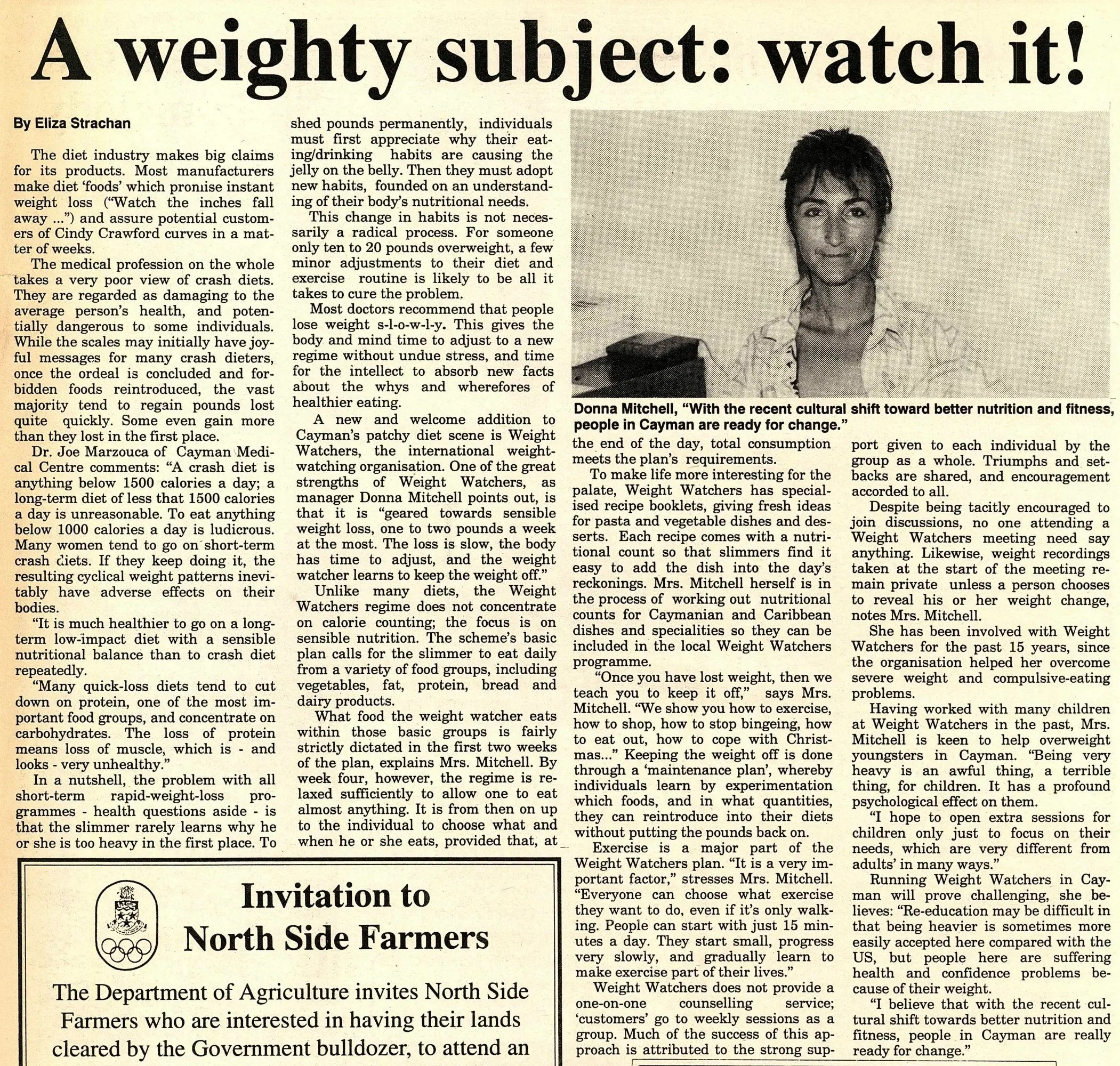
A new and welcome addition to Cayman's patchy diet scene is Weight Watchers, the international weightwatching organisation. One of the great strengths of Weight Watchers, as manager Donna Mitchell points out, is that it is "geared towards sensible weight loss, one to two pounds a week at the most. The loss is slow, the body has time to adjust, and the weight watcher learns to keep the weight off."
Unlike many diets, the Weight Watchers regime does not concentrate on calorie counting; the focus is on sensible nutrition. The scheme's basic plan calls for the slimmer to eat daily from a variety of food groups, including vegetables, fat, protein, bread and dairy products.
What food the weight watcher eats within those basic groups is fairly strictly dictated in the first two weeks of the plan, explains Mrs. Mitchell. By week four, however, the regime is relaxed sufficiently to allow one to eat almost anything. It is from then on up to the individual to choose what and when he or she eats, provided that, at the end of the day, total consumption meets the plan's requirements.
To make life more interesting for the palate, Weight Watchers has specialised recipe booklets, giving fresh ideas for pasta and vegetable dishes and desserts. Each recipe comes with a nutritional count so that slimmers find it easy to add the dish into the day's reckonings. Mrs. Mitchell herself is in the process of working out nutritional counts for Caymanian and Caribbean dishes and specialities so they can be included in the local Weight Watchers programme.
"Once you have lost weight, then we teach you to keep it off," says Mrs. Mitchell. "We show you how to exercise, how to shop, how to stop bingeing, how to eat out, how to cope with Christmas..." Keeping the weight off is done through a 'maintenance plan', whereby individuals learn by experimentation which foods, and in what quantities, they can reintroduce into their diets without putting the pounds back on.
Exercise is a major part of the Weight Watchers plan. "It is a very important factor," stresses Mrs. Mitchell. "Everyone can choose what exercise they want to do, even if it's only walking. People can start with just 15 minutes a day. They start small, progress very slowly, and gradually learn to make exercise part of their lives."
Weight Watchers does not provide a one-on-one counselling service; 'customers' go to weekly sessions as a group. Much of the success of this approach is attributed to the strong support given to each individual by the group as a whole. Triumphs and setbacks are shared, and encouragement accorded to all.
Despite being tacitly encouraged to join discussions, no one attending a Weight Watchers meeting need say anything. Likewise, weight recordings taken at the start of the meeting remain private unless a person chooses to reveal his or her weight change, notes Mrs. Mitchell.
She has been involved with Weight Watchers for the past 15 years, since the organisation helped her overcome severe weight and compulsive-eating problems.
Having worked with many children at Weight Watchers in the past, Mrs. Mitchell is keen to help overweight youngsters in Cayman. "Being very heavy is an awful thing, a terrible thing, for children. It has a profound psychological effect on them.
"I hope to open extra sessions for children only just to focus on their needs, which are very different from adults' in many ways."
Running Weight Watchers in Cayman will prove challenging, she believes: "Re-education may be difficult in that being heavier is sometimes more easily accepted here compared with the US, but people here are suffering health and confidence problems because of their weight.
"I believe that with the recent cultural shift towards better nutrition and fitness, people in Cayman are really ready for change."