Haiti's provisional president quits
About the article
This is a digitised version of an article from The Cayman Compass's print archive. Occasionally, the digitisation process introduces transcription errors, or other problems.
See the article in its original context from October 1994.
Brought to you by

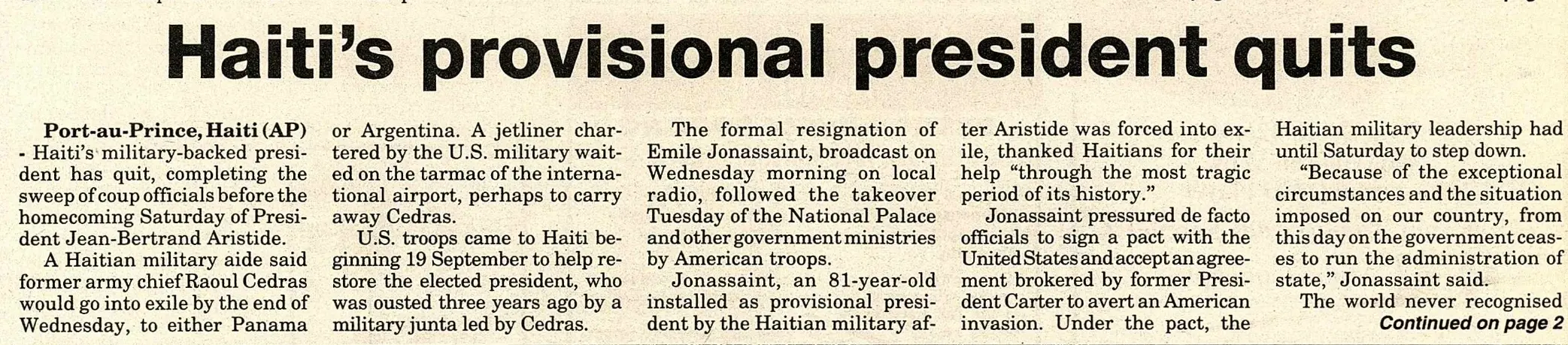
A Haitian military aide said former army chief Raoul Cedras would go into exile by the end of Wednesday, to either Panama or Argentina. A jetliner chartered by the U.S. military waited on the tarmac of the international airport, perhaps to carry away Cedras.
U.S. troops came to Haiti beginning 19 September to help restore the elected president, who was ousted three years ago by a military junta led by Cedras. The formal resignation of Emile Jonassaint, broadcast on Wednesday morning on local radio, followed the takeover Tuesday of the National Palace and other government ministries by American troops.
Jonassaint, an 81-year-old installed as provisional president by the Haitian military after Aristide was forced into exile, thanked Haitians for their help "through the most tragic period of its history."
Jonassaint pressured de facto officials to sign a pact with the United States and accept an agreement brokered by former President Carter to avert an American invasion. Under the pact, the Haitian military leadership had until Saturday to step down.
"Because of the exceptional circumstances and the situation imposed on our country, from this day on the government ceases to run the administration of state," Jonassaint said.
The world never recognised Continued on page 2 from page 1 the military's designation last May of Jonassaint to replace the democratically elected Aristide. Jonassaint was not expected to leave the country.
But Cedras and his family will leave Haiti sometime Wednesday, an aide to new commander Maj. Gen. Jean-Claude Duperval told The Associated Press at the airport. The aide, identified only as Lt. Bernard, said Cedras was going to Panama or Argentina.
Duperval met 90 minutes at the airport with U.S. military officials. Meanwhile, the Cedras family packed at their hillside mansion overlooking Port-au-Prince. When asked by reporters when the family was going, Cedras' brother Alix replied testily: "Why would you ask me that?"
U.S. Embassy spokesman Stanley Schrager said Wednesday that Panama is "a very good possibility" for taking in Cedras, his family, fellow coup leader Brig. Gen. Philippe Biamby and others tied to the military.
Panama President Ernesto Perez Balladares said this morning that he hadn't decided whether to grant political asylum to Cedras and it may take a day or more.
"The one who has to make the decision is me, and I still have not," Perez Balladares said. He said he doesn't plan to decide as long as he is out of the country.
He spoke to reporters at Panama City airport before taking off for Managua, the Nicaraguan capital, where a summit of Central American presidents is being held on ecological problems affecting the region. Perez Balladares is expected to return Thursday to Panama.