No simple answer to the cholesterol problem
About the article
This is a digitised version of an article from The Cayman Compass's print archive. Occasionally, the digitisation process introduces transcription errors, or other problems.
See the article in its original context from December 1994.
Brought to you by

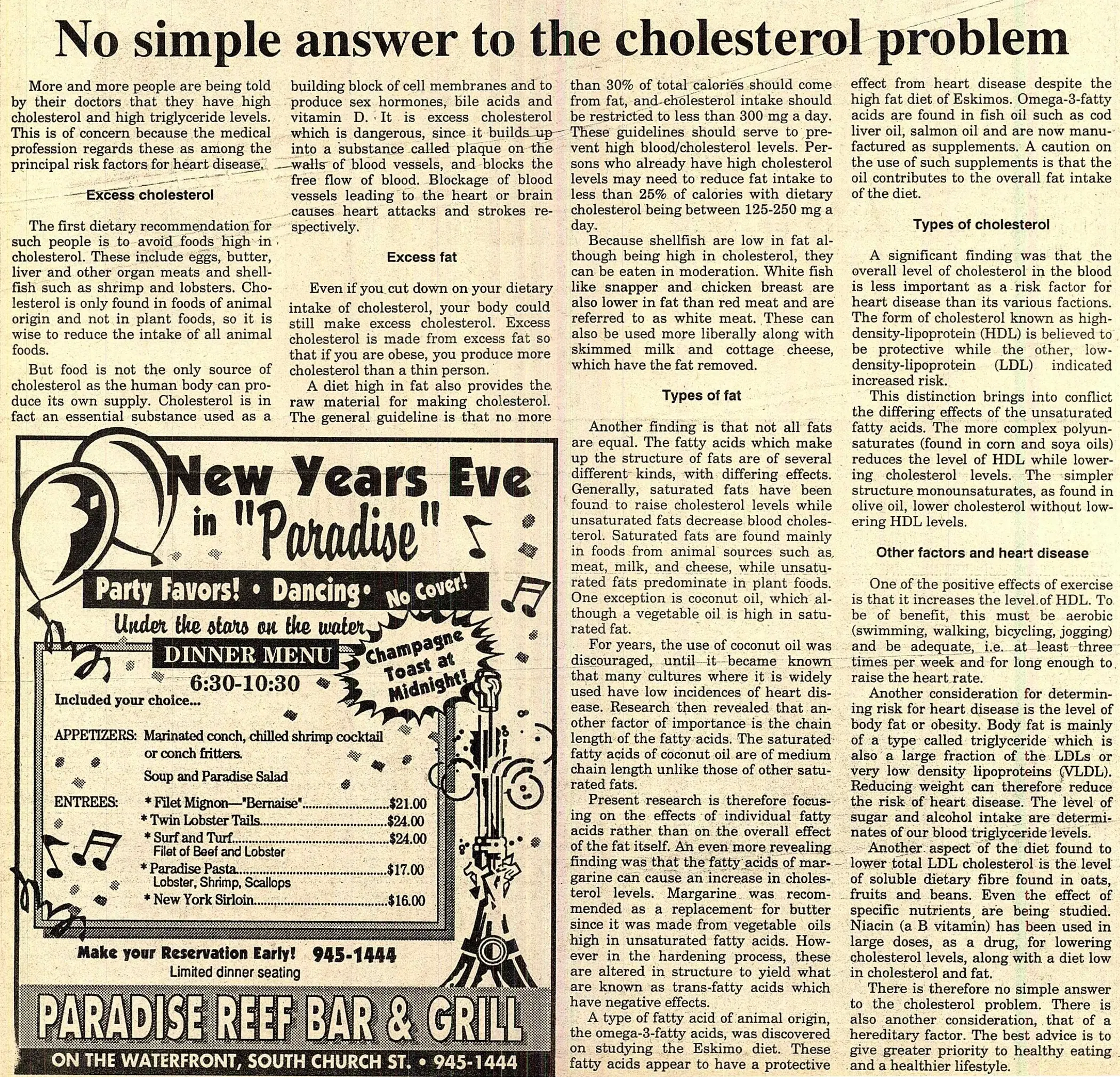
This is of concern because the medical profession regards these as among the principal risk factors for heart disease.
Excess cholesterol
The first dietary recommendation for such people is to avoid foods high in cholesterol. These include eggs, butter, liver and other organ meats and shellfish such as shrimp and lobsters. Cholesterol is only found in foods of animal origin and not in plant foods, so it is wise to reduce the intake of all animal foods. But food is not the only source of cholesterol as the human body can produce its own supply.
Cholesterol is in fact an essential substance used as a building block of cell membranes and to produce sex hormones, bile acids and vitamin D. It is excess cholesterol which is dangerous, since it builds up into a substance called plaque on the walls of blood vessels, and blocks the free flow of blood.
Blockage of blood vessels leading to the heart or brain causes heart attacks and strokes respectively.
Excess fat
Even if you cut down on your dietary intake of cholesterol, your body could still make excess cholesterol. Excess cholesterol is made from excess fat so that if you are obese, you produce more cholesterol than a thin person.
A diet high in fat also provides the raw material for making cholesterol. The general guideline is that no more than 30% of total calories should come from fat, and cholesterol intake should be restricted to less than 300 mg a day. These guidelines should serve to prevent high blood/cholesterol levels. Persons who already have high cholesterol levels may need to reduce fat intake to less than 25% of calories with dietary cholesterol being between 125-250 mg a day.
Because shellfish are low in fat although being high in cholesterol, they can be eaten in moderation. White fish like snapper and chicken breast are also lower in fat than red meat and are referred to as white meat. These can also be used more liberally along with skimmed milk and cottage cheese, which have the fat removed.
Types of fat
Another finding is that not all fats are equal. The fatty acids which make up the structure of fats are of several different kinds, with differing effects. Generally, saturated fats have been found to raise cholesterol levels while unsaturated fats decrease blood cholesterol. Saturated fats are found mainly in foods from animal sources such as, meat, milk, and cheese, while unsaturated fats predominate in plant foods. One exception is coconut oil, which although a vegetable oil is high in saturated fat.
For years, the use of coconut oil was discouraged, until it became known that many cultures where it is widely used have low incidences of heart disease. Research then revealed that another factor of importance is the chain length of the fatty acids. The saturated fatty acids of coconut oil are of medium chain length unlike those of other saturated fats.
Present research is therefore focusing on the effects of individual fatty acids rather than on the overall effect of the fat itself. An even more revealing finding was that the fatty acids of margarine can cause an increase in cholesterol levels. Margarine was recommended as a replacement for butter since it was made from vegetable oils high in unsaturated fatty acids. However in the hardening process, these are altered in structure to yield what are known as trans-fatty acids which have negative effects.
A type of fatty acid of animal origin, the omega-3-fatty acids, was discovered on studying the Eskimo diet. These fatty acids appear to have a protective effect from heart disease despite the high fat diet of Eskimos. Omega-3-fatty acids are found in fish oil such as cod liver oil, salmon oil and are now manufactured as supplements. A caution on the use of such supplements is that the oil contributes to the overall fat intake of the diet.
Types of cholesterol
A significant finding was that the overall level of cholesterol in the blood is less important as a risk factor for heart disease than its various factions. The form of cholesterol known as high-density-lipoprotein (HDL) is believed to be protective while the other, low-density-lipoprotein (LDL) indicated increased risk.
This distinction brings into conflict the differing effects of the unsaturated fatty acids. The more complex polyunsaturates (found in corn and soya oils) reduces the level of HDL while lowering cholesterol levels. The simpler structure monounsaturates, as found in olive oil, lower cholesterol without lowering HDL levels.
Other factors and heart disease
One of the positive effects of exercise is that it increases the level of HDL. To be of benefit, this must be aerobic (swimming, walking, bicycling, jogging) and be adequate, i.e. at least three times per week and for long enough to raise the heart rate.
Another consideration for determining risk for heart disease is the level of body fat or obesity. Body fat is mainly of a type called triglyceride which is also a large fraction of the LDLs or very low density lipoproteins (VLDL). Reducing weight can therefore reduce the risk of heart disease. The level of sugar and alcohol intake are determinates of our blood triglyceride levels.
Another aspect of the diet found to lower total LDL cholesterol is the level of soluble dietary fibre found in oats, fruits and beans. Even the effect of specific nutrients, are being studied. Niacin (a B vitamin) has been used in large doses, as a drug, for lowering cholesterol levels, along with a diet low in cholesterol and fat.
There is therefore no simple answer to the cholesterol problem. There is also another consideration, that of a hereditary factor. The best advice is to give greater priority to healthy eating and a healthier lifestyle.