CJ reports on state of the courts
About the article
This is a digitised version of an article from The Cayman Compass's print archive. Occasionally, the digitisation process introduces transcription errors, or other problems.
See the article in its original context from January 1995.
Brought to you by

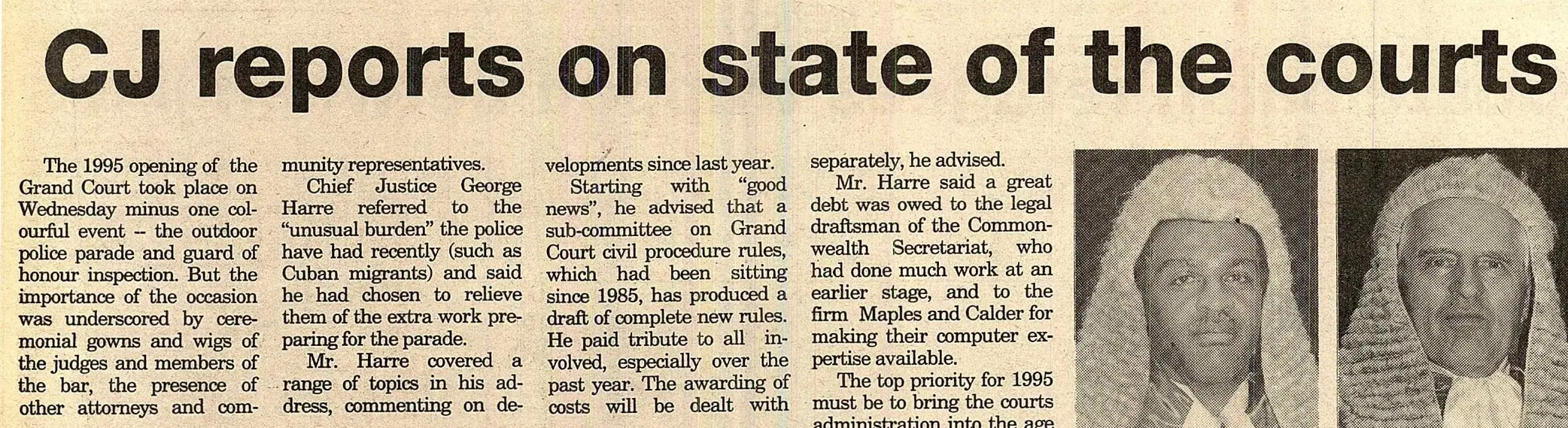
Mr. Harre covered a range of topics in his address, commenting on developments since last year. Starting with "good news", he advised that a sub-committee on Grand Court civil procedure rules, which had been sitting since 1985, has produced a draft of complete new rules.
He paid tribute to all involved, especially over the past year. The awarding of costs will be dealt with. separately, he advised. Mr. Harre said a great debt was owed to the legal draftsman of the Commonwealth Secretariat, who had done much work at an earlier stage, and to the firm Maples and Calder for making their computer expertise available.
The top priority for 1995 must be to bring the courts administration into the age of the computer, Mr. Harre said. "Criticism has been made, and it is fair, of a lack of coordination between the various arms of government who are involved in criminal proceedings," he agreed. One major way in which computerisation will assist is in the co-ordination between the Courts office, Legal Department and Police in bringing matters before the judges and magistrates, he indicated. Another function will be in the enforcement of court orders for money payment. Amendments have been proposed to current laws to provide more effective measures for enforcing judgements involving the payment of money, Mr. Harre reported. The co-operation of the community will also be involved.
"Attachment of earnings at source, for example, puts some extra burden on employers who have recalcitrant debtors on their payroll," he acknowledged. "But I urge them to accept this for the greater good of all, and indeed as a piece of enlightened self-interest. The fabric of society is one and indivisible, and the child who grows up deprived because a parent is able to flout a maintenance order is the more likely to be the one you may find breaking into your premises later on," he said.
In England, an administrative support programme has been produced to enable court lists to be distributed in electronic form to attorneys' offices, prosecutors, police, prison and probation services, Mr. Harre said. Technically it is possible to develop a programme for lawyers "and all other key participants in the justice system" to receive such lists and feed information back as case readiness and availability of persons involved.
Proper computer-based records and follow-up procedures will be essential, the Chief Justice emphasised. "These are long overdue and I am glad to say that funds have been provided in the 1995 budget to address this and the Clerk of Courts [Mrs. Delene Bodden] has just returned from a six week course in London covering these very matters."
Mr. Harre reported he had already contacted London with a view to developing a project based on the recommendations of former Attorney General Mr. Michael Bradley [who served for several months as consultant for increasing court efficiency].
Now that all Deputy Clerks are legally qualified, he noted, the office management can be left in the hands of the Clerk of Court where it belongs. Once a new system is running for dealing with short "nonurgent" Chambers matters, Mr. Harre said he may seek an amendment to allow some of these to be handled by a "Grand Court Master".
On the subject of legal aid, Mr. Harre agreed the number of lawyers who take on such cases is a small percentage of the total number of practitioners. Fees have not changed for eight years.
The Chief Justice asked that all attorneys share responsibility "as officers of the court" for legal aid cases. "I am not going so far as to say that senior specialists should themselves take time away from the clients through whom in other ways they contribute to the economic welfare of the Cayman Islands in order to do work which is outside their field, but is it too much to ask those larger firms who have not yet done so to have at a more junior level people who are willing to take on this work...?" Mr. Harre said it was "unfair that the burden should fall to the extent it does now on the sole practitioners and smaller firms".