Reports: Iranian funded Lockerbie bombing
About the article
This is a digitised version of an article from The Cayman Compass's print archive. Occasionally, the digitisation process introduces transcription errors, or other problems.
See the article in its original context from January 1995.
Brought to you by

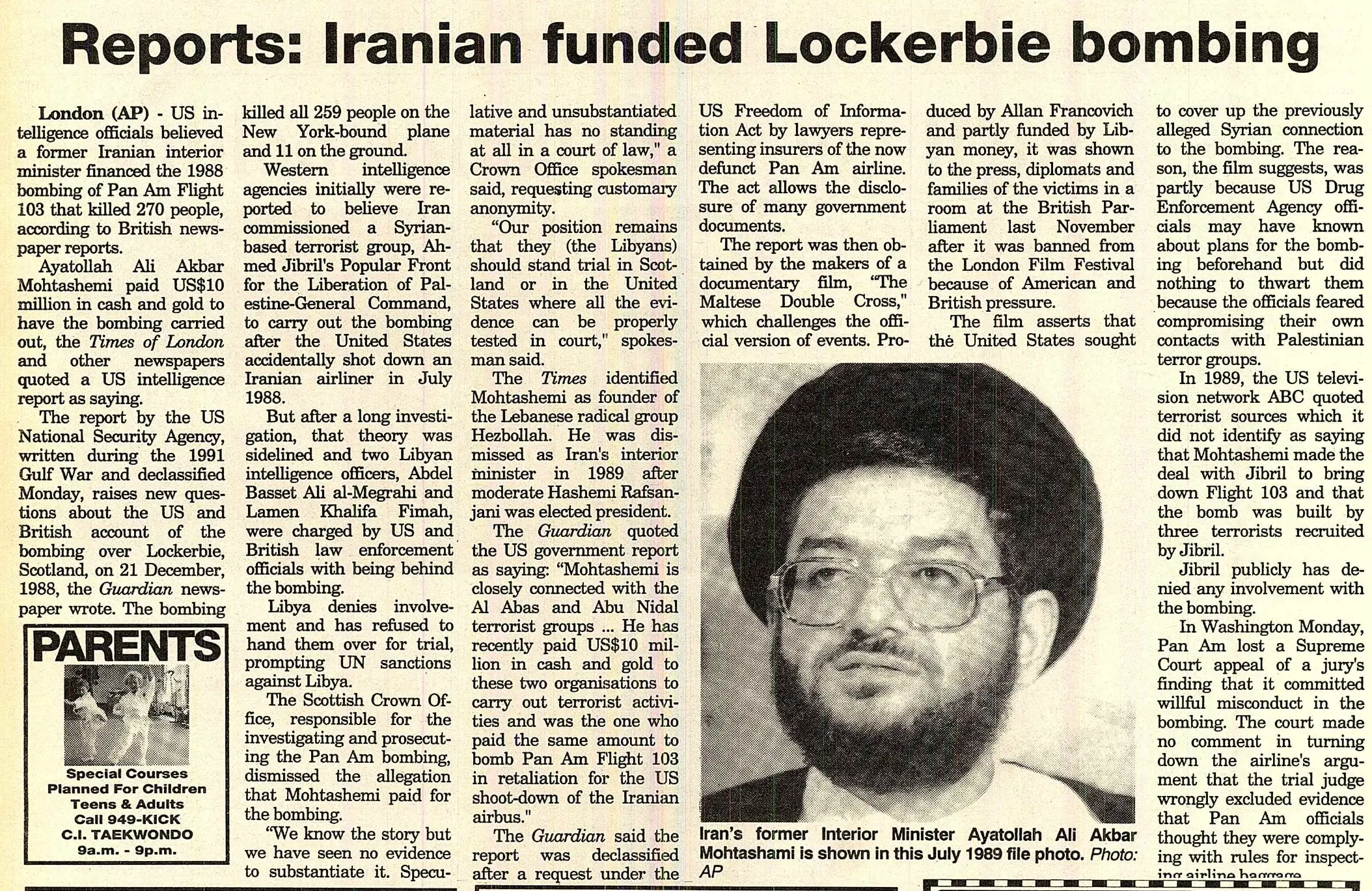
Ayatollah Ali Akbar Mohtashemi paid US$10 million in cash and gold to have the bombing carried out, the Times of London and other newspapers quoted a US intelligence report as saying.
The report by the US National Security Agency, written during the 1991 Gulf War and declassified Monday, raises new questions about the US and British account of the bombing over Lockerbie, Scotland, on 21 December, 1988, the Guardian newspaper wrote. The bombing killed all 259 people on the New York-bound plane and 11 on the ground. Western intelligence agencies initially were reported to believe Iran commissioned a Syrian-based terrorist group, Ahmed Jibril's Popular Front for the Liberation of Palestine-General Command, to carry out the bombing after the United States accidentally shot down an Iranian airliner in July 1988.
But after a long investigation, that theory was sidelined and two Libyan intelligence officers, Abdel Basset Ali al-Megrahi and Lamen Khalifa Fimah, were charged by US and British law enforcement officials with being behind the bombing.
Libya denies involvement and has refused to hand them over for trial, prompting UN sanctions against Libya.
The Scottish Crown Office, responsible for the investigating and prosecuting the Pan Am bombing, dismissed the allegation that Mohtashemi paid for the bombing.
"We know the story but we have seen no evidence to substantiate it. Speculative and unsubstantiated material has no standing at all in a court of law," a Crown Office spokesman said, requesting customary anonymity.
"Our position remains that they (the Libyans) should stand trial in Scotland or in the United States where all the evidence can be properly tested in court," spokesman said.
The Times identified Mohtashemi as founder of the Lebanese radical group Hezbollah. He was dismissed as Iran's interior minister in 1989 after moderate Hashemi Rafsanjani was elected president.
The Guardian quoted the US government report as saying: "Mohtashemi is closely connected with the Al Abas and Abu Nidal terrorist groups ... He has recently paid US$10 million in cash and gold to these two organisations to carry out terrorist activities and was the one who paid the same amount to bomb Pan Am Flight 103 in retaliation for the US shoot-down of the Iranian airbus." The Guardian said the report was declassified after a request under the US Freedom of Information Act by lawyers representing insurers of the now defunct Pan Am airline. The act allows the disclosure of many government documents.
The report was then obtained by the makers of a documentary film, "The Maltese Double Cross," which challenges the official version of events. Produced by Allan Francovich and partly funded by Libyan money, it was shown to the press, diplomats and families of the victims in a room at the British Parliament last November after it was banned from the London Film Festival because of American and British pressure.
The film asserts that the United States sought to cover up the previously alleged Syrian connection to the bombing. The reason, the film suggests, was partly because US Drug Enforcement Agency officials may have known about plans for the bombing beforehand but did nothing to thwart them because the officials feared compromising their own contacts with Palestinian terror groups.
In 1989, the US television network ABC quoted terrorist sources which it did not identify as saying that Mohtashemi made the deal with Jibril to bring down Flight 103 and that the bomb was built by three terrorists recruited by Jibril.
Jibril publicly has denied any involvement with the bombing.
In Washington Monday, Pan Am lost a Supreme Court appeal of a jury's finding that it committed willful misconduct in the bombing. The court made no comment in turning down the airline's argument that the trial judge wrongly excluded evidence that Pan Am officials thought they were complying with rules for inspect