Godspell
About the article
This is a digitised version of an article from The Cayman Compass's print archive. Occasionally, the digitisation process introduces transcription errors, or other problems.
See the article in its original context from May 1995.
Brought to you by

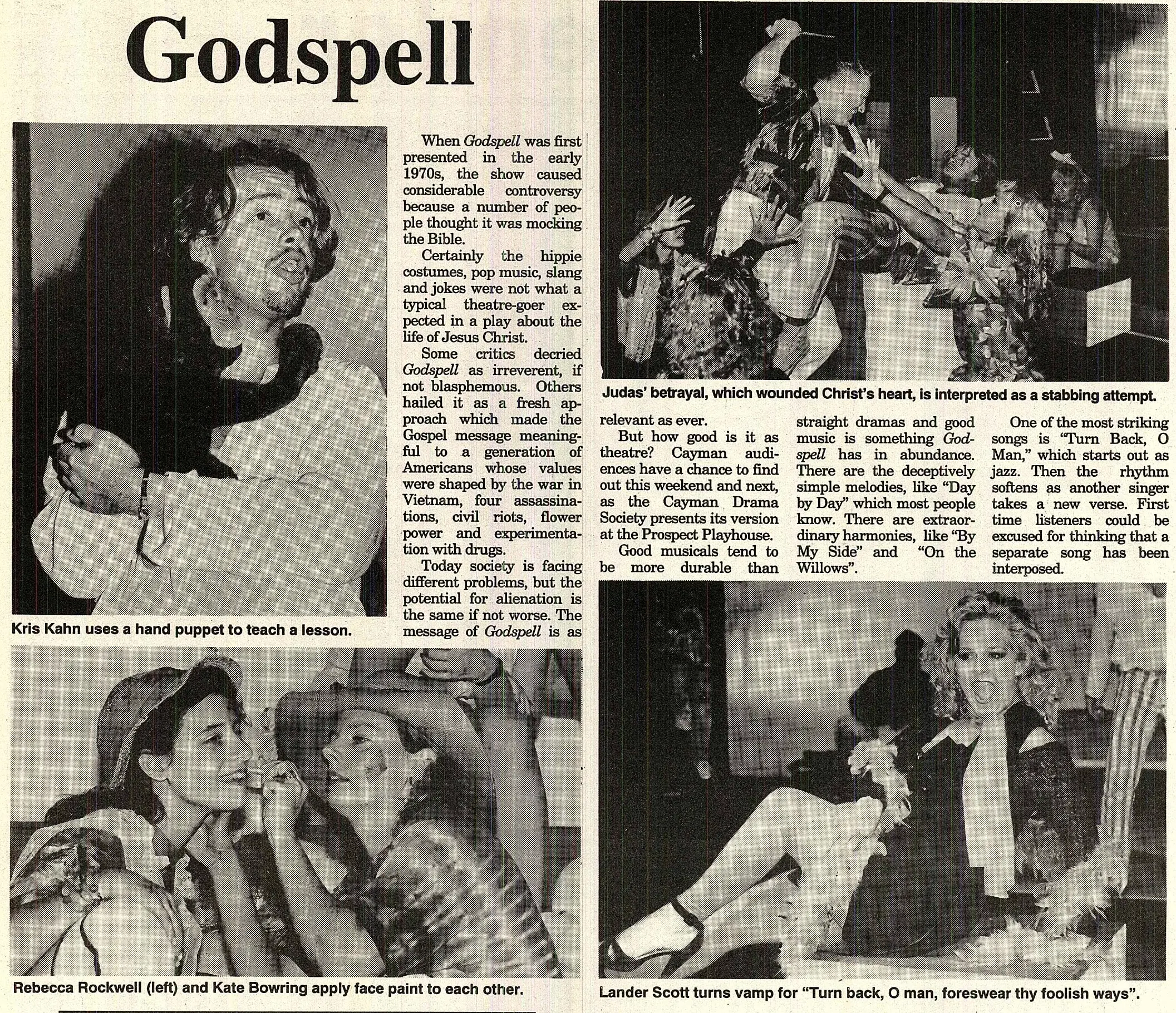
Certainly the hippie costumes, pop music, slang and jokes were not what a typical theatregoer expected in a play about the life of Jesus Christ.
Some critics decried Godspell as irreverent, if not blasphemous. Others hailed it as a fresh approach which made the Gospel message meaningful to a generation of Americans whose values were shaped by the war in Vietnam, four assassinations, civil riots, flower power and experimentation with drugs.
Today society is facing different problems, but the potential for alienation is the same if not worse. The message of Godspell is as relevant as ever.
But how good is it as theatre? Cayman audiences have a chance to find out this weekend and next, as the Cayman Drama Society presents its version at the Prospect Playhouse.
Good musicals tend to be more durable than straight dramas and good music is something Godspell has in abundance.
There are the deceptively simple melodies, like "Day by Day" which most people know. There are extraordinary harmonies, like "By My Side" and "On the Willows". One of the most striking songs is "Turn Back, O Man," which starts out as jazz. Then the rhythm softens as another singer takes a new verse. First time listeners could be excused for thinking that a separate song has been interposed. Then there are the ensemble numbers, including "God Save the People" and "We Beseech Thee, Hear Us". In fact the entire cast is involved in most of the songs, which is almost necessary because everyone is on stage for virtually the entire show.
During dress rehearsal on Monday, the wholegroup songs featured strong voices and enthusiastically executed choreography. The duets by Kate Bowring and Karin Gus-tasson, Kris Kahn and Lander Scott were nothing less than spell-binding. Musical director Lana Sannachan expressed satisfaction with the cast's achievements. She explained that the accompaniment is taped because there wasn't enough time to organise a band which could master the complex score. One advantage of tape is consistency. A disadvantage is that music cannot be played in another key if desirable to suit a singer's range.
Some of the harmonies are actually dissonant, she pointed out. Experienced singers would know which note "fits" naturally, but when harmony is unusual they must memorise sequences and stick to them.
The dissonance is most obvious in the beginning of the play. In fact, some people may feel uncomfortable with the music, lighting and format of the opening minutes. But such discomfort mirrors the disparate philosophers being quoted and the confusion of the Tower of Babel-Babble.
Soon the script makes its transition to the familiar parables and narrative of Christ's last days before the Crucifixion. Their presentation is unusual but entertaining and likely to provoke thought long after the show is over. That combination is what good theatre is all about.