Quake rocks Russia's far east
About the article
This is a digitised version of an article from The Cayman Compass's print archive. Occasionally, the digitisation process introduces transcription errors, or other problems.
See the article in its original context from May 1995.
Brought to you by

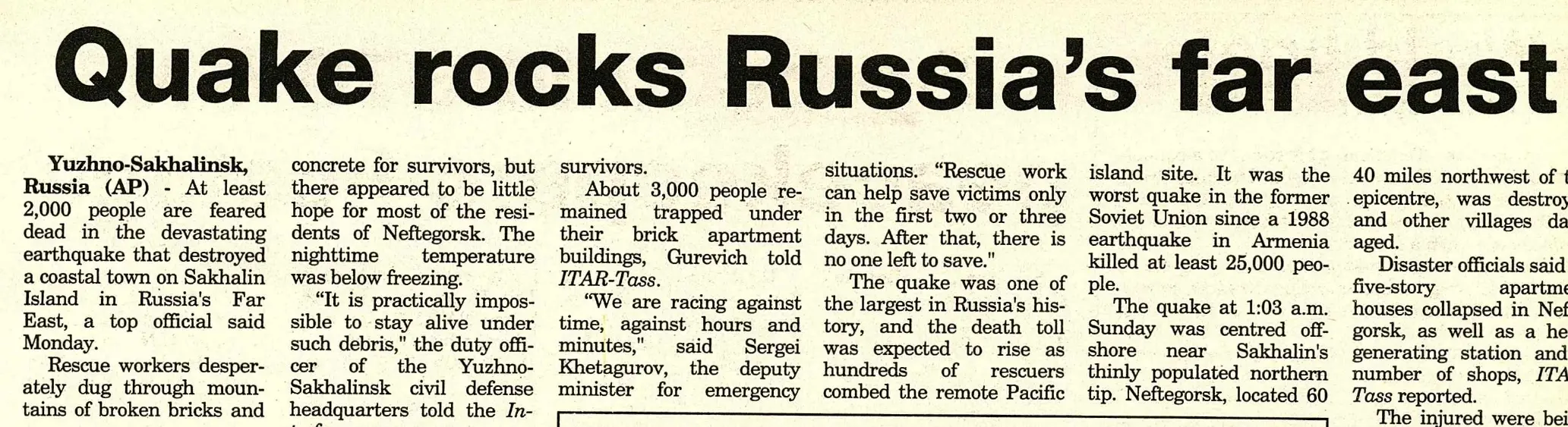
Rescue workers desperately dug through mountains of broken bricks and concrete for survivors, but there appeared to be little hope for most of the residents of Neftegorsk. The nighttime temperature was below freezing. "It is practically impossible to stay alive under such debris," the duty officer of the Yuzhno-Sakhalinsk civil defense headquarters told the Interfax news agency.
Sergei Shoigu, Russia's minister for emergency situations, told the ITAR-Tass news agency that the death toll would reach at least 2,000 people, but others said the figure could hit 2,500. So far, 300 bodies have been recovered. Shoigu spoke after he and other top government officials surveyed the damage.
Nearly everyone in Neftegorsk was either dead, injured or missing. Of the town's 3,500 people, nearly 3,000 were unaccounted for, including 450 children.
Moans could be heard from under the ruined apartment buildings in the oil town, which bore the brunt of the magnitude 7.5 quake that rattled the island while most residents slept early Sunday.
Rescuers gently carried survivors from the rubble, while the heads and limbs of some victims poked out from the debris. Some stunned survivors sat on piles of masonry and cried. Nearby, bodies lay on the ground beneath sheets and blankets. Smoke billowed over the town from a number of fires sparked by the quake.
At least 300 people were hospitalized, many in critical condition, said Viktor Gurevich, vice governor of the Sakhalin Region. Doctors said they would have to amputate the crushed arms and legs of many survivors.
About 3,000 people remained trapped under their brick apartment buildings, Gurevich told ITAR-Tass.
"We are racing against time, against hours and minutes," said Sergei Khetagurov, the deputy minister for emergency situations. "Rescue work can help save victims only in the first two or three days. After that, there is no one left to save."
The quake was one of the largest in Russia's history, and the death toll was expected to rise as hundreds of rescuers combed the remote Pacific. island site. It was the worst quake in the former Soviet Union since a 1988 earthquake in Armenia killed at least 25,000 people. The quake at 1:03 a.m. Sunday was centred offshore near Sakhalin's thinly populated northern tip. Neftegorsk, located 60 40 miles northwest of the epicentre, was destroyed and other villages damaged.
Disaster officials said 17 five-story apartment houses collapsed in Neftegorsk, as well as a heat-generating station and a number of shops, ITAR-Tass reported.
The injured were being brought from Neftegorsk, which translates as "oil town," to hospitals in the regional center of Okha and to Khabarovsk on the Russian mainland.
"The dead are being collected on the site in Neftegorsk," said Raisa Mikhailova, municipal spokeswoman for Okha. "We don't know the exact number." Camps were set up for those evacuated from the quake zone. Russian news reports said 500 workers and dozens of helicopters and airplanes were involved in the rescue effort, with more teams en route. Authorities sent an icebreaker from the Russian mainland to clear the way for a hospital ship, disaster officials said in Moscow.
Russia's Independent Television said many of the victims in Neftegorsk lived in brick apartment buildings that were built during the Khrushchev era in the 1960s and simply crumbled during the quake.
Soviet building practices were notoriously shoddy, and poor construction was one of the reasons for the large number of victims in the 1988 Armenia earthquake.