Carib. banks move to control credit card fraud
About the article
This is a digitised version of an article from The Cayman Compass's print archive. Occasionally, the digitisation process introduces transcription errors, or other problems.
See the article in its original context from November 1995.
Brought to you by

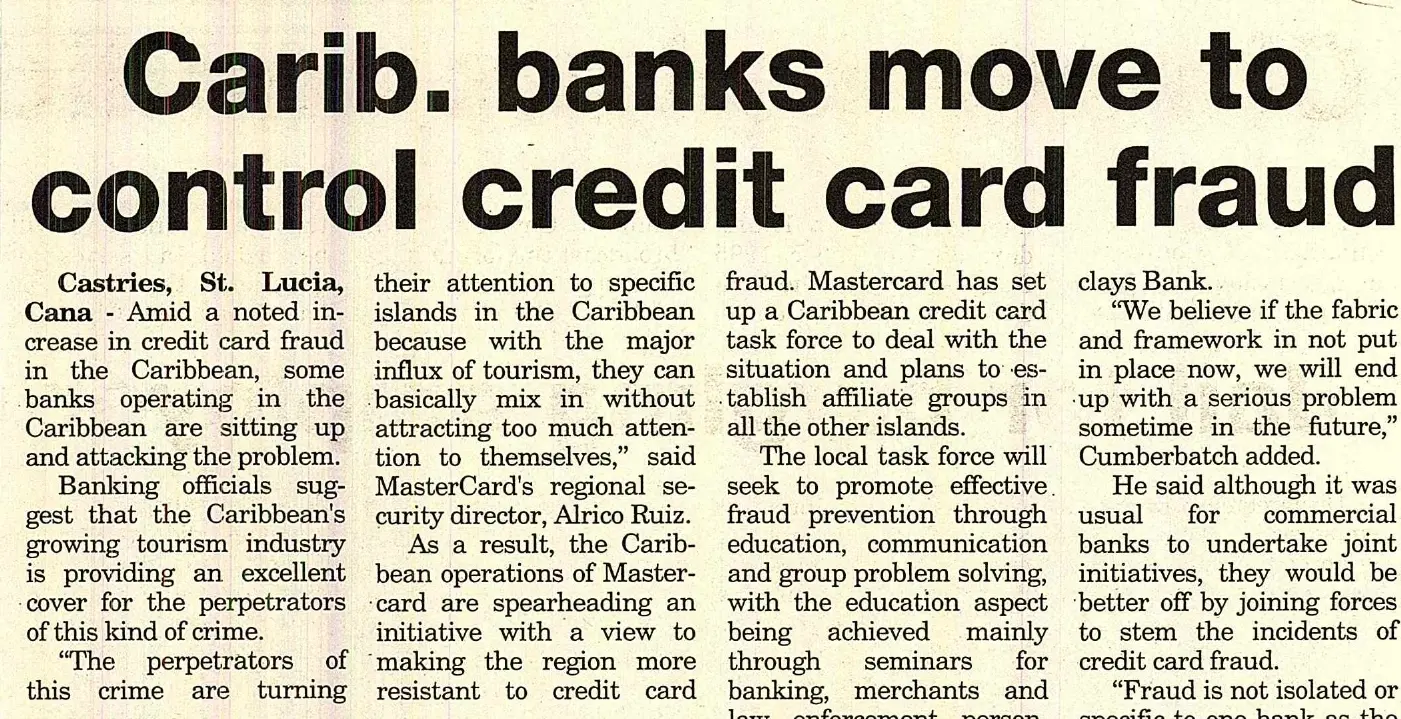
Banking officials suggest that the Caribbean's growing tourism industry is providing an excellent cover for the perpetrators of this kind of crime.
"The perpetrators of this crime are turning their attention to specific islands in the Caribbean because with the major influx of tourism, they can basically mix in without attracting too much attention to themselves," said MasterCard's regional security director, Alrico Ruiz.
As a result, the Caribbean operations of Mastercard are spearheading an initiative with a view to making the region more resistant to credit card fraud. Mastercard has set up a Caribbean credit card task force to deal with the situation and plans to establish affiliate groups in all the other islands.
The local task force will seek to promote effective fraud prevention through education, communication and group problem solving, with the education aspect being achieved mainly through seminars for banking, merchants and law enforcement personnel. The first of those was held here last week and a credit card fraud task force established.
The eastern Caribbean, which so far does not appear to have a major problem with credit card fraud, is considered a fertile breeding ground for criminal elements since manufacturing and banking operations are somewhat unprepared to deal with it. Officials of Barclays Bank, which has been assisting Mastercard in the initiative, say although there have not been too many incidents in the area, there was evidence of a disturbing trend developing which must be nipped in the bud.
"Over the years, there has been an increasing tendency for the perpetrators to move from areas where information is being fed to combat the misuse of the card, to the Caribbean where these incidents are not as commonplace," said Stevenson Cumberbatch, assistant manager of Barclays Bank. "We believe if the fabric and framework in not put in place now, we will end up with a serious problem sometime in the future," Cumberbatch added. He said although it was usual for commercial banks to undertake joint initiatives, they would be better off by joining forces to stem the incidents of credit card fraud.
"Fraud is not isolated or specific to one bank as the perpetrators will target any bank at any time, so we do not see ourselves as competitors when it comes to fraudulent activity," Cumberbatch explained. "This is why we can put competitiveness aside today, look at the problems, address them, them become competitive tomorrow with a better knowledge of the problems of credit card fraud that are likely to face us all."
Over the past year, say Mastercard officials, criminal groups facing increased pressure at home have shifted their operations to areas where they can beat the system. As a result, there has been increased activity and losses in the Caribbean and Latin American regions.
In 1993, the amount of loses from credit card fraud in St. Lucia amounted to US$3,500. However, loses in the financial year April to April have increased to over US$25,000.
The figures for Barbados are quite similar. Five thousand (US) dollars in losses were reported in 1993 but the figure jumped to over US$20,000 up to September this year. However, Mastercard officials say that Puerto Rico and the Dominican Republic are the main targets, reporting losses of over US$400,000 and US$300,000 respectively so far this year.
"Although this suggests that there is not a major problem at present, we have decided to take a proactive approach as this is an illegal activity that will certainly fester," said Ruiz, who is also the vice chairman of the Caribbean Fraud Task Force.
He said his organisation was aware that organised groups such as the Asian Mafia, Nigerian syndicates and Latin American counterfeiters were targeting the Caribbean.
It is against this backdrop that the Caribbean fraud task force was set up in 1994 to establish training and communications throughout the financial and mercantile community so they can detect counterfeit credit cards.
"You have individuals and groups involved in counterfeiting of the plastic, some altering the card by changing one or two numbers, others using lost or stolen cards and forging signatures on a sales draft," Ruiz explained.