Robert Edwards: IVF pioneer
About the article
This is a digitised version of an article from The Cayman Compass's print archive. Occasionally, the digitisation process introduces transcription errors, or other problems.
See the article in its original context from February 1996.
Brought to you by

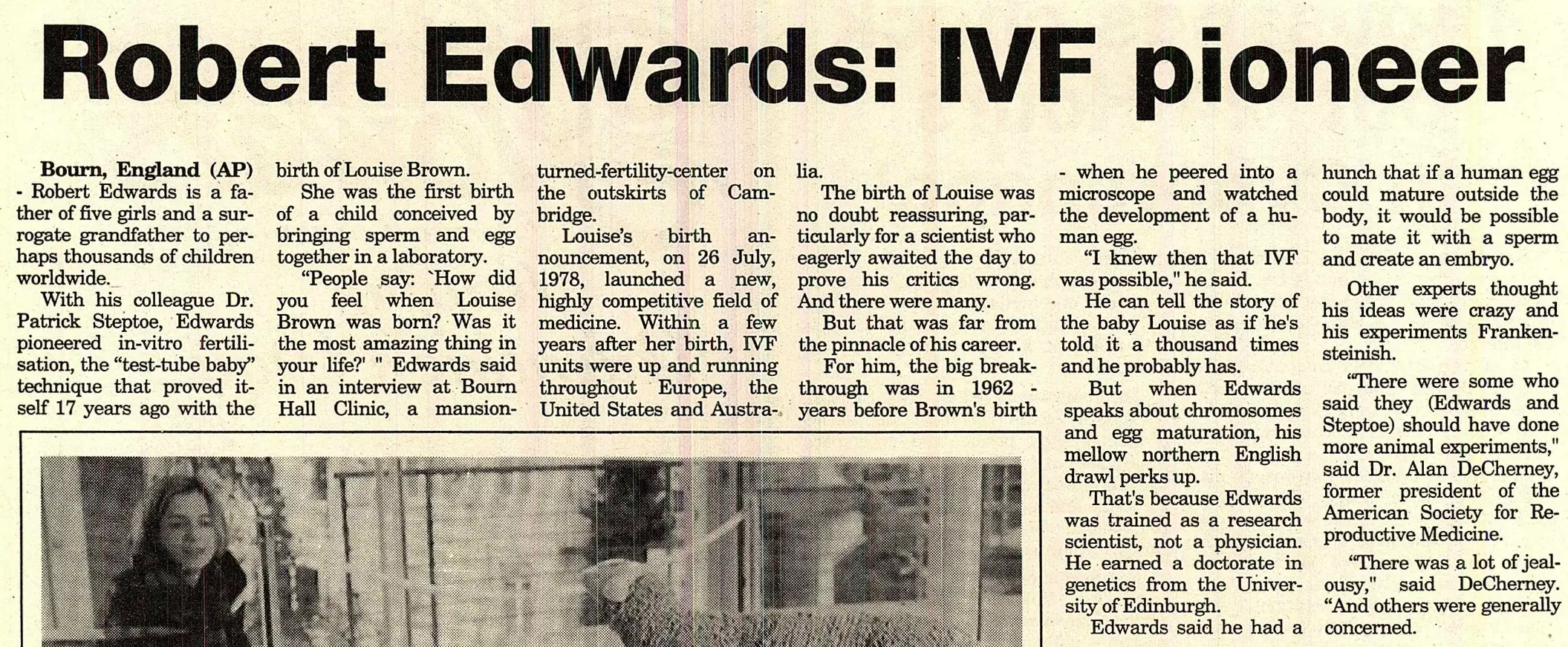
With his colleague Dr. Patrick Steptoe, Edwards pioneered in-vitro fertilisation, the "test-tube baby" technique that proved itself 17 years ago with the birth of Louise Brown. She was the first birth of a child conceived by bringing sperm and egg together in a laboratory.
"People say: 'How did you feel when Louise Brown was born? Was it the most amazing thing in your life?' " Edwards said in an interview at Bourn Hall Clinic, a mansion. turned-fertility-center on the outskirts of Cambridge.
Louise's birth announcement, on 26 July, 1978, launched a new, highly competitive field of medicine. Within a few years after her birth, IVF units were up and running throughout Europe, the United States and Australia. lia. The birth of Louise was no doubt reassuring, particularly for a scientist who eagerly awaited the day to prove his critics wrong. And there were many. But that was far from the pinnacle of his career. For him, the big breakthrough was in 1962 - years before Brown's birth - when he peered into a microscope and watched the development of a human egg.
"I knew then that IVF was possible," he said. He can tell the story of the baby Louise as if he's told it a thousand times and he probably has.
But when Edwards speaks about chromosomes and egg maturation, his mellow northern English drawl perks up.
That's because Edwards was trained as a research scientist, not a physician. He earned a doctorate in genetics from the University of Edinburgh. Edwards said he had a hunch that if a human egg could mature outside the body, it would be possible to mate it with a sperm and create an embryo. Other experts thought his ideas were crazy and his experiments Frankensteinish. "There were some who said they (Edwards and Steptoe) should have done more animal experiments," said Dr. Alan DeCherney, former president of the American Society for Reproductive Medicine. "There was a lot of jealousy," said DeCherney.
"And others were generally concerned.