Researchers unearth 10M year old ape
About the article
This is a digitised version of an article from The Cayman Compass's print archive. Occasionally, the digitisation process introduces transcription errors, or other problems.
See the article in its original context from July 1996.
Brought to you by

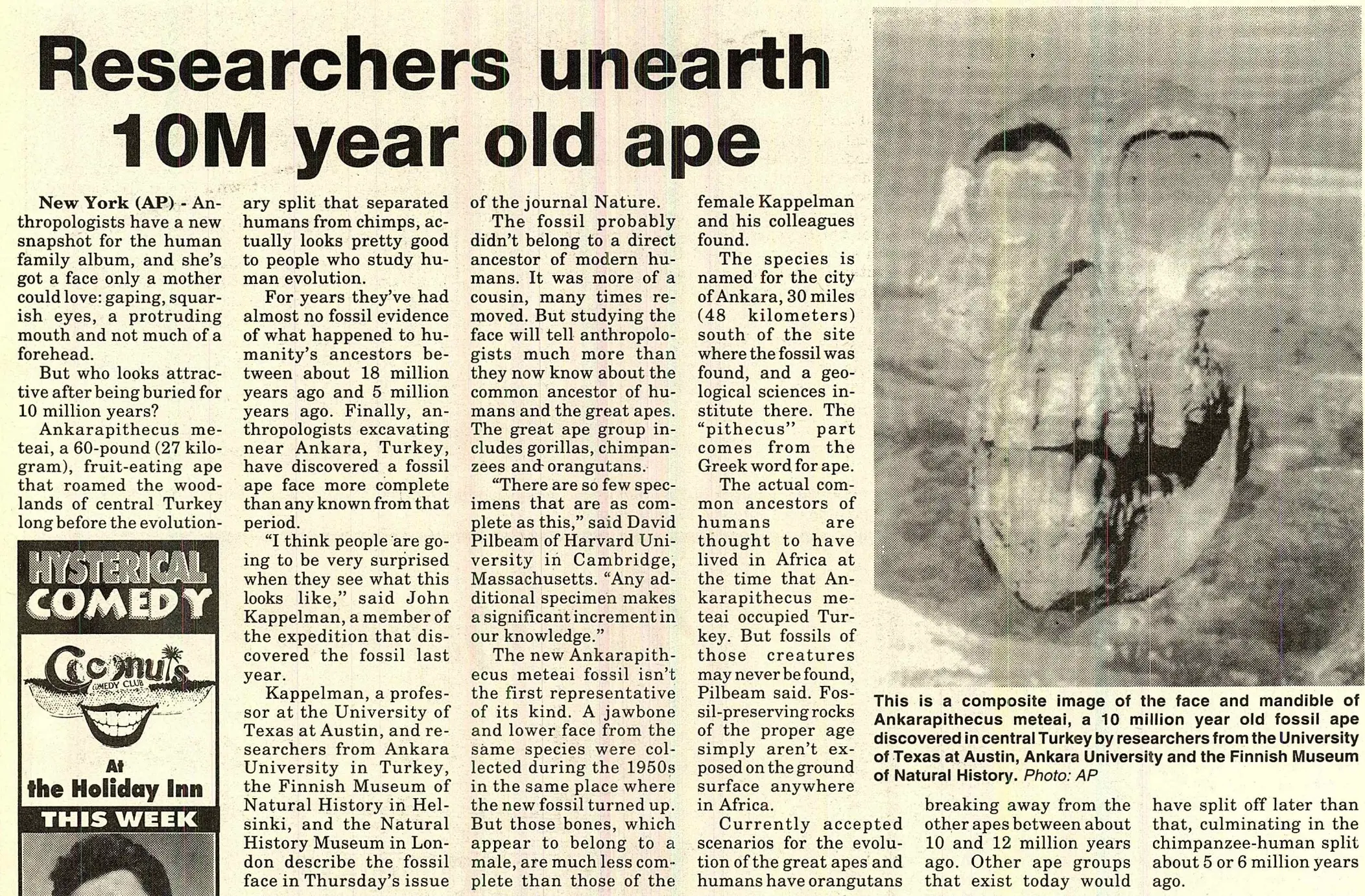
But who looks attractive after being buried for 10 million years?
Ankarapithecus meteai, a 60-pound (27 kilogram), fruit-eating ape that roamed the woodlands of central Turkey long before the evolution. ary split that separated humans from chimps, actually looks pretty good to people who study human evolution.
For years they've had almost no fossil evidence of what happened to humanity's ancestors between about 18 million years ago and 5 million years ago. Finally, anthropologists excavating near Ankara, Turkey, have discovered a fossil ape face more complete than any known from that period.
"I think people are going to be very surprised when they see what this looks like," said John Kappelman, a member of the expedition that discovered the fossil last year.
Kappelman, a professor at the University of Texas at Austin, and researchers from Ankara University in Turkey, the Finnish Museum of Natural History in Helsinki, and the Natural History Museum in London describe the fossil face in Thursday's issue of the journal Nature. The fossil probably didn't belong to a direct ancestor of modern humans. It was more of a cousin, many times removed. But studying the face will tell anthropologists much more than they now know about the common ancestor of humans and the great apes. The great ape group includes gorillas, chimpanzees and orangutans.
"There are so few specimens that are as complete as this," said David Pilbeam of Harvard University in Cambridge, Massachusetts. "Any additional specimen makes a significant increment in our knowledge."
The new Ankarapithecus meteai fossil isn't the first representative of its kind. A jawbone and lower face from the same species were collected during the 1950s in the same place where the new fossil turned up. But those bones, which appear to belong to a male, are much less complete than those of the female Kappelman and his colleagues found.
The species is named for the city of Ankara, 30 miles (48 kilometers) south of the site where the fossil was found, and a geological sciences institute there. The "pithecus" part comes from the Greek word for ape. The actual common ancestors of humans are thought to have lived in Africa at the time that Ankarapithecus meteai occupied Turkey. But fossils of those creatures may never be found, Pilbeam said. Fossil-preserving rocks of the proper age simply aren't exposed on the ground surface anywhere in Africa.
Currently accepted scenarios for the evolution of the great apes and humans have orangutans breaking away from the other apes between about 10 and 12 million years ago.
Other ape groups that exist today would have split off later than that, culminating in the chimpanzee-human split about 5 or 6 million years ago.