Chile's air pollution among world's worst
About the article
This is a digitised version of an article from The Cayman Compass's print archive. Occasionally, the digitisation process introduces transcription errors, or other problems.
See the article in its original context from August 1996.
Brought to you by

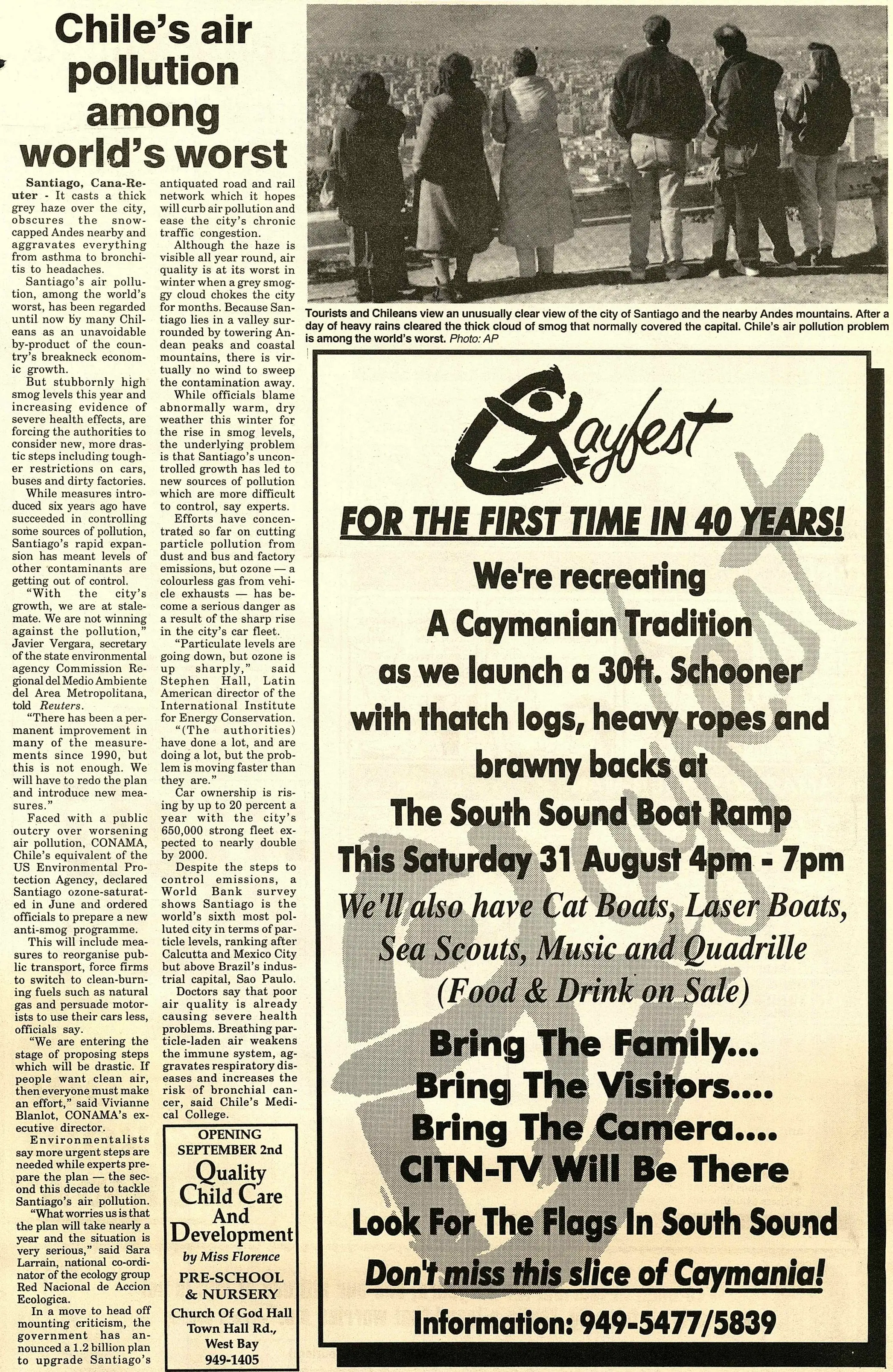
Santiago's air pollution, among the world's worst, has been regarded until now by many Chileans as an unavoidable by-product of the country's breakneck economic growth.
But stubbornly high smog levels this year and increasing evidence of severe health effects, are forcing the authorities to consider new, more drastic steps including tougher restrictions on cars, buses and dirty factories. While measures introduced six years ago have succeeded in controlling some sources of pollution, Santiago's rapid expansion has meant levels of other contaminants are getting out of control.
"With the city's growth, we are at stalemate. We are not winning against the pollution," Javier Vergara, secretary of the state environmental agency Commission Regional del Medio Ambiente del Area Metropolitana, told Reuters.
"There has been a permanent improvement in many of the measurements since 1990, but this is not enough. We will have to redo the plan and introduce new measures."
Faced with a public outcry over worsening air pollution, CONAMA, Chile's equivalent of the US Environmental Protection Agency, declared Santiago ozone-saturated in June and ordered officials to prepare a new anti-smog programme. This will include measures to reorganise public transport, force firms to switch to clean-burning fuels such as natural gas and persuade motorists to use their cars less, officials say.
"We are entering the stage of proposing steps which will be drastic. If people want clean air, then everyone must make an effort," said Vivianne Blanlot, CONAMA's executive director.
Environmentalists say more urgent steps are needed while experts prepare the plan - the second this decade to tackle Santiago's air pollution. "What worries us is that the plan will take nearly a year and the situation is very serious," said Sara Larrain, national coordinator of the ecology group Red Nacional de Accion Ecologica.
In a move to head off mounting criticism, the government has announced a 1.2 billion plan to upgrade Santiago's antiquated road and rail network which it hopes will curb air pollution and ease the city's chronic traffic congestion.
Although the haze is visible all year round, air quality is at its worst in winter when a grey smoggy cloud chokes the city for months. Because Santiago lies in a valley surrounded by towering Andean peaks and coastal mountains, there is virtually no wind to sweep the contamination away. While officials blame abnormally warm, dry weather this winter for the rise in smog levels, the underlying problem is that Santiago's uncontrolled growth has led to new sources of pollution which are more difficult to control, say experts.
Efforts have concentrated so far on cutting particle pollution from dust and bus and factory emissions, but ozone - a colourless gas from vehicle exhausts - has become a serious danger as a result of the sharp rise in the city's car fleet. "Particulate levels are going down, but ozone is up sharply," said Stephen Hall, Latin American director of the International Institute for Energy Conservation. "(The authorities) have done a lot, and are doing a lot, but the problem is moving faster than they are."
Car ownership is rising by up to 20 percent a year with the city's 650,000 strong fleet expected to nearly double by 2000.
Despite the steps to control emissions, a World Bank survey shows Santiago is the world's sixth most polluted city in terms of particle levels, ranking after Calcutta and Mexico City but above Brazil's industrial capital, Sao Paulo.
Doctors say that poor air quality is already causing severe health problems. Breathing particle-laden air weakens the immune system, aggravates respiratory diseases and increases the risk of bronchial cancer, said Chile's Medical College.