Jacques Cousteau, 87, passes away
About the article
This is a digitised version of an article from The Cayman Compass's print archive. Occasionally, the digitisation process introduces transcription errors, or other problems.
See the article in its original context from June 1997.
Brought to you by

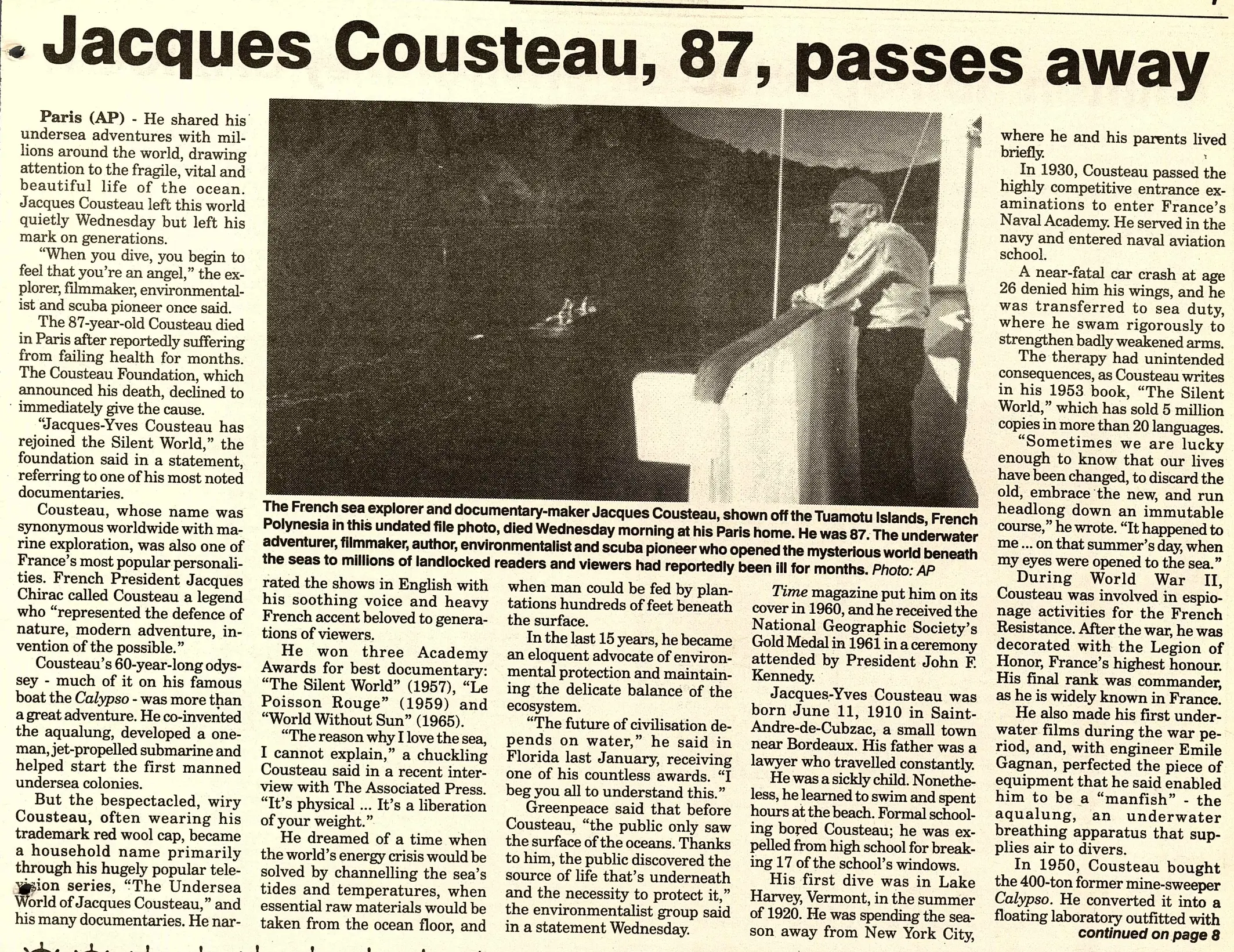
"When you dive, you begin to feel that you're an angel," the explorer, filmmaker, environmentalist and scuba pioneer once said. The 87-year-old Cousteau died in Paris after reportedly suffering from failing health for months. The Cousteau Foundation, which announced his death, declined to immediately give the cause. "Jacques-Yves Cousteau has rejoined the Silent World," the foundation said in a statement, referring to one of his most noted documentaries.
Cousteau, whose name was synonymous worldwide with marine exploration, was also one of France's most popular personalities. French President Jacques Chirac called Cousteau a legend who "represented the defence of nature, modern adventure, invention of the possible."
Cousteau's 60-year-long odyssey much of it on his famous boat the Calypso - was more than a great adventure. He co-invented the aqualung, developed a one-man, jet-propelled submarine and helped start the first manned undersea colonies.
But the bespectacled, wiry Cousteau, often wearing his trademark red wool cap, became a household name primarily through his hugely popular television series, "The Undersea World of Jacques Cousteau," and his many documentaries. He narrated the shows in English with his soothing voice and heavy French accent beloved to generations of viewers.
He won three Academy Awards for best documentary: "The Silent World" (1957), "Le Poisson Rouge" (1959) and "World Without Sun" (1965).
"The reason why I love the sea, I cannot explain," a chuckling Cousteau said in a recent interview with The Associated Press. "It's physical ... It's a liberation of your weight."
He dreamed of a time when the world's energy crisis would be solved by channelling the sea's tides and temperatures, when essential raw materials would be taken from the ocean floor, and when man could be fed by plantations hundreds of feet beneath the surface.
In the last 15 years, he became an eloquent advocate of environmental protection and maintaining the delicate balance of the ecosystem.
"The future of civilisation depends on water," he said in Florida last January, receiving one of his countless awards. "I beg you all to understand this." Greenpeace said that before Cousteau, "the public only saw the surface of the oceans. Thanks to him, the public discovered the source of life that's underneath and the necessity to protect it," the environmentalist group said in a statement Wednesday. Time magazine put him on its cover in 1960, and he received the National Geographic Society's Gold Medal in 1961 in a ceremony attended by President John F. Kennedy.
Jacques-Yves Cousteau was born June 11, 1910 in Saint-Andre-de-Cubzac, a small town near Bordeaux. His father was a lawyer who travelled constantly. He was a sickly child. Nevertheless, he learned to swim and spent hours at the beach. Formal schooling bored Cousteau; he was expelled from high school for breaking 17 of the school's windows.
His first dive was in Lake Harvey, Vermont, in the summer of 1920. He was spending the season away from New York City. where he and his parents lived briefly.
In 1930, Cousteau passed the highly competitive entrance examinations to enter France's Naval Academy. He served in the navy and entered naval aviation school.
A near-fatal car crash at age 26 denied him his wings, and he was transferred to sea duty, where he swam rigorously to strengthen badly weakened arms. The therapy had unintended consequences, as Cousteau writes in his 1953 book, "The Silent World," which has sold 5 million copies in more than 20 languages. "Sometimes we are lucky enough to know that our lives have been changed, to discard the old, embrace the new, and run headlong down an immutable course," he wrote. "It happened to me ... on that summer's day, when my eyes were opened to the sea."
During World War II, Cousteau was involved in espionage activities for the French Resistance. After the war, he was decorated with the Legion of Honor, France's highest honour. His final rank was commander, as he is widely known in France. He also made his first underwater films during the war period, and, with engineer Emile Gagnan, perfected the piece of equipment that he said enabled him to be a "manfish" - the aqualung, an underwater breathing apparatus that supplies air to divers.
In 1950, Cousteau bought the 400-ton former mine-sweeper Calypso. He converted it into a floating laboratory outfitted with continued on page 8 from page 7 the most modern equipment, including underwater television gear.
In 1952-53 Cousteau took the Calypso to the Red Sea and shot the first color footage ever taken at a depth of 50 metres (150 feet.) With funding from the National Geographic Society and the French Academy of Sciences, he began a four-year voyage across the oceans of the world in 1952.
Cousteau's feature-length documentary, "The Silent World," won him the Golden Palm award at the Cannes Film Festival in 1956 and the Academy Award a year later.
He authored many books, including "The Living Sea" (1963) and "World Without Sun" (1965). A 20-volume encyclopedia, "The Ocean World of Jacques Cousteau," was published in the United States and England.
In 1977, the "Cousteau Odyssey" series premiered on PBS. Seven years later, the "Cousteau Amazon" series premiered on the Turner Broadcasting System. In all, his documentaries have won 40 Emmy nominations. In the 1970s, he formed the Cousteau Society, an environmental group based in Norfolk, Virginia.
He had his critics. Some said he lacked scientific training. A biographer, Bernard Violet, said he mistreated animals during the filming of some documentaries, and that he once bought lobsters at a market in Marseille and used them in a film about the Red Sea.
Cousteau's son and heir apparent, Philippe, was killed in 1979 in a seaplane crash. His other son, Jean-Michel, is a renowned conservationist in his own right. But a dispute over lending the Cousteau name to a Fijian resort soured their relationship.
The younger Cousteau said Wednesday they had resolved their differences before his father's death.
"I saw him, unfortunately, in the hospital, and I was able to communicate all the love that I have. And I intend to help carry on (his) message," Jean-Michel Cousteau told Associated Press Television.
Survivors also include his second wife, Francine Triplet, and their children, Diane and Pierre-Yves.