'Little Rock Nine' go back to school
About the article
This is a digitised version of an article from The Cayman Compass's print archive. Occasionally, the digitisation process introduces transcription errors, or other problems.
See the article in its original context from September 1997.
Brought to you by

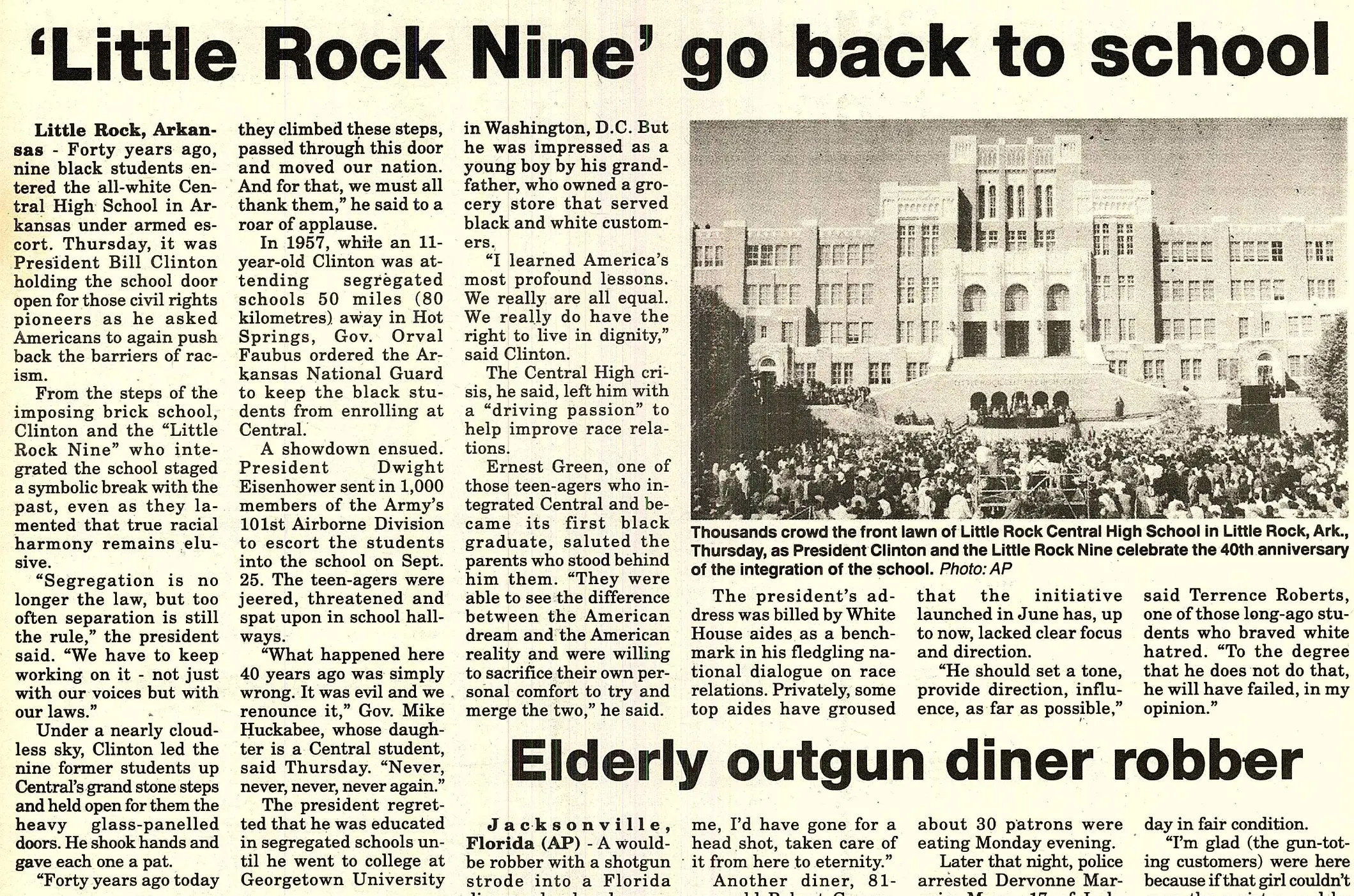
From the steps of the imposing brick school, Clinton and the "Little Rock Nine" who integrated the school staged a symbolic break with the past, even as they lamented that true racial harmony remains elusive.
"Segregation is no longer the law, but too often separation is still the rule," the president said. "We have to keep working on it - not just with our voices but with our laws."
Under a nearly cloudless sky, Clinton led the nine former students up Central's grand stone steps and held open for them the heavy glass-panelled doors. He shook hands and gave each one a pat. "Forty years ago today they climbed these steps, passed through this door and moved our nation. And for that, we must all thank them," he said to a roar of applause.
In 1957, while an 11-year-old Clinton was attending segregated schools 50 miles (80 kilometres) away in Hot Springs, Gov. Orval Faubus ordered the Arkansas National Guard to keep the black students from enrolling at Central.
A showdown ensued. President Dwight Eisenhower sent in 1,000 members of the Army's 101st Airborne Division to escort the students into the school on Sept. 25. The teenagers were jeered, threatened and spat upon in school hallways.
"What happened here 40 years ago was simply wrong. It was evil and we renounce it," Gov. Mike Huckabee, whose daughter is a Central student, said Thursday. "Never, never, never, never again." The president regretted that he was educated in segregated schools until he went to college at Georgetown University in Washington, D.C. But he was impressed as a young boy by his grandfather, who owned a grocery store that served black and white customers.
"I learned America's most profound lessons. We really are all equal. We really do have the right to live in dignity," said Clinton.
The Central High crisis, he said, left him with a "driving passion" to help improve race relations.
Ernest Green, one of those teenagers who integrated Central and became its first black graduate, saluted the parents who stood behind him them. "They were able to see the difference between the American dream and the American reality and were willing to sacrifice their own personal comfort to try and merge the two," he said. The president's address was billed by White House aides as a benchmark in his fledgling national dialogue on race relations. Privately, some top aides have groused that the initiative launched in June has, up to now, lacked clear focus and direction.
"He should set a tone, provide direction, influence, as far as possible," said Terrence Roberts, one of those long-ago students who braved white hatred. "To the degree that he does not do that, he will have failed, in my opinion."