Carib agriculture research institute to help Cayman farmers
About the article
This is a digitised version of an article from The Cayman Compass's print archive. Occasionally, the digitisation process introduces transcription errors, or other problems.
See the article in its original context from April 1998.
Brought to you by

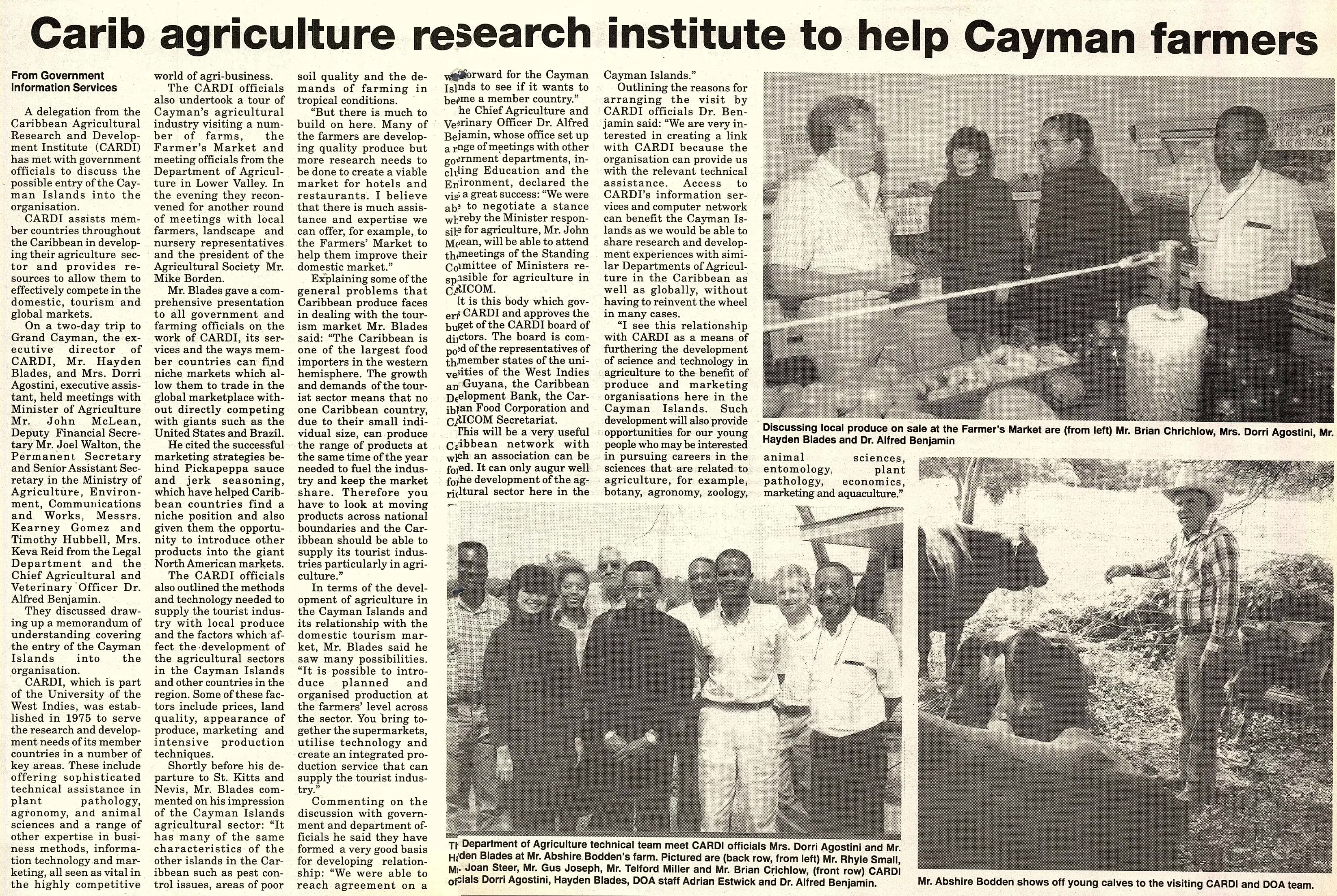
CARDI assists member countries throughout the Caribbean in developing their agriculture sector and provides resources to allow them to effectively compete in the domestic, tourism and global markets.
On a two-day trip to Grand Cayman, the executive director of CARDI, Mr. Hayden Blades, and Mrs. Dorri Agostini, executive assistant, held meetings with Minister of Agriculture Mr. John McLean, Deputy Financial Secretary Mr. Joel Walton, the Permanent Secretary and Senior Assistant Secretary in the Ministry of Agriculture, Environment, Communications and Works, Messrs. Kearney Gomez and Timothy Hubbell, Mrs. Keva Reid from the Legal Department and the Chief Agricultural and Veterinary Officer Dr. Alfred Benjamin.
They discussed drawing up a memorandum of understanding covering the entry of the Cayman Islands into the organisation.
CARDI, which is part of the University of the West Indies, was established in 1975 to serve the research and development needs of its member countries in a number of key areas. These include offering sophisticated technical assistance in plant pathology, agronomy, and animal sciences and a range of other expertise in business methods, information technology and marketing, all seen as vital in the highly competitive. world of agri-business. The CARDI officials also undertook a tour of Cayman's agricultural industry visiting a number of farms, the Farmer's Market and meeting officials from the Department of Agriculture in Lower Valley. In the evening they reconvened for another round of meetings with local farmers, landscape and nursery representatives and the president of the Agricultural Society Mr. Mike Borden.
Mr. Blades gave a comprehensive presentation to all government and farming officials on the work of CARDI, its services and the ways member countries can find niche markets which allow them to trade in the global marketplace without directly competing with giants such as the United States and Brazil. He cited the successful marketing strategies behind Pickapeppa sauce and jerk seasoning, which have helped Caribbean countries find a niche position and also given them the opportunity to introduce other products into the giant North American markets. The CARDI officials also outlined the methods and technology needed to supply the tourist industry with local produce and the factors which affect the development of the agricultural sectors in the Cayman Islands and other countries in the region. Some of these factors include prices, land quality, appearance of produce, marketing and intensive production techniques.
Shortly before his departure to St. Kitts and Nevis, Mr. Blades commented on his impression of the Cayman Islands agricultural sector: "It has many of the same characteristics of the other islands in the Caribbean such as pest control issues, areas of poor soil quality and the demands of farming in tropical conditions. "But there is much to build on here. Many of the farmers are developing quality produce but more research needs to be done to create a viable market for hotels and restaurants. I believe that there is much assistance and expertise we can offer, for example, to the Farmers' Market to help them improve their domestic market."
Explaining some of the general problems that Caribbean produce faces in dealing with the tourism market Mr. Blades said: "The Caribbean is one of the largest food importers in the western hemisphere. The growth and demands of the tourist sector means that no one Caribbean country, due to their small individual size, can produce the range of products at the same time of the year needed to fuel the industry and keep the market share. Therefore you have to look at moving products across national boundaries and the Caribbean should be able to supply its tourist industries particularly in agriculture."
In terms of the development of agriculture in the Cayman Islands and its relationship with the domestic tourism market, Mr. Blades said he saw many possibilities. "It is possible to introduce planned and organised production at the farmers' level across the sector. You bring together the supermarkets, utilise technology and create an integrated production service that can supply the tourist industry." Commenting on the discussion with government and department officials he said they have formed a very good basis for developing relationship: "We were able to reach agreement on a forward for the Cayman Islands to see if it wants to beome a member country."
The Chief Agriculture and Veerinary Officer Dr. Alfred Bejamin, whose office set up a rnge of meetings with other government departments, inclling Education and the Environment, declared the vis a great success: "We were abe to negotiate a stance whereby the Minister responsible for agriculture, Mr. John Mean, will be able to attend thmeetings of the Standing Comittee of Ministers responsible for agriculture in CARICOM.
It is this body which gover CARDI and approves the buget of the CARDI board of dictors. The board is composed of the representatives of thmember states of the universities of the West Indies an Guyana, the Caribbean Development Bank, the Caribbean Food Corporation and CARICOM Secretariat.
This will be a very useful Caribbean network with wch an association can be fojed. It can only augur well forthe development of the agricultural sector here in the Cayman Islands." Outlining the reasons for arranging the visit by CARDI officials Dr. Benjamin said: "We are very interested in creating a link with CARDI because the organisation can provide us with the relevant technical assistance. Access to CARDI's information services and computer network can benefit the Cayman Islands as we would be able to share research and development experiences with similar Departments of Agriculture in the Caribbean as well as globally, without having to reinvent the wheel in many cases.
"I see this relationship with CARDI as a means of furthering the development of science and technology in agriculture to the benefit of produce and marketing organisations here in the Cayman Islands. Such development will also provide opportunities for our young people who may be interested in pursuing careers in the sciences that are related to agriculture, for example, botany, agronomy, zoology, animal entomology, pathology, marketing and a sciences, plant economics, aquaculture."