Hurricane Georges claims 10 lives
About the article
This is a digitised version of an article from The Cayman Compass's print archive. Occasionally, the digitisation process introduces transcription errors, or other problems.
See the article in its original context from September 1998.
Brought to you by

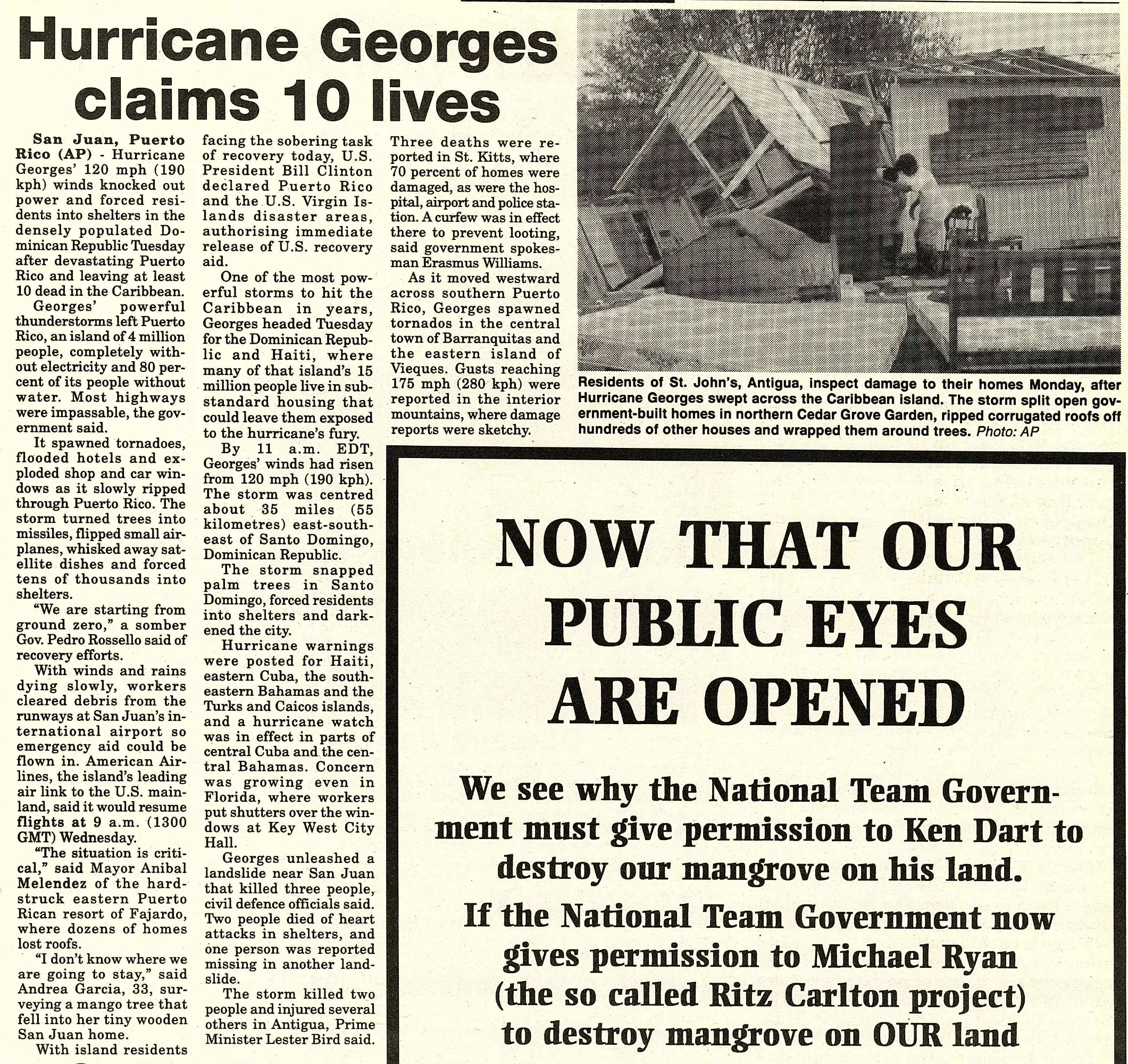
Georges' powerful thunderstorms left Puerto Rico, an island of 4 million people, completely without electricity and 80 percent of its people without water. Most highways were impassable, the government said.
It spawned tornadoes, flooded hotels and exploded shop and car windows as it slowly ripped through Puerto Rico. The storm turned trees into missiles, flipped small airplanes, whisked away satellite dishes and forced tens of thousands into shelters. "We are starting from ground zero," a somber Gov. Pedro Rossello said of recovery efforts.
With winds and rains dying slowly, workers cleared debris from the runways at San Juan's international airport so emergency aid could be flown in. American Airlines, the island's leading air link to the U.S. mainland, said it would resume flights at 9 a.m. (1300 GMT) Wednesday.
"The situation is critical," said Mayor Anibal Melendez of the hard-struck eastern Puerto Rican resort of Fajardo, where dozens of homes lost roofs.
"I don't know where we are going to stay," said Andrea Garcia, 33, surveying a mango tree that fell into her tiny wooden San Juan home. With island residents facing the sobering task of recovery today, U.S. President Bill Clinton declared Puerto Rico and the U.S. Virgin Islands disaster areas, authorising immediate release of U.S. recovery aid. One of the most powerful storms to hit the Caribbean in years, Georges headed Tuesday for the Dominican Republic and Haiti, where many of that island's 15 million people live in substandard housing that could leave them exposed to the hurricane's fury.
By 11 a.m. EDT, Georges' winds had risen from 120 mph (190 kph). The storm was centred about 35 miles (55 kilometres) east-southeast of Santo Domingo, Dominican Republic.
The storm snapped palm trees in Santo Domingo, forced residents into shelters and darkened the city.
Hurricane warnings were posted for Haiti, eastern Cuba, the southeastern Bahamas and the Turks and Caicos islands, and a hurricane watch was in effect in parts of central Cuba and the central Bahamas. Concern was growing even in Florida, where workers put shutters over the windows at Key West City Hall. Georges unleashed a landslide near San Juan that killed three people, civil defence officials said.
Two people died of heart attacks in shelters, and one person was reported missing in another landslide.
The storm killed two people and injured several others in Antigua, Prime Minister Lester Bird said. Three deaths were reported in St. Kitts, where 70 percent of homes were damaged, as were the hospital, airport and police station. A curfew was in effect there to prevent looting, said government spokesman Erasmus Williams.
As it moved westward across southern Puerto Rico, Georges spawned tornados in the central town of Barranquitas and the eastern island of Vieques. Gusts reaching 175 mph (280 kph) were reported in the interior mountains, where damage reports were sketchy.