John D. Ehrlichman, 73, dies
About the article
This is a digitised version of an article from The Cayman Compass's print archive. Occasionally, the digitisation process introduces transcription errors, or other problems.
See the article in its original context from February 1999.
Brought to you by

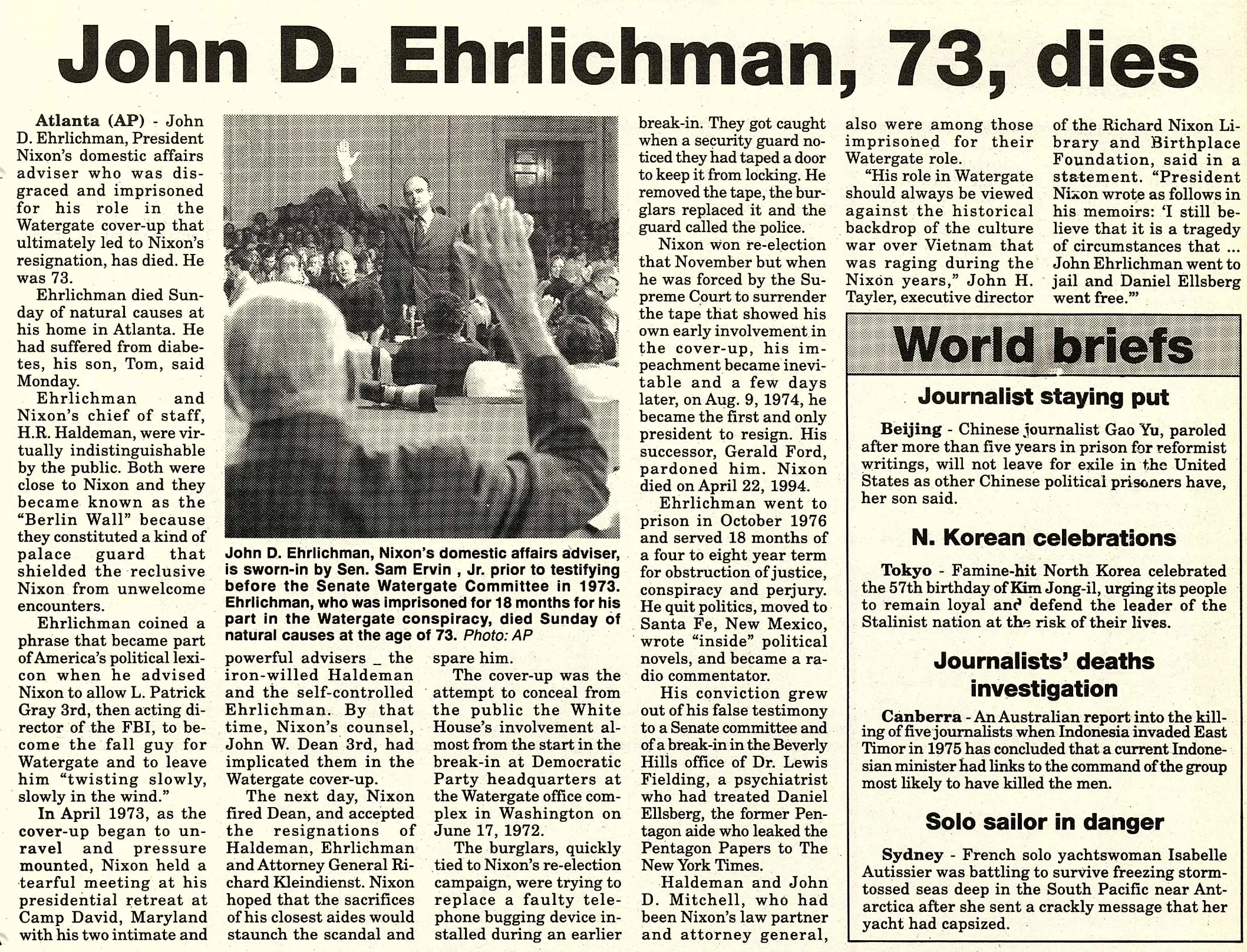
Ehrlichman died Sunday of natural causes at his home in Atlanta. He had suffered from diabetes, his son, Tom, said Monday.
Ehrlichman and Nixon's chief of staff, H.R. Haldeman, were virtually indistinguishable by the public. Both were close to Nixon and they became known as the "Berlin Wall" because they constituted a kind of palace guard that shielded the reclusive Nixon from unwelcome encounters.
Ehrlichman coined a phrase that became part of America's political lexicon when he advised Nixon to allow L. Patrick Gray 3rd, then acting director of the FBI, to become the fall guy for Watergate and to leave him "twisting slowly, slowly in the wind."
In April 1973, as the cover-up began to unravel and pressure mounted, Nixon held a tearful meeting at his presidential retreat at Camp David, Maryland with his two intimate and powerful advisers the iron-willed Haldeman and the self-controlled Ehrlichman. By that time, Nixon's counsel, John W. Dean 3rd, had implicated them in the Watergate cover-up.
The next day, Nixon fired Dean, and accepted the resignations of Haldeman, Ehrlichman and Attorney General Richard Kleindienst. Nixon hoped that the sacrifices of his closest aides would staunch the scandal and spare him.
The cover-up was the attempt to conceal from the public the White House's involvement almost from the start in the break-in at Democratic Party headquarters at the Watergate office complex in Washington on June 17, 1972.
The burglars, quickly tied to Nixon's reelection campaign, were trying to replace a faulty telephone bugging device installed during an earlier. break-in. They got caught when a security guard noticed they had taped a door to keep it from locking. He removed the tape, the burglars replaced it and the guard called the police.
Nixon won reelection that November but when he was forced by the Supreme Court to surrender the tape that showed his own early involvement in the cover-up, his impeachment became inevitable and a few days later, on Aug. 9, 1974, he became the first and only president to resign. His successor, Gerald Ford, pardoned him. Nixon died on April 22, 1994.
Ehrlichman went to prison in October 1976 and served 18 months of a four to eight year term for obstruction of justice, conspiracy and perjury. He quit politics, moved to Santa Fe, New Mexico, wrote "inside" political novels, and became a radio commentator.
His conviction grew out of his false testimony to a Senate committee and of a break-in in the Beverly Hills office of Dr. Lewis Fielding, a psychiatrist who had treated Daniel Ellsberg, the former Pentagon aide who leaked the Pentagon Papers to The New York Times.
Haldeman and John D. Mitchell, who had been Nixon's law partner and attorney general, also were among those imprisoned for their Watergate role.
"His role in Watergate should always be viewed against the historical backdrop of the culture war over Vietnam that was raging during the Nixon years," John H. Tayler, executive director of the Richard Nixon Library and Birthplace Foundation, said in a statement. "President Nixon wrote as follows in his memoirs: 'I still believe that it is a tragedy of circumstances that ... John Ehrlichman went to jail and Daniel Ellsberg went free.'"