Blair introduces euro plan
About the article
This is a digitised version of an article from The Cayman Compass's print archive. Occasionally, the digitisation process introduces transcription errors, or other problems.
See the article in its original context from February 1999.
Brought to you by

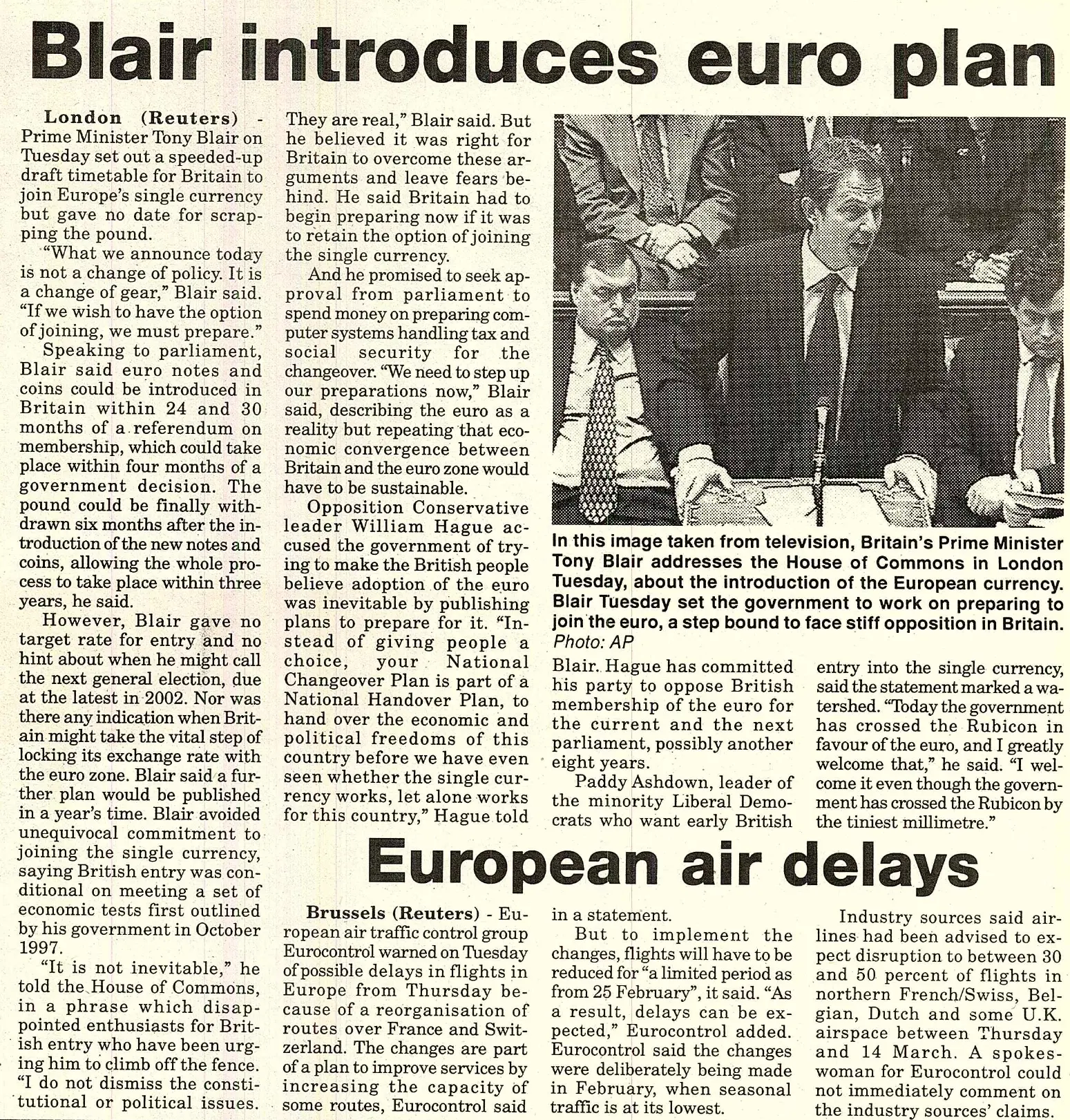
"What we announce today is not a change of policy. It is a change of gear," Blair said. "If we wish to have the option of joining, we must prepare." Speaking to parliament, Blair said euro notes and coins could be introduced in Britain within 24 and 30 months of a referendum on membership, which could take place within four months of a government decision. The pound could be finally withdrawn six months after the introduction of the new notes and coins, allowing the whole process to take place within three years, he said.
However, Blair gave no target rate for entry and no hint about when he might call the next general election, due at the latest in 2002. Nor was there any indication when Britain might take the vital step of locking its exchange rate with the euro zone. Blair said a further plan would be published in a year's time. Blair avoided unequivocal commitment to joining the single currency, saying British entry was conditional on meeting a set of economic tests first outlined by his government in October 1997.
"It is not inevitable," he told the House of Commons, in a phrase which disappointed enthusiasts for British entry who have been urging him to climb off the fence. "I do not dismiss the constitutional or political issues. "They are real," Blair said. But he believed it was right for Britain to overcome these arguments and leave fears behind. He said Britain had to begin preparing now if it was to retain the option of joining the single currency.
And he promised to seek approval from parliament to spend money on preparing computer systems handling tax and social security for the changeover. "We need to step up our preparations now," Blair said, describing the euro as a reality but repeating that economic convergence between Britain and the euro zone would have to be sustainable.
Opposition Conservative leader William Hague accused the government of trying to make the British people believe adoption of the euro was inevitable by publishing plans to prepare for it. "Instead of giving people a choice, your National Changeover Plan is part of a National Handover Plan, to hand over the economic and political freedoms of this country before we have even seen whether the single currency works, let alone works for this country," Hague told Blair. Hague has committed his party to oppose British membership of the euro for the current and the next parliament, possibly another eight years.
Paddy Ashdown, leader of the minority Liberal Democrats who want early British entry into the single currency, said the statement marked a watershed.
"Today the government has crossed the Rubicon in favour of the euro, and I greatly welcome that," he said. "I welcome it even though the government has crossed the Rubicon by the tiniest millimetre."