Man charged with murders in UK bombings
About the article
This is a digitised version of an article from The Cayman Compass's print archive. Occasionally, the digitisation process introduces transcription errors, or other problems.
See the article in its original context from May 1999.
Brought to you by

David Copeland, 22, who was charged Sunday, spoke only to confirm his address, and did not enter a plea during a 5-minute hearing at West London Magistrates Court. He was returned to jail until his next court appearance 10 May.
Copeland was charged with murdering three people with a nail bomb which exploded Friday evening at the Admiral Duncan, a gay pub in central London, More than 70 people were injured; 19 were still hospitalised Monday, 6 of them in serious condition.
He was also charged with three counts of causing explosions, including nail bomb attacks on 17 April in Brixton, south London, injuring 39 people, and Brick Lane in east London a week later, injuring 7.
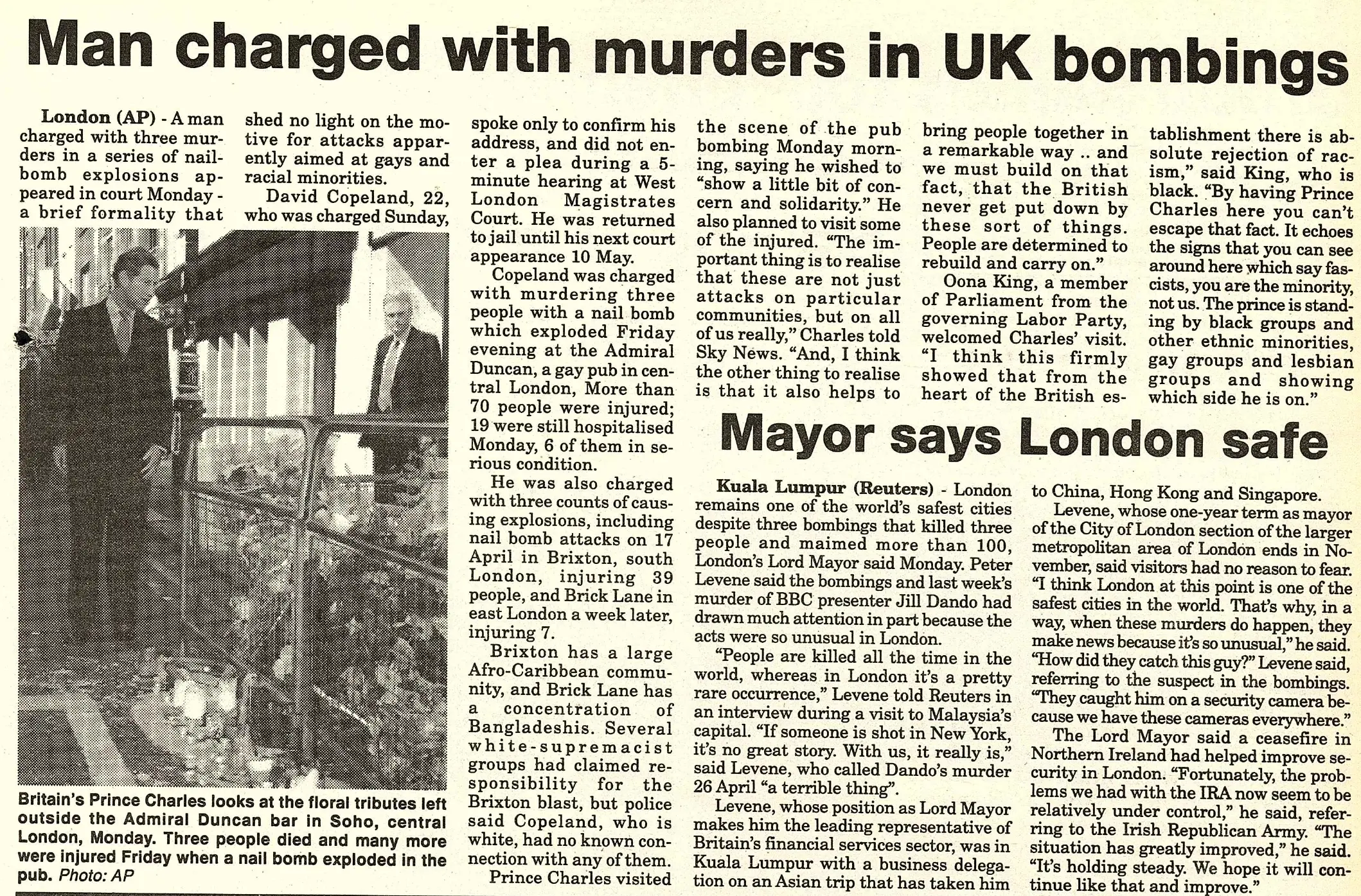
Brixton has a large Afro-Caribbean community, and Brick Lane has a concentration of Bangladeshis. Several white-supremacist groups had claimed responsibility for the Brixton blast, but police said Copeland, who is white, had no known connection with any of them. Prince Charles visited the scene of the pub bombing Monday morning, saying he wished to "show a little bit of concern and solidarity." He also planned to visit some of the injured. "The important thing is to realise that these are not just attacks on particular communities, but on all of us really," Charles told Sky News. "And, I think the other thing to realise is that it also helps to bring people together in a remarkable way.. and we must build on that fact, that the British never get put down by these sort of things. People are determined to rebuild and carry on."
Oona King, a member of Parliament from the governing Labor Party, welcomed Charles' visit. "I think this firmly showed that from the heart of the British es"establishment there is absolute rejection of racism," said King, who is black. "By having Prince Charles here you can't escape that fact. It echoes the signs that you can see around here which say fascists, you are the minority, not us. The prince is standing by black groups and other ethnic minorities, gay groups and lesbian groups and showing which side he is on."