NORTH CAUCASUS Land of blood feuds
About the article
This is a digitised version of an article from The Cayman Compass's print archive. Occasionally, the digitisation process introduces transcription errors, or other problems.
See the article in its original context from August 1999.
Brought to you by

Hundreds of tribes, each with its own language and traditions, inhabit the northern slopes of the glacier-topped Greater Caucasus Mountains, Europe's highest peaks.
Below, in the vast steppes between the Black and the Caspian Seas, Russia maintained garrison towns of paramilitary Cossack horsemen since the days of Tsar Peter the Great.
The dangerous frontier was the setting of classic works by the greatest Russian writers Pushkin, Tolstoy and Lermontov. But Moscow has never fully controlled the region, which remains a land of blood feuds, both ancient and modern.
Through much of the 19th century Moscow fought a series of wars with Caucasus tribes, most notably against Imam Shamil, a charismatic leader who united Moslem mountain tribes.
During World War II, Soviet dictator Josef Stalin accused ethnic Chechens and Ingush of collaborating with invading Nazis and deported them en masse to central Asia and Kazakhstan. His successor, Nikita Khrushchev, allowed them to return in 1957.
The North Caucasus exploded into world headlines in December 1994, when President Boris Yeltsin sent tanks to crush an independence bid by the Chechens, the region's largest group.
The war that followed was fought ruthlessly. Russian forces killed tens of thousands of civilians and bombed the regional capital Grozny to rubble, but were finally forced to withdraw in defeat after a 1996 peace deal that put off the question of Chechenindependence for five years.
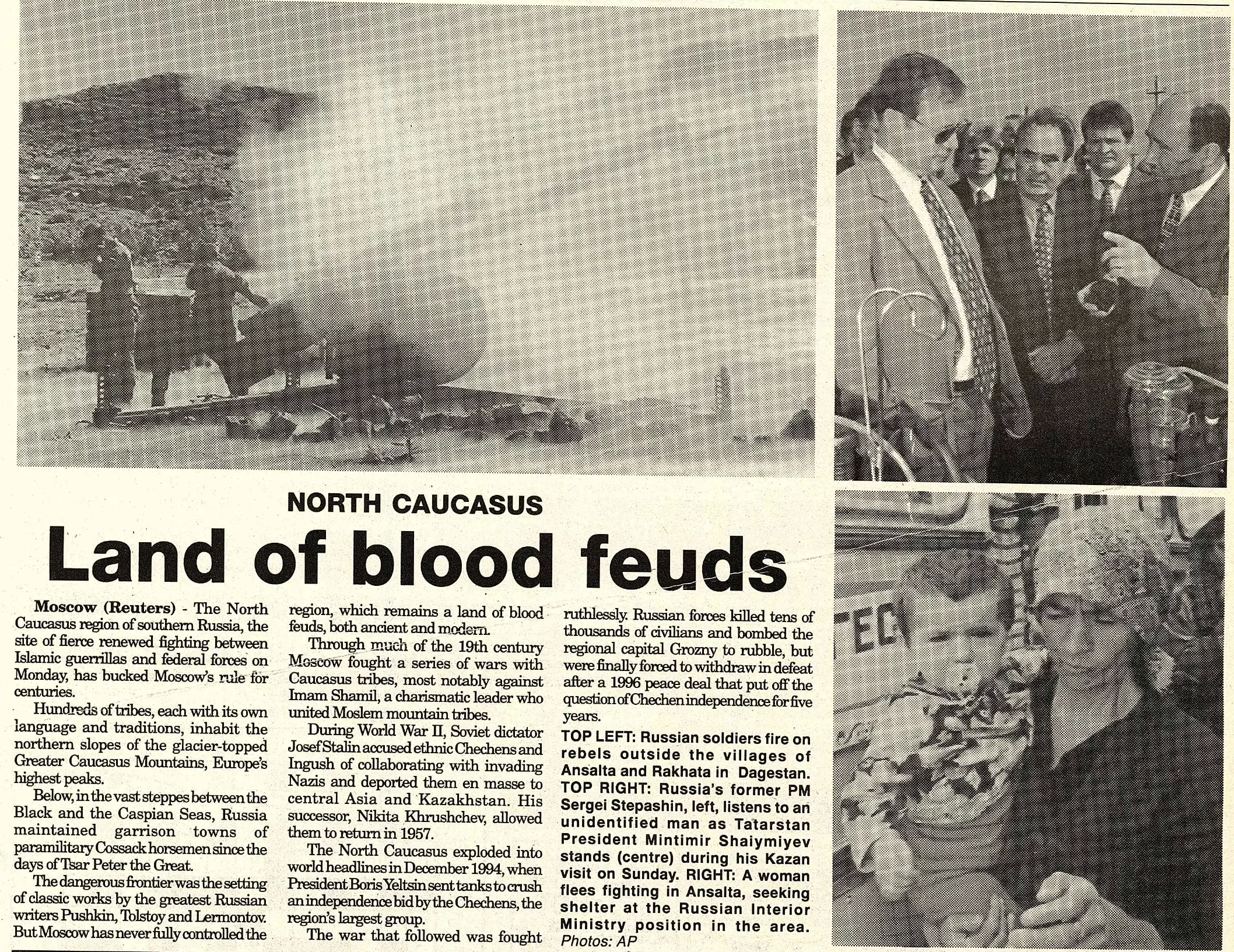
TOP LEFT: Russian soldiers fire on rebels outside the villages of Ansalta and Rakhata in Dagestan. TOP RIGHT: Russia's former PM Sergei Stepashin, left, listens to an unidentified man as Tatarstan President Mintimir Shaiymiyev stands (centre) during his Kazan visit on Sunday. RIGHT: A woman flees fighting in Ansalta, seeking shelter at the Russian Interior Ministry position in the area. Photos: AP