Quake rocks Athens
About the article
This is a digitised version of an article from The Cayman Compass's print archive. Occasionally, the digitisation process introduces transcription errors, or other problems.
See the article in its original context from September 1999.
Brought to you by

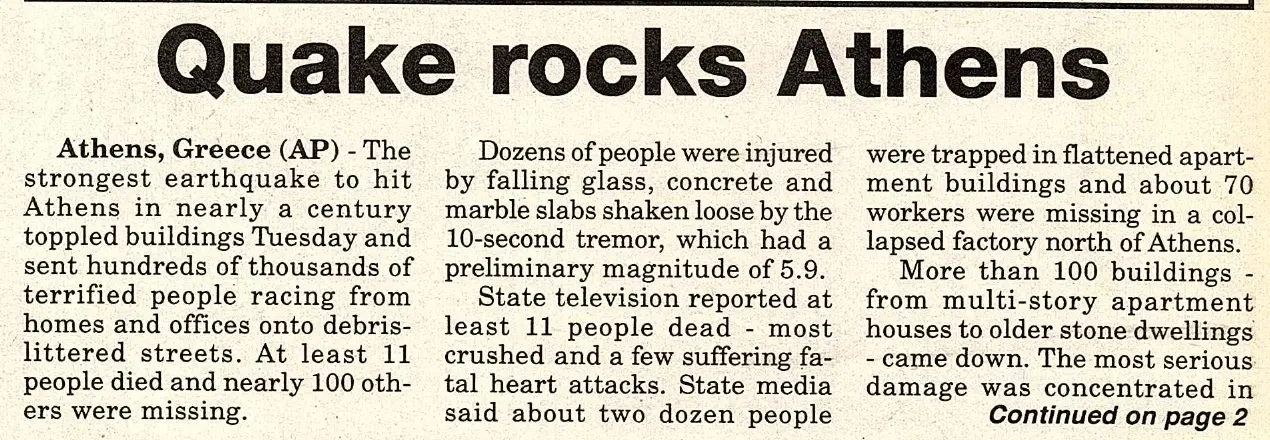
At least 11 people died and nearly 100 others were missing. Dozens of people were injured by falling glass, concrete and marble slabs shaken loose by the 10-second tremor, which had a preliminary magnitude of 5.9.
State television reported at least 11 people dead - most crushed and a few suffering fatal heart attacks. State media said about two dozen people were trapped in flattened apartment buildings and about 70 workers were missing in a collapsed factory north of Athens.
More than 100 buildings from multi-story apartment houses to older stone dwellings - came down. The most serious damage was concentrated in Continued on page 2 from page 1 the Menidi district and other immigrant and working-class areas north of central Athens and closer to the tremor's epicentre.
There was no apparent damage to ancient sites, including the Acropolis and the towering columns of the Temple of Zeus.
A series of aftershocks - as strong as 4.5 - swayed buildings and kept panicked people from attempting to return indoors.
Chunks of concrete and marble fell from buildings, landing atop cars and shattering on streets and sidewalks. Windows shattered and sprayed glass shards onto sobbing crowds. People at a midafternoon concert at a central Athens auditorium screamed and raced for the exits.
Power and telephone service was out in many places of this city of more than 5 million.
According to the Athens Seismological Institute, the 2:56pm quake was centred about 12 miles north of Athens. The epicentre was between Menidi and Mount Parnes, a national park sparsely inhabited. The quake was felt across the Aegean Sea in Izmir, Turkey, about 180 miles east of Athens.
In Athens, people sought safety anywhere clear of buildings: on road median strips, parking lots and in the National Garden in central Athens near the site of a concert planned for later Tuesday to aid victims of last month's monstrous quake in neighbouring Turkey that claimed more than. 15,000 lives.
"Everyone panicked, especially because of the recent Turkish quake," said Dimitris Lalas, head of the Athens Seismological Institute.
"We had a very strong shock," said George Skordilis, a seismologist. Skordilis said there was no clear connection with the Turkish quake, but "we can say there is increased earthquake activity in the eastern Mediterranean."