Scrutiny of Citibank
About the article
This is a digitised version of an article from The Cayman Compass's print archive. Occasionally, the digitisation process introduces transcription errors, or other problems.
See the article in its original context from November 1999.
Brought to you by

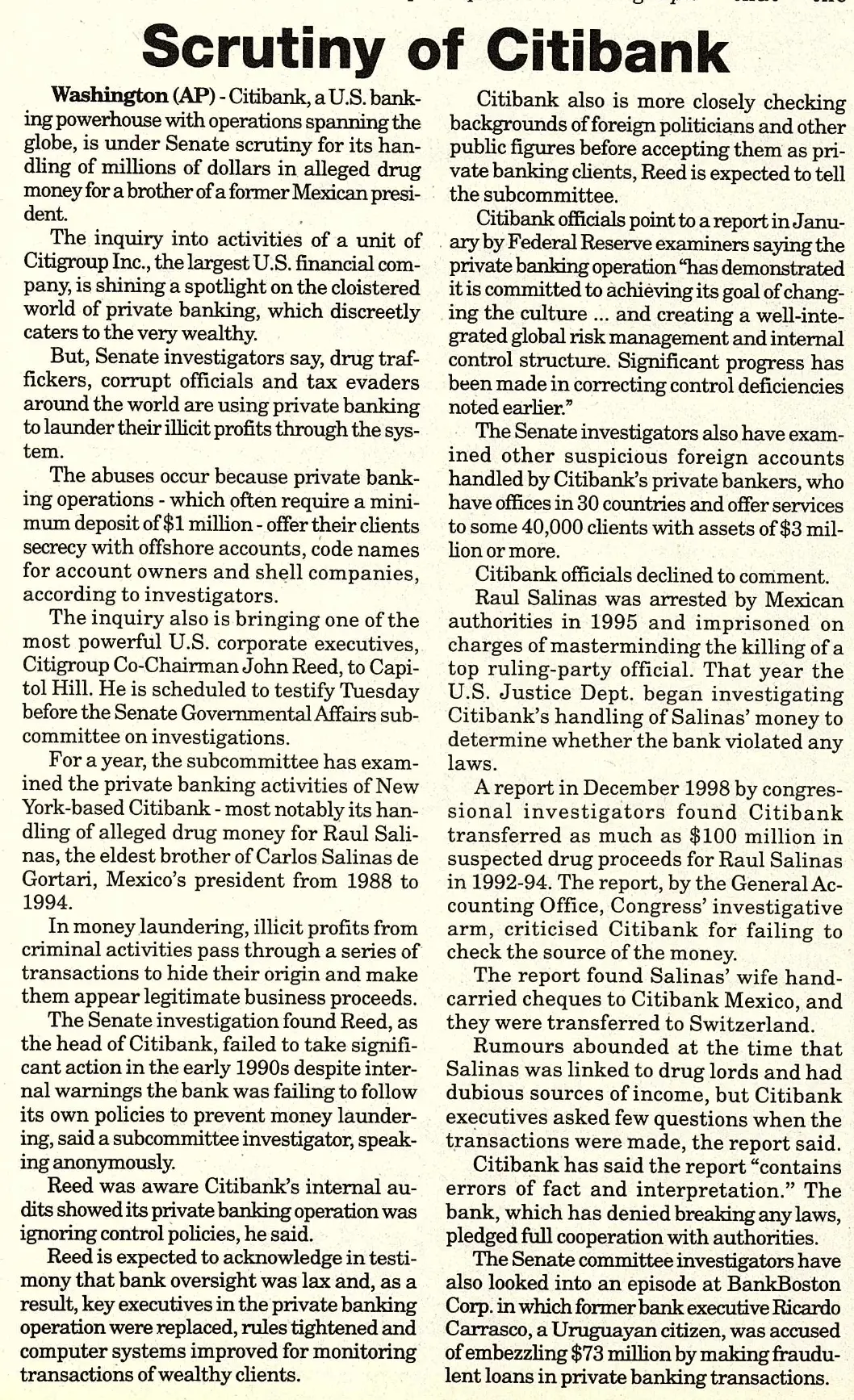
But, Senate investigators say, drug traffickers, corrupt officials and tax evaders around the world are using private banking to launder their illicit profits through the system. The abuses occur because private banking operations - which often require a minimum deposit of $1 million - offer their clients secrecy with offshore accounts, code names for account owners and shell companies, according to investigators.
The inquiry also is bringing one of the most powerful U.S. corporate executives, Citigroup Co-Chairman John Reed, to Capitol Hill. He is scheduled to testify Tuesday before the Senate Governmental Affairs subcommittee on investigations.
For a year, the subcommittee has examined the private banking activities of New York-based Citibank - most notably its handling of alleged drug money for Raul Salinas, the eldest brother of Carlos Salinas de Gortari, Mexico's president from 1988 to 1994.
In money laundering, illicit profits from criminal activities pass through a series of transactions to hide their origin and make them appear legitimate business proceeds. The Senate investigation found Reed, as the head of Citibank, failed to take significant action in the early 1990s despite internal warnings the bank was failing to follow its own policies to prevent money laundering, said a subcommittee investigator, speaking anonymously.
Reed was aware Citibank's internal audits showed its private banking operation was ignoring control policies, he said.
Reed is expected to acknowledge in testimony that bank oversight was lax and, as a result, key executives in the private banking operation were replaced, rules tightened and computer systems improved for monitoring transactions of wealthy clients. Citibank also is more closely checking backgrounds of foreign politicians and other public figures before accepting them as private banking clients, Reed is expected to tell the subcommittee.
Citibank officials point to a report in January by Federal Reserve examiners saying the private banking operation "has demonstrated it is committed to achieving its goal of changing the culture ... and creating a well-integrated global risk management and internal control structure. Significant progress has been made in correcting control deficiencies noted earlier."
The Senate investigators also have examined other suspicious foreign accounts handled by Citibank's private bankers, who have offices in 30 countries and offer services to some 40,000 clients with assets of $3 million or more.
Citibank officials declined to comment.
Raul Salinas was arrested by Mexican authorities in 1995 and imprisoned on charges of masterminding the killing of a top ruling-party official. That year the U.S. Justice Dept. began investigating Citibank's handling of Salinas' money to determine whether the bank violated any laws.
A report in December 1998 by congressional investigators found Citibank transferred as much as $100 million in suspected drug proceeds for Raul Salinas in 1992-94. The report, by the General Accounting Office, Congress' investigative arm, criticised Citibank for failing to check the source of the money.
The report found Salinas' wife hand-carried cheques to Citibank Mexico, and they were transferred to Switzerland.
Rumours abounded at the time that Salinas was linked to drug lords and had dubious sources of income, but Citibank executives asked few questions when the transactions were made, the report said.
Citibank has said the report "contains errors of fact and interpretation." The bank, which has denied breaking any laws, pledged full cooperation with authorities.
The Senate committee investigators have also looked into an episode at BankBoston Corp. in which former bank executive Ricardo Carrasco, a Uruguayan citizen, was accused of embezzling $73 million by making fraudulent loans in private banking transactions.