ARGENTINA De la Rua takes over presidency
About the article
This is a digitised version of an article from The Cayman Compass's print archive. Occasionally, the digitisation process introduces transcription errors, or other problems.
See the article in its original context from December 1999.
Brought to you by

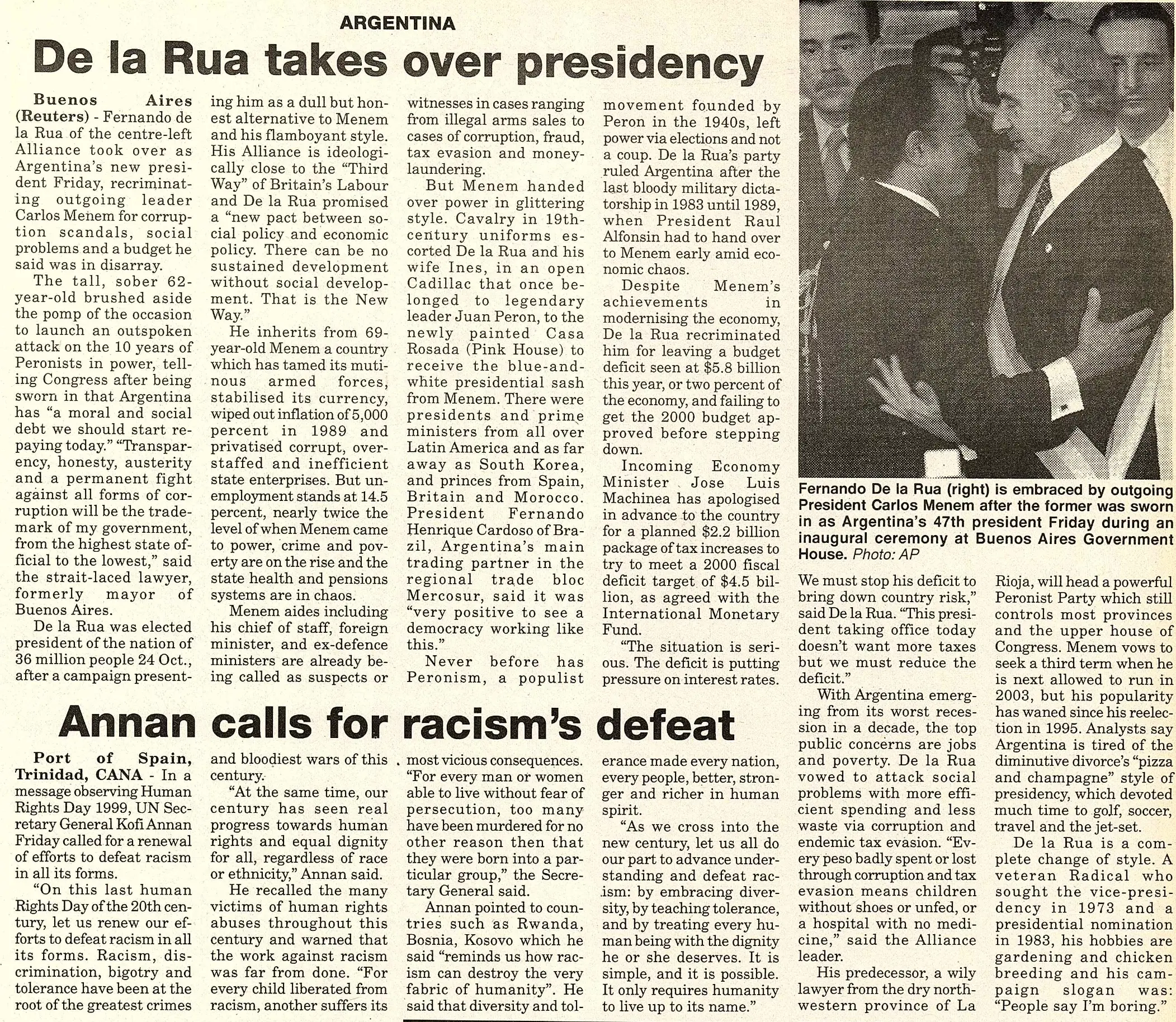
The tall, sober 62-year-old brushed aside the pomp of the occasion to launch an outspoken attack on the 10 years of Peronists in power, telling Congress after being sworn in that Argentina has "a moral and social debt we should start repaying today." "Transparency, honesty, austerity and a permanent fight against all forms of corruption will be the trademark of my government, from the highest state official to the lowest," said the strait-laced lawyer, formerly mayor of Buenos Aires.
De la Rua was elected president of the nation of 36 million people 24 Oct., after a campaign presenting him as a dull but honest alternative to Menem and his flamboyant style. His Alliance is ideologically close to the "Third Way" of Britain's Labour and De la Rua promised a "new pact between social policy and economic policy. There can be no sustained development without social development. That is the New Way."
He inherits from 69-year-old Menem a country which has tamed its mutinous armed forces, stabilised its currency, wiped out inflation of 5,000 percent in 1989 and privatised corrupt, overstaffed and inefficient state enterprises. But unemployment stands at 14.5 percent, nearly twice the level of when Menem came to power, crime and poverty are on the rise and the state health and pensions systems are in chaos.
Menem aides including his chief of staff, foreign minister, and ex-defence ministers are already being called as suspects or witnesses in cases ranging from illegal arms sales to cases of corruption, fraud, tax evasion and moneylaundering.
But Menem handed over power in glittering style. Cavalry in 19thcentury uniforms escorted De la Rua and his wife Ines, in an open Cadillac that once belonged to legendary leader Juan Peron, to the newly painted Casa Rosada (Pink House) to receive the blue-and-white presidential sash from Menem. There were presidents and prime ministers from all over Latin America and as far away as South Korea, and princes from Spain, Britain and Morocco. President Fernando Henrique Cardoso of Brazil, Argentina's main trading partner in the regional trade bloc Mercosur, said it was "very positive to see a democracy working like this."
Never before has Peronism, a populist movement founded by Peron in the 1940s, left power via elections and not a coup. De la Rua's party ruled Argentina after the last bloody military dictatorship in 1983 until 1989, when President Raul Alfonsin had to hand over to Menem early amid economic chaos.
Despite Menem's achievements in modernising the economy, De la Rua recriminated him for leaving a budget deficit seen at $5.8 billion this year, or two percent of the economy, and failing to get the 2000 budget approved before stepping down.
Incoming Economy Minister Jose Luis Machinea has apologised in advance to the country for a planned $2.2 billion package of tax increases to try to meet a 2000 fiscal deficit target of $4.5 billion, as agreed with the International Monetary Fund.
"The situation is serious. The deficit is putting pressure on interest rates. We must stop his deficit to bring down country risk," said De la Rua. "This president taking office today doesn't want more taxes but we must reduce the deficit."
With Argentina emerging from its worst recession in a decade, the top public concerns are jobs and poverty. De la Rua vowed to attack social problems with more efficient spending and less waste via corruption and endemic tax evasion. "Every peso badly spent or lost through corruption and tax evasion means children without shoes or unfed, or a hospital with no medicine," said the Alliance leader.
His predecessor, a wily lawyer from the dry northwestern province of La Rioja, will head a powerful Peronist Party which still controls most provinces and the upper house of Congress. Menem vows to seek a third term when he is next allowed to run in 2003, but his popularity has waned since his reelection in 1995. Analysts say Argentina is tired of the diminutive divorce's "pizza and champagne" style of presidency, which devoted much time to golf, soccer, travel and the jet-set.
De la Rua is a complete change of style. A veteran Radical who sought the vice-presidency in 1973 and a presidential nomination in 1983, his hobbies are gardening and chicken breeding and his campaign slogan was: "People say I'm boring."