Venezuela floods kill at least 10,000
About the article
This is a digitised version of an article from The Cayman Compass's print archive. Occasionally, the digitisation process introduces transcription errors, or other problems.
See the article in its original context from December 1999.
Brought to you by

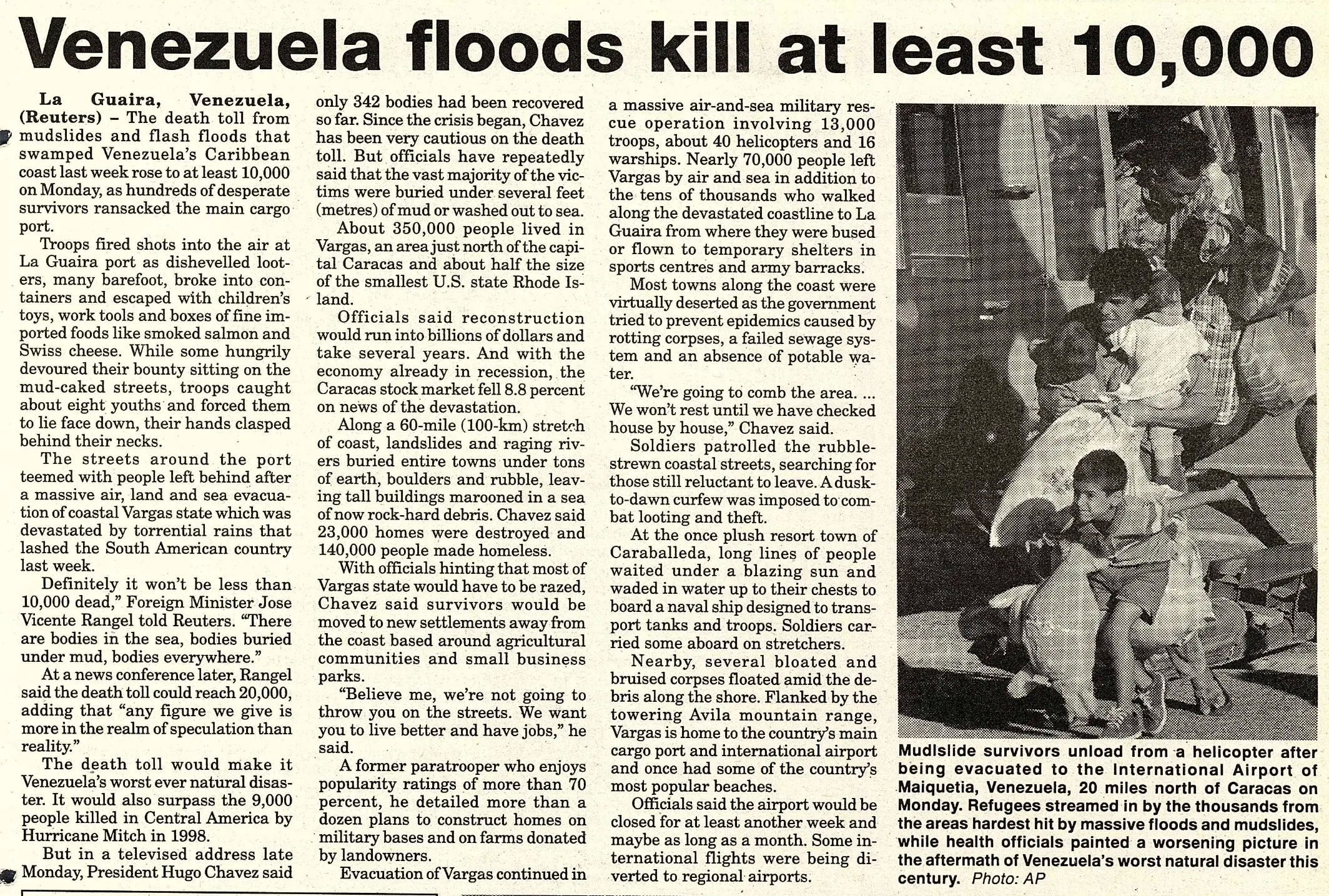
Troops fired shots into the air at La Guaira port as dishevelled looters, many barefoot, broke into containers and escaped with children's toys, work tools and boxes of fine imported foods like smoked salmon and Swiss cheese. While some hungrily devoured their bounty sitting on the mud-caked streets, troops caught about eight youths and forced them to lie face down, their hands clasped behind their necks.
The streets around the port teemed with people left behind after a massive air, land and sea evacuation of coastal Vargas state which was devastated by torrential rains that lashed the South American country last week.
Definitely it won't be less than 10,000 dead," Foreign Minister Jose Vicente Rangel told Reuters. "There are bodies in the sea, bodies buried under mud, bodies everywhere."
At a news conference later, Rangel said the death toll could reach 20,000, adding that "any figure we give is more in the realm of speculation than reality."
The death toll would make it Venezuela's worst ever natural disaster. It would also surpass the 9,000 people killed in Central America by Hurricane Mitch in 1998.
But in a televised address late Monday, President Hugo Chavez said only 342 bodies had been recovered so far. Since the crisis began, Chavez has been very cautious on the death toll. But officials have repeatedly said that the vast majority of the victims were buried under several feet (metres) of mud or washed out to sea.
About 350,000 people lived in Vargas, an area just north of the capital Caracas and about half the size of the smallest U.S. state Rhode Island.
Officials said reconstruction would run into billions of dollars and take several years. And with the economy already in recession, the Caracas stock market fell 8.8 percent on news of the devastation.
Along a 60-mile (100-km) stretch of coast, landslides and raging rivers buried entire towns under tons of earth, boulders and rubble, leaving tall buildings marooned in a sea of now rock-hard debris. Chavez said 23,000 homes were destroyed and 140,000 people made homeless.
With officials hinting that most of Vargas state would have to be razed, Chavez said survivors would be moved to new settlements away from the coast based around agricultural communities and small business parks.
"Believe me, we're not going to throw you on the streets. We want you to live better and have jobs," he said.
A former paratrooper who enjoys popularity ratings of more than 70 percent, he detailed more than a dozen plans to construct homes on military bases and on farms donated by landowners.
Evacuation of Vargas continued in a massive air-and-sea military rescue operation involving 13,000 troops, about 40 helicopters and 16 warships. Nearly 70,000 people left Vargas by air and sea in addition to the tens of thousands who walked along the devastated coastline to La Guaira from where they were bused or flown to temporary shelters in sports centres and army barracks.
Most towns along the coast were virtually deserted as the government tried to prevent epidemics caused by rotting corpses, a failed sewage system and an absence of potable water. "We're going to comb the area. ... We won't rest until we have checked house by house," Chavez said.
Soldiers patrolled the rubble-strewn coastal streets, searching for those still reluctant to leave. A dusk-to-dawn curfew was imposed to combat looting and theft.
At the once plush resort town of Caraballeda, long lines of people waited under a blazing sun and waded in water up to their chests to board a naval ship designed to transport tanks and troops. Soldiers carried some aboard on stretchers.
Nearby, several bloated and bruised corpses floated amid the debris along the shore. Flanked by the towering Avila mountain range, Vargas is home to the country's main cargo port and international airport and once had some of the country's most popular beaches.
Officials said the airport would be closed for at least another week and maybe as long as a month. Some international flights were being diverted to regional airports.