Bob Marley and the Wailers recognised by Time magazine
About the article
This is a digitised version of an article from The Cayman Compass's print archive. Occasionally, the digitisation process introduces transcription errors, or other problems.
See the article in its original context from January 2000.
Brought to you by

Interestingly, Time's proclamation came months after the British Broadcasting Corporation (BBC) named "One Love", the final song on "Exodus", as its Song Of the Century. Time's homage, published in December, read: "Every song is a classic, from the messages of love to the anthems of revolution. But more than that, the album is a nexus, drawing inspiration from the Third World and then giving voice to it the world over."
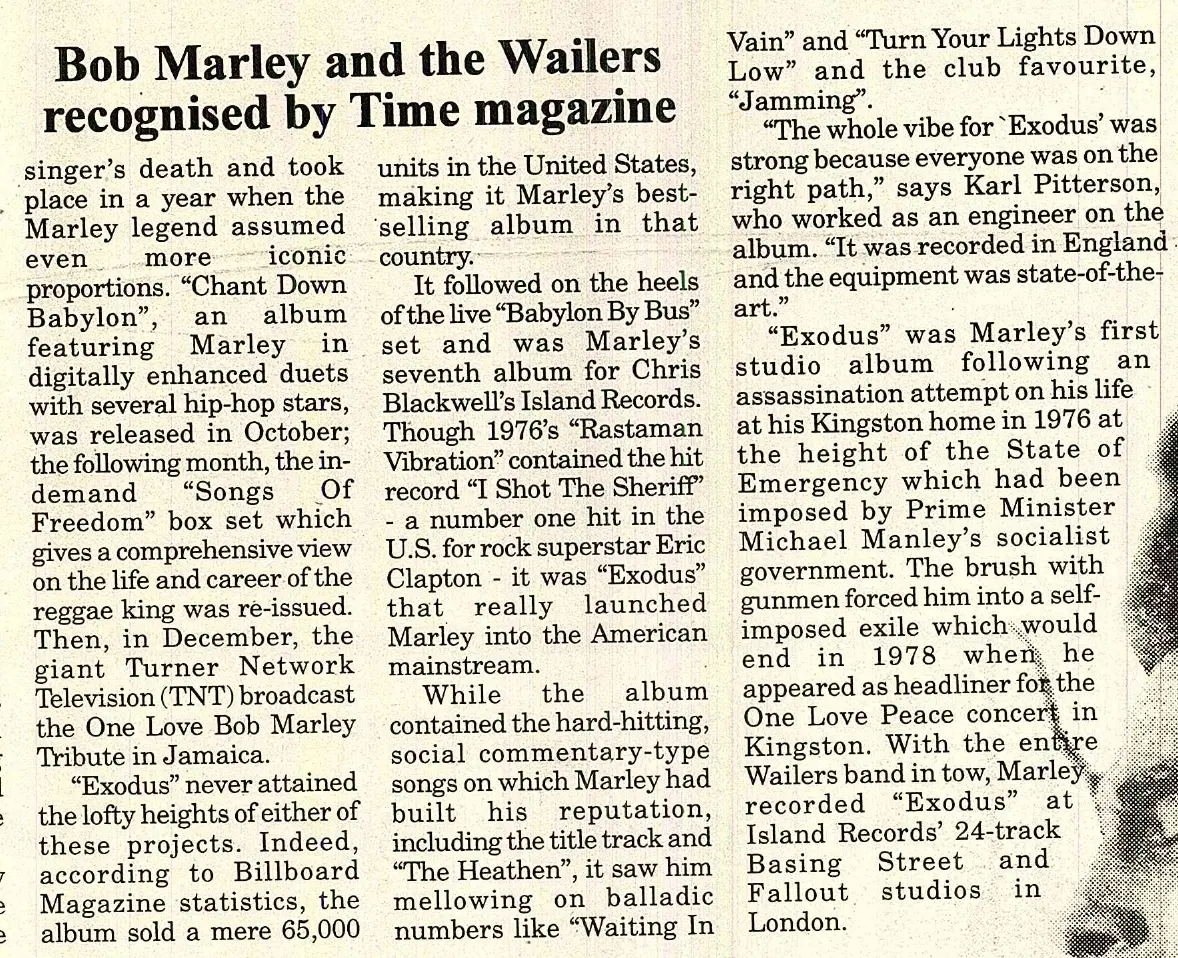
The observation by Time's editorial staff came eighteen years after the singer's death and took place in a year when the Marley legend assumed even more iconic proportions. "Chant Down Babylon", an album featuring Marley in digitally enhanced duets with several hip-hop stars, was released in October; the following month, the in-demand "Songs Of Freedom" box set which gives a comprehensive view on the life and career of the reggae king was re-issued. Then, in December, the giant Turner Network Television (TNT) broadcast the One Love Bob Marley Tribute in Jamaica.
"Exodus" never attained the lofty heights of either of these projects. Indeed, according to Billboard Magazine statistics, the album sold a mere 65,000 units in the United States, making it Marley's bestselling album in that country.
It followed on the heels of the live "Babylon By Bus" set and was Marley's seventh album for Chris Blackwell's Island Records. Though 1976's "Rastaman Vibration" contained the hit record "I Shot The Sheriff" - a number one hit in the U.S. for rock superstar Eric Clapton - it was "Exodus" that really launched Marley into the American mainstream.
While the album contained the hard-hitting, social commentary-type songs on which Marley had built his reputation, including the title track and "The Heathen", it saw him mellowing on balladic numbers like "Waiting In Vain" and "Turn Your Lights Down Low" and the club favourite, "Jamming".
"The whole vibe for 'Exodus' was strong because everyone was on the right path," says Karl Pitterson, who worked as an engineer on the album. "It was recorded in England and the equipment was state-of-the-art."
"Exodus" was Marley's first studio album following an assassination attempt on his life at his Kingston home in 1976 at the height of the State of Emergency which had been imposed by Prime Minister Michael Manley's socialist government. The brush with gunmen forced him into a self-imposed exile which would end in 1978 when he appeared as headliner for the One Love Peace concert in Kingston. With the entire Wailers band in tow, Marley recorded "Exodus" at Island Records' 24-track Basing Street and Fallout studios in London.