Eros, the bitter-sweet arbiter of love
About the article
This is a digitised version of an article from The Cayman Compass's print archive. Occasionally, the digitisation process introduces transcription errors, or other problems.
See the article in its original context from February 2000.
Brought to you by

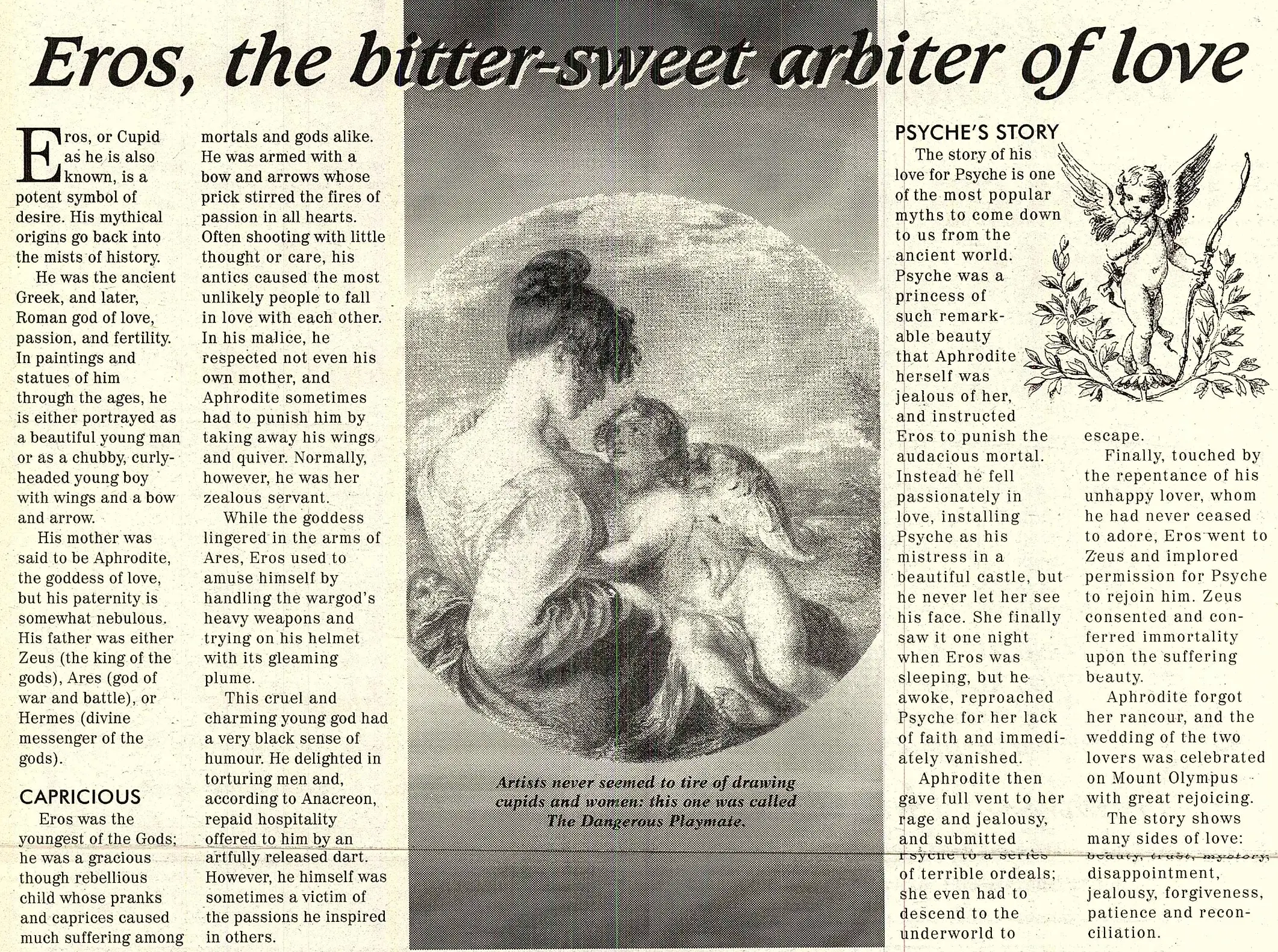
He was the ancient Greek, and later, Roman god of love, passion, and fertility. In paintings and statues of him through the ages, he is either portrayed as a beautiful young man or as a chubby, curly-headed young boy with wings and a bow and arrow. His mother was said to be Aphrodite, the goddess of love, but his paternity is somewhat nebulous.
His father was either Zeus (the king of the gods), Ares (god of war and battle), or Hermes (divine messenger of the gods).
CAPRICIOUS
Eros was the youngest of the Gods; he was a gracious though rebellious child whose pranks and caprices caused much suffering among mortals and gods alike. He was armed with a bow and arrows whose prick stirred the fires of passion in all hearts. Often shooting with little thought or care, his antics caused the most unlikely people to fall in love with each other.
In his malice, he respected not even his own mother, and Aphrodite sometimes had to punish him by taking away his wings and quiver. Normally, however, he was her zealous servant. While the goddess lingered in the arms of Ares, Eros used to amuse himself by handling the wargod's heavy weapons and trying on his helmet with its gleaming plume.
This cruel and charming young god had a very black sense of humour. He delighted in torturing men and, according to Anacreon, repaid hospitality offered to him by an artfully released dart.
However, he himself was sometimes a victim of the passions he inspired in others. The story of his love for Psyche is one of the most popular myths to come down to us from the ancient world.
Psyche was a princess of such remarkable beauty that Aphrodite herself was jealous of her,
and instructed Eros to punish the audacious mortal. Instead he fell passionately in love, installing Psyche as his mistress in a beautiful castle, but he never let her see his face. She finally saw it one night when Eros was sleeping, but he awoke, reproached Psyche for her lack of faith and immedi-
ately. ately vanished.
Aphrodite then gave full vent to her rage and jealousy, and submitted rsyche to a series of terrible ordeals; she even had to descend to the
underworld to escape.
Finally, touched by the repentance of his unhappy lover, whom he had never ceased to adore, Eros went to Zeus and implored permission for Psyche to rejoin him. Zeus consented and conferred immortality upon the suffering beauty. Aphrodite forgot her rancour, and the wedding of the two lovers was celebrated on Mount Olympus with great rejoicing.
The story shows many sides of love: tory, disappointment, jealousy, forgiveness, patience and reconciliation.