The fez makes a comeback in Turkey
About the article
This is a digitised version of an article from The Cayman Compass's print archive. Occasionally, the digitisation process introduces transcription errors, or other problems.
See the article in its original context from February 2000.
Brought to you by

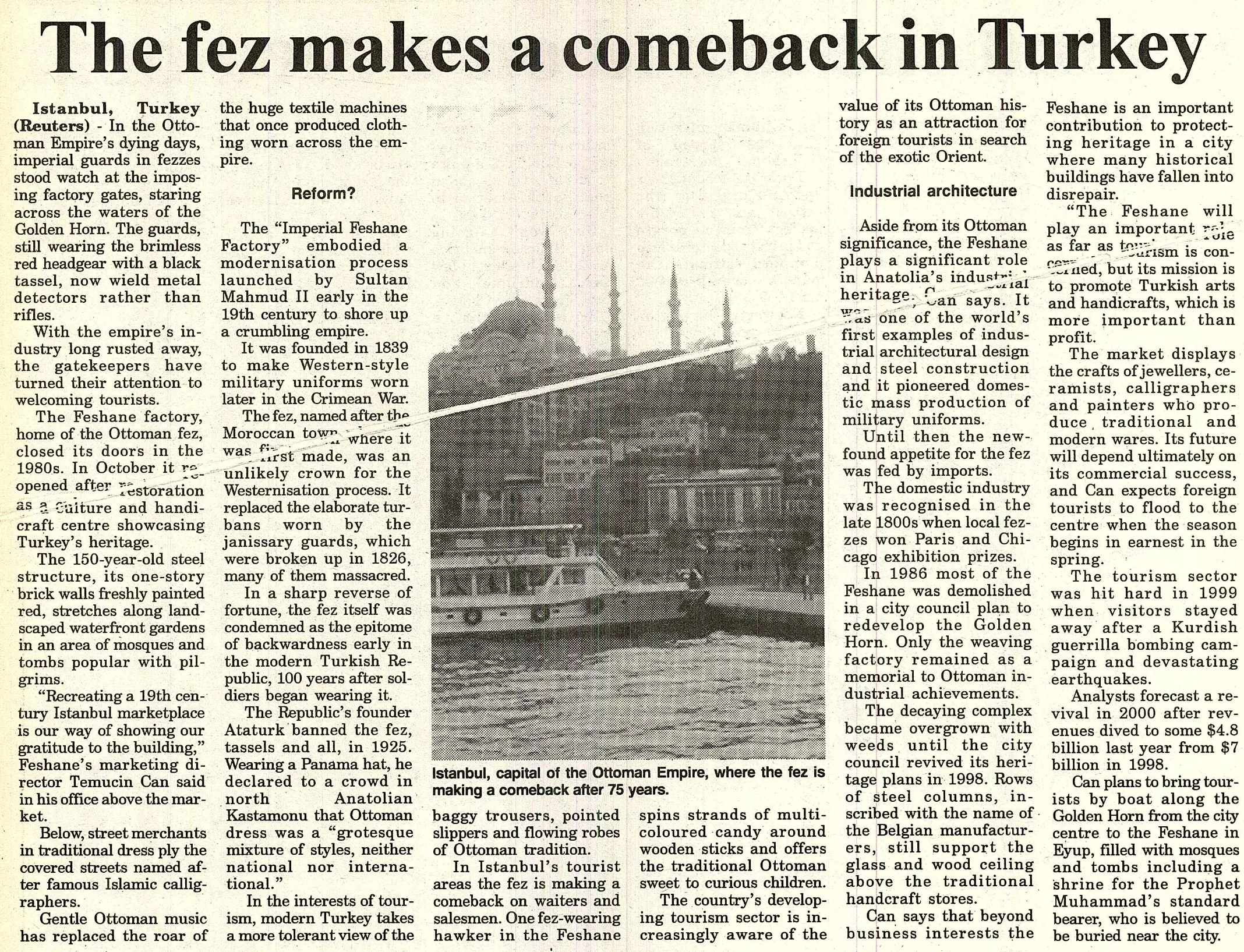
With the empire's industry long rusted away, the gatekeepers have turned their attention to welcoming tourists. The Feshane factory, home of the Ottoman fez, closed its doors in the 1980s. In October it reopened after restoration as a culture and handicraft centre showcasing Turkey's heritage.
The 150-year-old steel structure, its one-story brick walls freshly painted red, stretches along landscaped waterfront gardens in an area of mosques and tombs popular with pilgrims.
"Recreating a 19th century Istanbul marketplace is our way of showing our gratitude to the building," Feshane's marketing director Temucin Can said in his office above the market.
Below, street merchants in traditional dress ply the covered streets named after famous Islamic calligraphers.
Gentle Ottoman music has replaced the roar of the huge textile machines that once produced clothing worn across the empire.
Reform?
The "Imperial Feshane Factory" embodied a modernisation process launched by Sultan Mahmud II early in the 19th century to shore up a crumbling empire.
It was founded in 1839 to make Western-style military uniforms worn later in the Crimean War.
The fez, named after the Moroccan town where it was first made, was an unlikely crown for the Westernisation process. It replaced the elaborate turbans worn by the janissary guards, which were broken up in 1826, many of them massacred.
In a sharp reverse of fortune, the fez itself was condemned as the epitome of backwardness early in the modern Turkish Republic, 100 years after soldiers began wearing it.
The Republic's founder Ataturk banned the fez, tassels and all, in 1925. Wearing a Panama hat, he declared to a crowd in north Anatolian Kastamonu that Ottoman dress was a "grotesque mixture of styles, neither national nor international."
In the interests of tourism, modern Turkey takes a more tolerant view of the baggy trousers, pointed slippers and flowing robes of Ottoman tradition.
In Istanbul's tourist areas the fez is making a comeback on waiters and salesmen. One fez-wearing hawker in the Feshane. spins strands of multicoloured candy around wooden sticks and offers the traditional Ottoman sweet to curious children.
The country's developing tourism sector is increasingly aware of the value of its Ottoman history as an attraction for foreign tourists in search of the exotic Orient.
Industrial architecture
Aside from its Ottoman significance, the Feshane plays a significant role in Anatolia's industrial heritage. Can says. It was one of the world's first examples of industrial architectural design and steel construction and it pioneered domestic mass production of military uniforms.
Until then the newfound appetite for the fez was fed by imports.
The domestic industry was recognised in the late 1800s when local fezzes won Paris and Chicago exhibition prizes. In 1986 most of the Feshane was demolished in a city council plan to redevelop the Golden Horn. Only the weaving factory remained as a memorial to Ottoman industrial achievements.
The decaying complex became overgrown with weeds until the city council revived its heritage plans in 1998. Rows of steel columns, inscribed with the name of the Belgian manufacturers, still support the glass and wood ceiling above the traditional handcraft stores.
Can says that beyond business interests the Feshane is an important contribution to protecting heritage in a city where many historical buildings have fallen into disrepair.
"The Feshane will play an important role as far as tourism is concerned, but its mission is to promote Turkish arts and handicrafts, which is more important than profit.
The market displays the crafts of jewellers, ceramists, calligraphers and painters who produce traditional and modern wares. Its future will depend ultimately on its commercial success, and Can expects foreign tourists to flood to the centre when the season begins in earnest in the spring.
The tourism sector was hit hard in 1999 when visitors stayed away after a Kurdish guerrilla bombing campaign and devastating earthquakes.
Analysts forecast a revival in 2000 after revenues dived to some $4.8 billion last year from $7 billion in 1998.
Can plans to bring tourists by boat along the Golden Horn from the city centre to the Feshane in Eyup, filled with mosques and tombs including a shrine for the Prophet Muhammad's standard bearer, who is believed to be buried near the city.