Minibiographies of three famous mothers
About the article
This is a digitised version of an article from The Cayman Compass's print archive. Occasionally, the digitisation process introduces transcription errors, or other problems.
See the article in its original context from May 2000.
Brought to you by

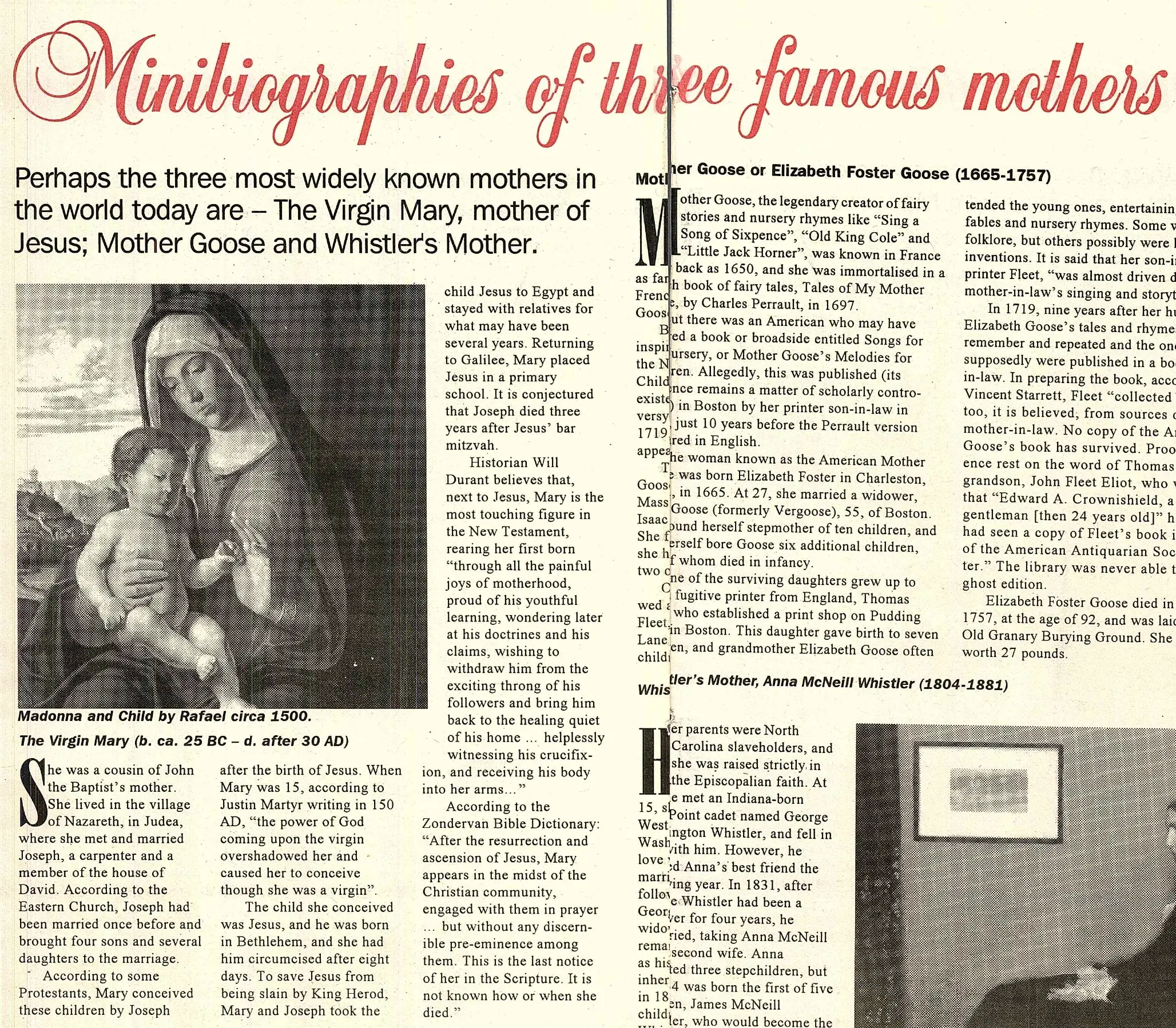
According to some Protestants, Mary conceived these children by Joseph after the birth of Jesus. When Mary was 15, according to Justin Martyr writing in 150 AD, "the power of God coming upon the virgin overshadowed her and caused her to conceive though she was a virgin".
The child she conceived was Jesus, and he was born in Bethlehem, and she had him circumcised after eight days. To save Jesus from being slain by King Herod, Mary and Joseph took the child Jesus to Egypt and stayed with relatives for what may have been several years. Returning to Galilee, Mary placed Jesus in a primary school. It is conjectured that Joseph died three years after Jesus' bar mitzvah.
Historian Will Durant believes that, next to Jesus, Mary is the most touching figure in the New Testament, rearing her first born "through all the painful joys of motherhood, proud of his youthful learning, wondering later at his doctrines and his claims, wishing to withdraw him from the exciting throng of his followers and bring him back to the healing quiet of his home ... helplessly witnessing his crucifixion, and receiving his body into her arms..."
According to the Zondervan Bible Dictionary: "After the resurrection and ascension of Jesus, Mary appears in the midst of the Christian community, engaged with them in prayer ... but without any discernible preeminence among them. This is the last notice of her in the Scripture. It is not known how or when she died."
Mother Goose or Elizabeth Foster Goose (1665-1757)
[M] as far French, Goose, Bu other Goose, the legendary creator of fairy stories and nursery rhymes like "Sing a Song of Sixpence", "Old King Cole" and "Little Jack Horner", was known in France back as 1650, and she was immortalised in a book of fairy tales, Tales of My Mother, by Charles Perrault, in 1697.
ut there was an American who may have Bed a book or broadside entitled Songs for nursery, or Mother Goose's Melodies for the ren. Allegedly, this was published (its existence remains a matter of scholarly controversy) in Boston by her printer son-in-law in just 10 years before the Perrault version appeared in English.
he woman known as the American Mother Goose was born Elizabeth Foster in Charleston, in 1665. At 27, she married a widower, Goose (formerly Vergoose), 55, of Boston. Isaac found herself stepmother of ten children, and She herself bore Goose six additional children, of whom died in infancy.
ne of the surviving daughters grew up to fugitive printer from England, Thomas who established a print shop on Pudding in Boston. This daughter gave birth to seven en, and grandmother Elizabeth Goose often tended the young ones, entertaining them with fables and nursery rhymes. Some were drawn from folklore, but others possibly were her own inventions. It is said that her son-in-law, the printer Fleet, "was almost driven distracted" by his mother-in-law's singing and storytelling.
In 1719, nine years after her husband's death, Elizabeth Goose's tales and rhymes - the ones she remember and repeated and the ones she created - supposedly were published in a book by her son-in-law. In preparing the book, according to Vincent Starrett, Fleet "collected other rhymes, too, it is believed, from sources other than" his mother-in-law. No copy of the American Mother Goose's book has survived. Proof of its existence rest on the word of Thomas Fleet's great-grandson, John Fleet Eliot, who wrote in 1860 that "Edward A. Crownishield, a literary gentleman [then 24 years old]" had told him "he had seen a copy of Fleet's book in the Library of the American Antiquarian Society at Worcester." The library was never able to produce that ghost edition.
Elizabeth Foster Goose died in Boston in 1757, at the age of 92, and was laid to rest in the Old Granary Burying Ground. She left an estate worth 27 pounds. Whistler's Mother, Anna McNeill Whistler (1804-1881) Her parents were North Carolina slaveholders, and she was raised strictly in the Episcopalian faith. At 15, she met an Indiana-born West Point cadet named George Washington Whistler, and fell in love with him. However, he loved Anna's best friend the marrying year. In 1831, after following Whistler had been a Governor for four years, he widowed, taking Anna McNeill remarried second wife. Anna as his listed three stepchildren, but in 1844 was born the first of five children, James McNeill Whistler, who would become the celebrated painter and do the celebrated portrait of his mother.
Incidentally, while it was Whistler's mother who became famous, it was actually Whistler's father who was considered a genius in his time. Consider, George Washington Whistler, an assistant professor of mathematics at West Point, a major and engineer, constructed the first mile of stricker railroad track in the passenger for the Baltimore and Ohio U.S. and invented the locomotive steam whistle (which was named after him), surveyed not near the U.S.-Canada border, part of Russia at the request of went Nicholas I to build the Czar Moscow-St. Petersburg railroad eventual cost of $40 at an 1. million.
When the elder Whistler died in 1849, his widow, Anna, took on James Whistler, then their back to Connecticut to resume his schooling. James resume the family black sheep. became thrown out of West Point He was third year for having both in his excess of demerits and poor an ex, and he later quit his job grade to War Department's Coast with todetic Survey section. In 1855, rebelling against tuition, James left America conveyed abroad, mostly in Paris to London, where he became a painter and L. After the Civil War, Anna hiser, went to live with sympathy, James, in London. her son moved his Irish Hastil mistress, Jo Heffernan, model. out of his flat, to make way for his prim, religious mother.
Although frequently at odds with his strait-laced mother, James Whistler respected her for her goodness and compassion. During her lifetime, she had devoted herself to nursing 20 members of her family and circle of friends before their deaths. James Whistler was also enchanted by his mother's face, in which he saw "grace wedded to dignity, strength enhancing sweetness." One day in 1870, when his mother was 65, James decided to paint her in his London flat. Wearing her lace bonnet and black dress, she sat in an ebony dining room chair, using a footstool because of her age, as he did his classic portrait of her. Completing it in 1871, he called it, "Arrangement in Gray and Black No. 1." The world would come to call it "Whistler's Mother".
Anna Whistler died in Hastings, England. Her artist son arranged for her burial in the local cemetery. On her white gravestl was inscribed: "Blessed are they who have/not seen/And yet have believed."
After the funeral, James Whistler borrowed £50 to get his mother's portrait out of hock. Later, he tried to sell the portrait in New York for $500, but there were no takers. When Degas arranged to have the painting compete in an exhibit of the French Salon, it won the third-class medal, and that proved to be the turning point for Whistler. He wanted the painting to be accepted by a French museum. Through the efforts of the poet Mallarme, and the lobbying of future Premier Clemenceau, the National Museum of the Luxembourg Palace bought the masterpiece for the equivalent of $625. Today it hangs in the Louvre. In 1934, the U.S. Postmaster issued a commemorative Mother's Day stamp bearing the painting of