Woman who built up beauty-salon chain credited as founder of franchising
About the article
This is a digitised version of an article from The Cayman Compass's print archive. Occasionally, the digitisation process introduces transcription errors, or other problems.
See the article in its original context from May 2000.
Brought to you by

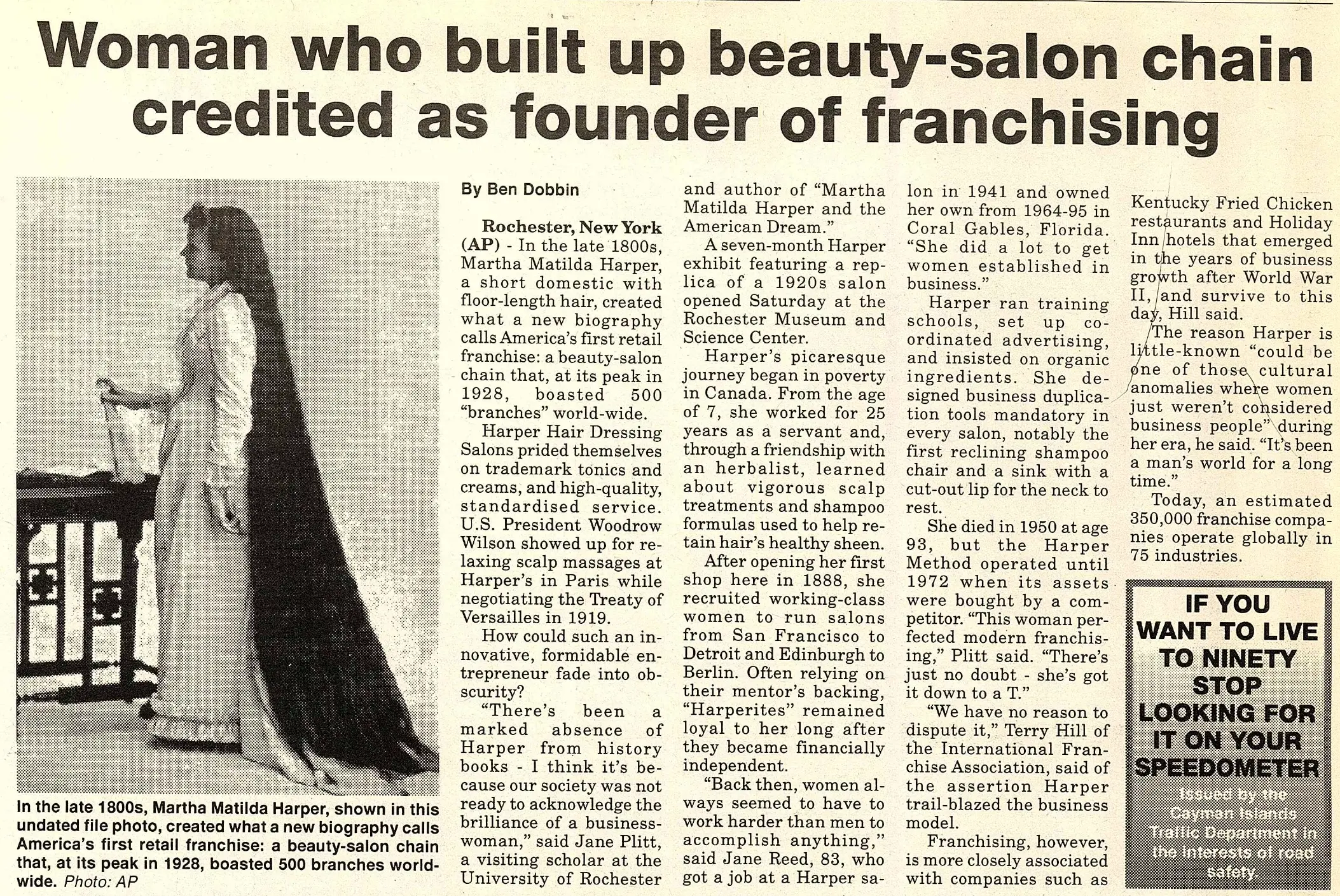
Harper Hair Dressing Salons prided themselves on trademark tonics and creams, and high-quality, standardised service. U.S. President Woodrow Wilson showed up for relaxing scalp massages at Harper's in Paris while negotiating the Treaty of Versailles in 1919.
How could such an innovative, formidable entrepreneur fade into obscurity?
"There's been a marked absence of Harper from history books - I think it's because our society was not ready to acknowledge the brilliance of a businesswoman," said Jane Plitt, a visiting scholar at the University of Rochester and author of "Martha Matilda Harper and the American Dream."
A seven-month Harper exhibit featuring a replica of a 1920s salon opened Saturday at the Rochester Museum and Science Center.
Harper's picaresque journey began in poverty in Canada. From the age of 7, she worked for 25 years as a servant and, through a friendship with an herbalist, learned about vigorous scalp treatments and shampoo formulas used to help retain hair's healthy sheen. After opening her first shop here in 1888, she recruited working-class women to run salons from San Francisco to Detroit and Edinburgh to Berlin. Often relying on their mentor's backing, "Harperites" remained loyal to her long after they became financially independent.
"Back then, women always seemed to have to work harder than men to accomplish anything," said Jane Reed, 83, who got a job at a Harper salon in 1941 and owned her own from 1964-95 in Coral Gables, Florida. "She did a lot to get women established in business."
Harper ran training schools, set up coordinated advertising, and insisted on organic ingredients. She designed business duplication tools mandatory in every salon, notably the first reclining shampoo chair and a sink with a cut-out lip for the neck to rest. She died in 1950 at age 93, but the Harper Method operated until 1972 when its assets were bought by a competitor. "This woman perfected modern franchising," Plitt said. "There's just no doubt - she's got it down to a T."
"We have no reason to dispute it," Terry Hill of the International Franchise Association, said of the assertion Harper trailblazed the business model.
Franchising, however, is more closely associated with companies such as Kentucky Fried Chicken restaurants and Holiday Inn hotels that emerged in the years of business growth after World War II, and survive to this day, Hill said.
The reason Harper is little-known "could be one of those cultural anomalies where women just weren't considered business people" during her era, he said. "It's been a man's world for a long time." Today, an estimated 350,000 franchise companies operate globally in 75 industries.