Kangaroo meat set to be an Olympic winner
About the article
This is a digitised version of an article from The Cayman Compass's print archive. Occasionally, the digitisation process introduces transcription errors, or other problems.
See the article in its original context from June 2000.
Brought to you by

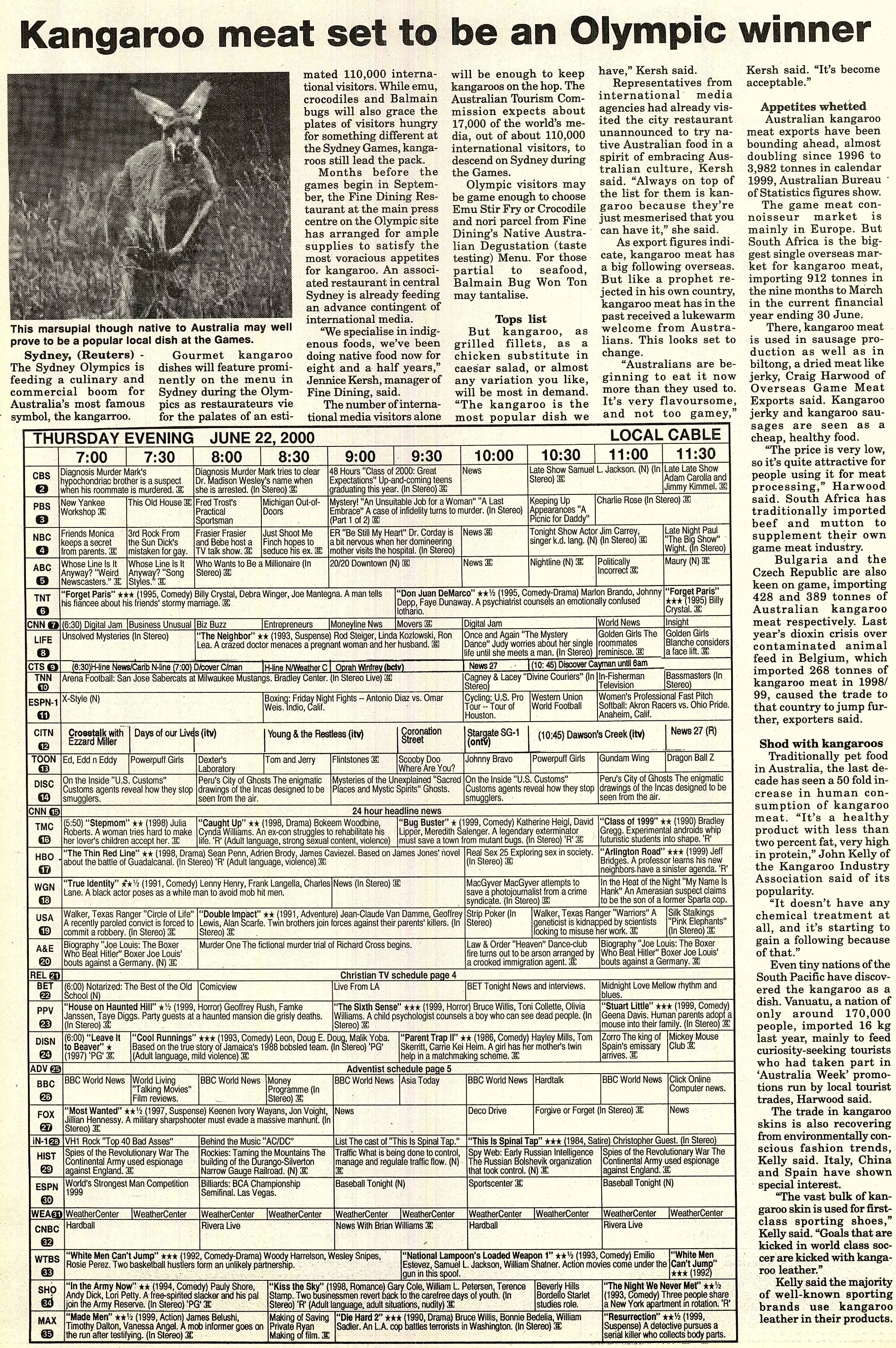
The Sydney Olympics is feeding a culinary and commercial boom for Australia's most famous symbol, the kangaroo. Gourmet kangaroo dishes will feature prominently on the menu in Sydney during the Olympics as restaurateurs vie for the palates of an estimated 110,000 international visitors. While emu, crocodiles and Balmain bugs will also grace the plates of visitors hungry for something different at the Sydney Games, kangaroos still lead the pack.
Months before the games begin in September, the Fine Dining Restaurant at the main press centre on the Olympic site has arranged for ample supplies to satisfy the most voracious appetites for kangaroo. An associated restaurant in central Sydney is already feeding an advance contingent of international media.
"We specialise in indigenous foods, we've been doing native food now for eight and a half years," Jennice Kersh, manager of Fine Dining, said.
The number of international media visitors alone will be enough to keep kangaroos on the hop. The Australian Tourism Commission expects about 17,000 of the world's media, out of about 110,000 international visitors, to descend on Sydney during the Games.
Olympic visitors may be game enough to choose Emu Stir Fry or Crocodile and nori parcel from Fine Dining's Native Australian Degustation (tastetesting) Menu. For those partial to seafood, Balmain Bug Won Ton may tantalise. Tops list
But kangaroo, as grilled fillets, as a chicken substitute in caesar salad, or almost any variation you like, will be most in demand.
"The kangaroo is the most popular dish we "have," Kersh said. Representatives from international media agencies had already visited the city restaurant unannounced to try native Australian food in a spirit of embracing Australian culture, Kersh said. "Always on top of the list for them is kangaroo because they're just mesmerised that you can have it," she said.
As export figures indicate, kangaroo meat has a big following overseas. But like a prophet rejected in his own country, kangaroo meat has in the past received a lukewarm welcome from Australians. This looks set to change.
"Australians are beginning to eat it now more than they used to. It's very flavoursome, and not too gamey," Kersh said. “It’s become acceptable.” Appetites whetted Australian kangaroo meat exports have been bounding ahead, almost doubling since 1996 to 3,982 tonnes in calendar 1999, Australian Bureau of Statistics figures show.
The game meat connoisseur market is mainly in Europe. But South Africa is the biggest single overseas market for kangaroo meat, importing 912 tonnes in the nine months to March in the current financial year ending 30 June.
There, kangaroo meat is used in sausage production as well as in biltong, a dried meat like jerky, Craig Harwood of Overseas Game Meat Exports said. Kangaroo jerky and kangaroo sausages are seen as a cheap, healthy food.
"The price is very low, so it's quite attractive for people using it for meat processing," Harwood said. South Africa has traditionally imported beef and mutton to supplement their own game meat industry.
Bulgaria and the Czech Republic are also keen on game, importing 428 and 389 tonnes of Australian kangaroo meat respectively. Last year's dioxin crisis over contaminated animal feed in Belgium, which imported 268 tonnes of kangaroo meat in 1998/99, caused the trade to that country to jump further, exporters said. Shod with kangaroos Traditionally pet food in Australia, the last decade has seen a 50 fold increase in human consumption of kangaroo meat. "It's a healthy product with less than two percent fat, very high in protein," John Kelly of the Kangaroo Industry Association said of its popularity.
"It doesn't have any chemical treatment at all, and it's starting to gain a following because of that."
Even tiny nations of the South Pacific have discovered the kangaroo as a dish. Vanuatu, a nation of only around 170,000 people, imported 16 kg last year, mainly to feed curiosity-seeking tourists who had taken part in 'Australia Week' promotions run by local tourist trades, Harwood said.
The trade in kangaroo skins is also recovering from environmentally conscious fashion trends, Kelly said. Italy, China and Spain have shown special interest.
"The vast bulk of kangaroo skin is used for first-class sporting shoes," Kelly said. "Goals that are kicked in world class soccer are kicked with kangaroo leather."
Kelly said the majority of well-known sporting brands use kangaroo leather in their products.