Feathery fossil shows birds aren't dinosaurs
About the article
This is a digitised version of an article from The Cayman Compass's print archive. Occasionally, the digitisation process introduces transcription errors, or other problems.
See the article in its original context from June 2000.
Brought to you by

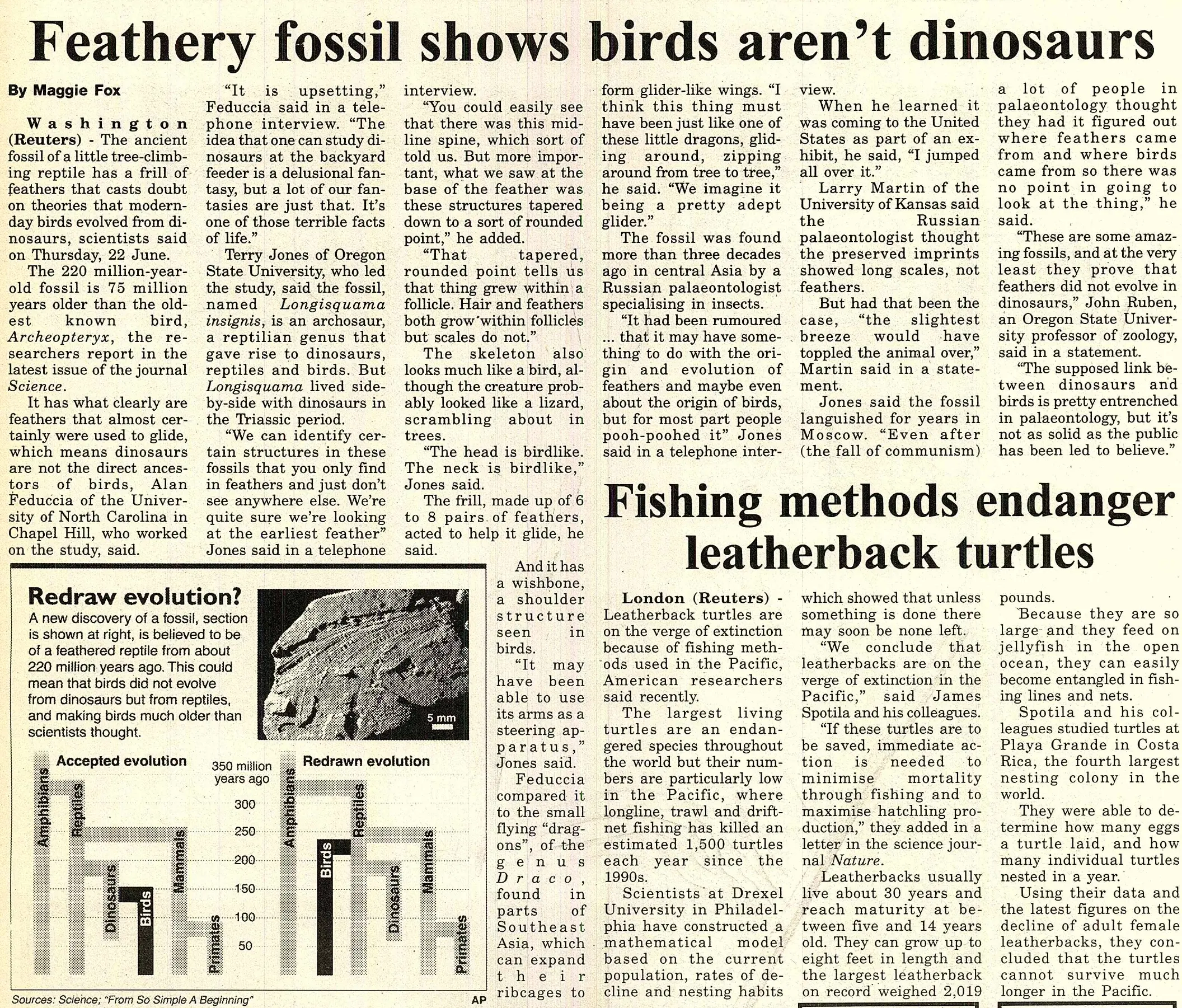
The 220 million-year-old fossil is 75 million years older than the oldest known bird, Archeopteryx, the researchers report in the latest issue of the journal Science.
It has what clearly are feathers that almost certainly were used to glide, which means dinosaurs are not the direct ancestors of birds, Alan Feduccia of the University of North Carolina in Chapel Hill, who worked on the study, said. "It is upsetting," Feduccia said in a telephone interview. "The idea that one can study dinosaurs at the backyard feeder is a delusional fantasy, but a lot of our fantasies are just that. It's one of those terrible facts of life."
Terry Jones of Oregon State University, who led the study, said the fossil, named Longisquama insignis, is an archosaur, a reptilian genus that gave rise to dinosaurs, reptiles and birds. But Longisquama lived side-by-side with dinosaurs in the Triassic period.
"We can identify certain structures in these fossils that you only find in feathers and just don't see anywhere else. We're quite sure we're looking at the earliest feather" Jones said in a telephone interview. "You could easily see that there was this midline spine, which sort of told us. But more important, what we saw at the base of the feather was these structures tapered down to a sort of rounded point," he added.
"That tapered, rounded point tells us that thing grew within a follicle. Hair and feathers both grow within follicles but scales do not."
The skeleton also looks much like a bird, although the creature probably looked like a lizard, scrambling about in trees.
"The head is birdlike. The neck is birdlike," Jones said.
The frill, made up of 6 to 8 pairs of feathers, acted to help it glide, he said. And it has a wishbone, a shoulder structure seen in birds. "It may have been able to use its arms as a steering apparatus," Jones said.
Feduccia compared it to the small flying "dragons", of the genus Draco, found in parts of Southeast Asia, which can expand their ribcages to form glider-like wings. "I think this thing must have been just like one of these little dragons, gliding around, zipping around from tree to tree," he said. "We imagine it being a pretty adept glider."
The fossil was found more than three decades ago in central Asia by a Russian palaeontologist specialising in insects.
"It had been rumoured... that it may have something to do with the origin and evolution of feathers and maybe even about the origin of birds, but for most part people pooh-poohed it" Jones said in a telephone interview. When he learned it was coming to the United States as part of an exhibit, he said, "I jumped all over it."
Larry Martin of the University of Kansas said the Russian palaeontologist thought the preserved imprints showed long scales, not feathers.
But had that been the case, "the slightest breeze would have toppled the animal over," Martin said in a statement.
Jones said the fossil languished for years in Moscow. "Even after (the fall of communism) a lot of people in palaeontology thought they had it figured out where feathers came from and where birds came from so there was no point in going to look at the thing," he said.
"These are some amazing fossils, and at the very least they prove that feathers did not evolve in dinosaurs," John Ruben, an Oregon State University professor of zoology, said in a statement.
"The supposed link between dinosaurs and birds is pretty entrenched in palaeontology, but it's not as solid as the public has been led to believe."