Actor Sir Alec Guinness dies at 86
About the article
This is a digitised version of an article from The Cayman Compass's print archive. Occasionally, the digitisation process introduces transcription errors, or other problems.
See the article in its original context from August 2000.
Brought to you by

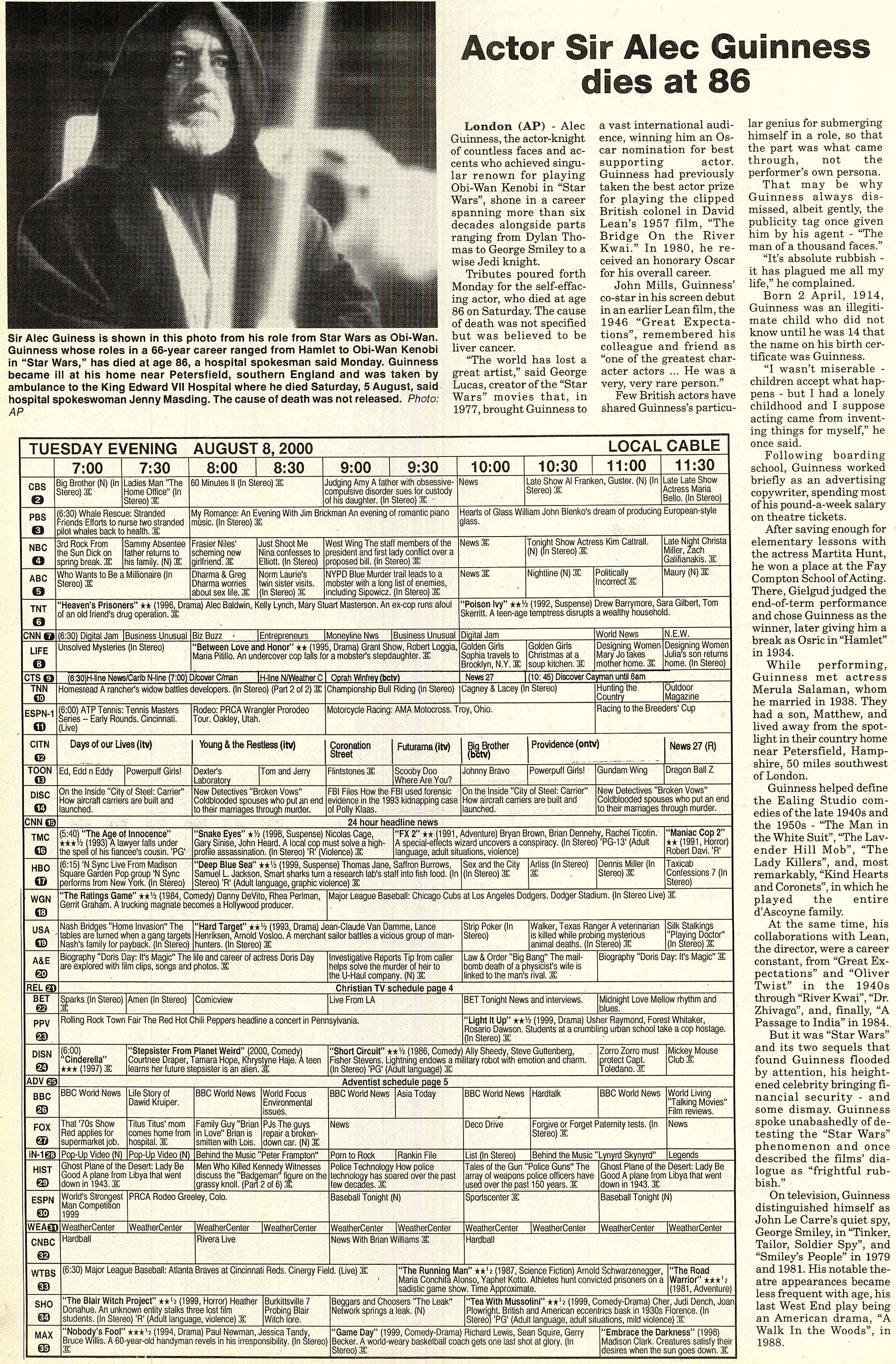
Tributes poured forth Monday for the self-effacing actor, who died at age 86 on Saturday. The cause of death was not specified but was believed to be liver cancer.
"The world has lost a great artist," said George Lucas, creator of the "Star Wars" movies that, in 1977, brought Guinness to a vast international audience, winning him an Oscar nomination for best supporting actor.
Guinness had previously taken the best actor prize for playing the clipped British colonel in David Lean's 1957 film, "The Bridge On the River Kwai." In 1980, he received an honorary Oscar for his overall career.
John Mills, Guinness' co-star in his screen debut in an earlier Lean film, the 1946 "Great Expectations", remembered his colleague and friend as "one of the greatest character actors ... He was a very, very rare person."
Few British actors have shared Guinness's particular genius for submerging himself in a role, so that the part was what came through, not the performer's own persona. That may be why Guinness always dismissed, albeit gently, the publicity tag once given him by his agent - "The man of a thousand faces." "It's absolute rubbish - it has plagued me all my life," he complained.
Born 2 April, 1914, Guinness was an illegitimate child who did not know until he was 14 that the name on his birth certificate was Guinness. "I wasn't miserable - children accept what happens - but I had a lonely childhood and I suppose acting came from inventing things for myself," he once said.
Following boarding school, Guinness worked briefly as an advertising copywriter, spending most of his pound-a-week salary on theatre tickets.
After saving enough for elementary lessons with the actress Martita Hunt, he won a place at the Fay Compton School of Acting. There, Gielgud judged the end-of-term performance and chose Guinness as the winner, later giving him a break as Osric in "Hamlet" in 1934.
While performing, Guinness met actress Merula Salaman, whom he married in 1938. They had a son, Matthew, and lived away from the spotlight in their country home near Petersfield, Hampshire, 50 miles southwest of London.
Guinness helped define the Ealing Studio comedies of the late 1940s and the 1950s - "The Man in the White Suit", "The Lavender Hill Mob", "The Lady Killers", and, most remarkably, "Kind Hearts and Coronets", in which he played the entire d'Ascoyne family.
At the same time, his collaborations with Lean, the director, were a career constant, from "Great Expectations" and "Oliver Twist" in the 1940s through "River Kwai", "Dr. Zhivago", and, finally, "A Passage to India" in 1984.. But it was "Star Wars" and its two sequels that found Guinness flooded by attention, his heightened celebrity bringing financial security and some dismay. Guinness spoke unabashedly of detesting the "Star Wars" phenomenon and once described the films' dialogue as "frightful rubbish."
On television, Guinness distinguished himself as John Le Carre's quiet spy, George Smiley, in "Tinker, Tailor, Soldier Spy", and "Smiley's People" in 1979 and 1981. His notable theatre appearances became less frequent with age, his last West End play being an American drama, "A Walk In the Woods", in 1988.