What is DOS?
About the article
This is a digitised version of an article from The Cayman Compass's print archive. Occasionally, the digitisation process introduces transcription errors, or other problems.
See the article in its original context from August 2000.
Brought to you by

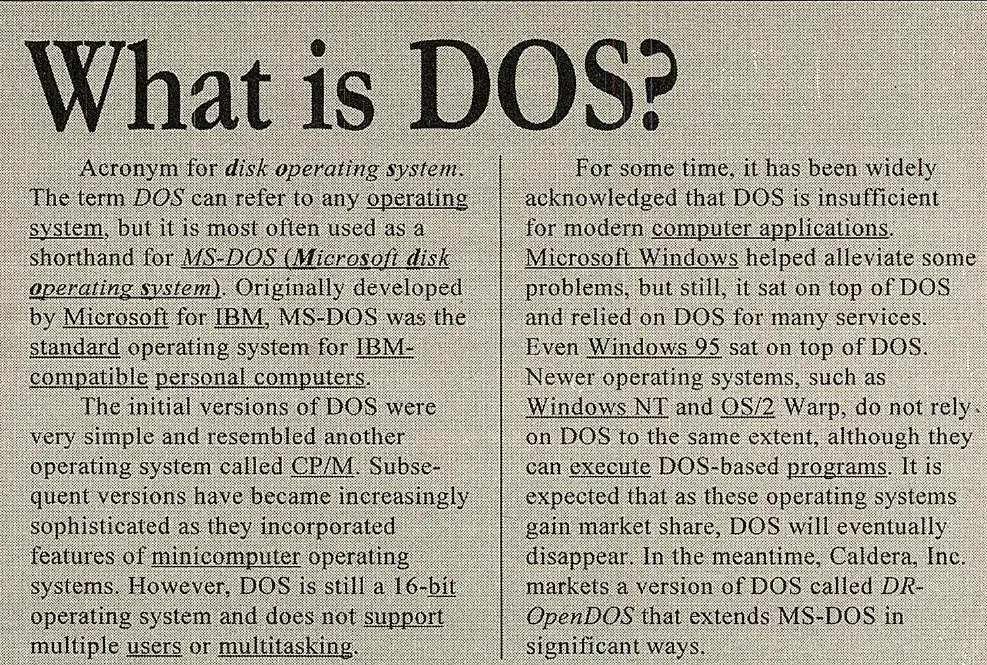
The initial versions of DOS were very simple and resembled another operating system called CP/M. Subsequent versions have became increasingly sophisticated as they incorporated features of minicomputer operating systems. However, DOS is still a 16-bit operating system and does not support multiple users or multitasking. For some time, it has been widely acknowledged that DOS is insufficient for modern computer applications.
Microsoft Windows helped alleviate some problems, but still, it sat on top of DOS and relied on DOS for many services. Even Windows 95 sat on top of DOS. Newer operating systems, such as Windows NT and OS/2 Warp, do not rely on DOS to the same extent, although they can execute DOS-based programs. It is expected that as these operating systems gain market share, DOS will eventually disappear. In the meantime, Caldera, Inc. markets a version of DOS called DR-OpenDOS that extends MS-DOS in significant ways.