Author goes from autoworker to award winner
About the article
This is a digitised version of an article from The Cayman Compass's print archive. Occasionally, the digitisation process introduces transcription errors, or other problems.
See the article in its original context from November 2000.
Brought to you by

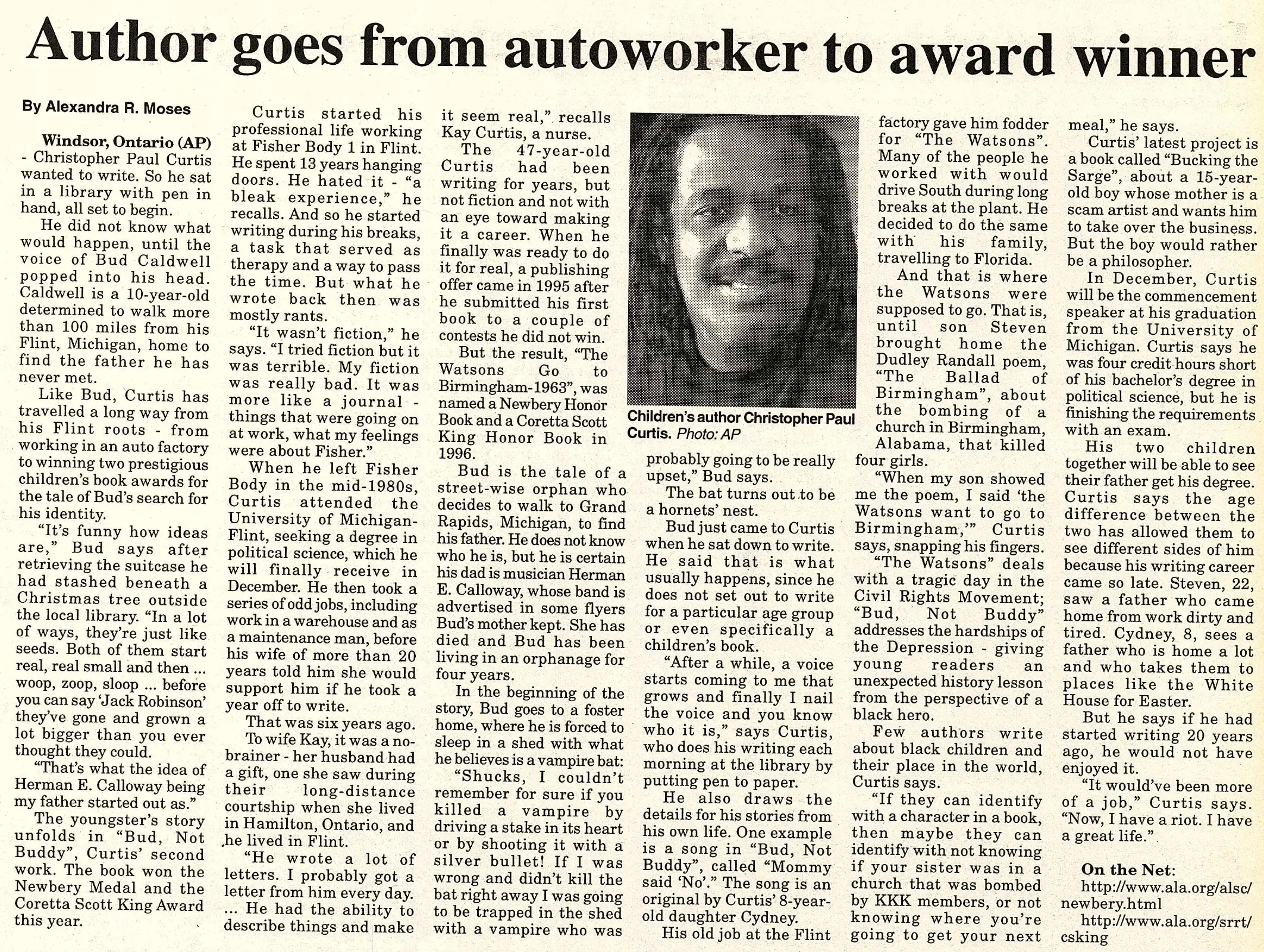
Like Bud, Curtis has travelled a long way from his Flint roots from working in an auto factory to winning two prestigious children's book awards for the tale of Bud's search for his identity.
"It's funny how ideas are," Bud says after retrieving the suitcase he had stashed beneath a Christmas tree outside the local library. "In a lot of ways, they're just like seeds. Both of them start real, real small and then woop, zoop, sloop ... before you can say 'Jack Robinson' they've gone and grown a lot bigger than you ever thought they could.
"That's what the idea of Herman E. Calloway being my father started out as." The youngster's story unfolds in "Bud, Not Buddy", Curtis' second work. The book won the Newbery Medal and the Coretta Scott King Award this year. Curtis started his professionallife working at Fisher Body 1 in Flint. He spent 13 years hanging doors. He hated it - "a bleak experience," he recalls. And so he started writing during his breaks, a task that served as therapy and a way to pass the time. But what he wrote back then was mostly rants.
"It wasn't fiction," he says. "I tried fiction but it was terrible. My fiction was really bad. It was more like a journal - things that were going on at work, what my feelings were about Fisher." When he left Fisher Body in the mid-1980s, Curtis attended the University of Michigan-Flint, seeking a degree in political science, which he will finally receive in December. He then took a series of odd jobs, including work in a warehouse and as a maintenanceman, before his wife of more than 20 years told him she would support him if he took a year off to write.
That was six years ago. To wife Kay, it was a no-brainer - her husband had a gift, one she saw during their long-distance courtship when she lived in Hamilton, Ontario, and he lived in Flint.
"He wrote a lot of letters. I probably got a letter from him every day. ... He had the ability to describe things and make "it seem real," recalls Kay Curtis, a nurse.
The 47-year-old Curtis had been writing for years, but not fiction and not with an eye toward making it a career. When he finally was ready to do it for real, a publishing offer came in 1995 after he submitted his first book to a couple of contests he did not win.
But the result, "The Watsons Go to Birmingham-1963", was named a Newbery Honor Book and a Coretta Scott King Honor Book in 1996. Bud is the tale of a street-wise orphan who decides to walk to Grand Rapids, Michigan, to find his father. He does not know who he is, but he is certain his dad is musician Herman E. Calloway, whose band is advertised in some flyers Bud's mother kept. She has died and Bud has been living in an orphanage for four years.
In the beginning of the story, Bud goes to a foster home, where he is forced to sleep in a shed with what he believes is a vampire bat: "Shucks, I couldn't remember for sure if you killed a vampire by driving a stake in its heart or by shooting it with a silver bullet! If I was wrong and didn't kill the bat right away I was going to be trapped in the shed with a vampire who was probably going to be really upset," Bud says. The bat turns out to be a hornets' nest.
Bud just came to Curtis when he sat down to write. He said that is what usually happens, since he does not set out to write for a particular age group or even specifically a children's book.
"After a while, a voice starts coming to me that grows and finally I nail the voice and you know who it is," says Curtis, who does his writing each morning at the library by putting pen to paper. He also draws the details for his stories from his own life. One example is a song in "Bud, Not Buddy", called "Mommy said 'No'." The song is an original by Curtis' 8-year-old daughter Cydney. His old job at the Flint factory gave him fodder for "The Watsons". Many of the people he worked with would drive South during long breaks at the plant. He decided to do the same with his family, travelling to Florida. And that is where the Watsons were supposed to go. That is, until son Steven brought home the Dudley Randall poem, "The Ballad of Birmingham", about the bombing of a church in Birmingham, Alabama, that killed four girls.
"When my son showed me the poem, I said 'the Watsons want to go to Birmingham," Curtis says, snapping his fingers. "The Watsons" deals with a tragic day in the Civil Rights Movement; "Bud, Not Buddy" addresses the hardships of the Depression - giving young readers an unexpected history lesson from the perspective of a black hero.
Few authors write about black children and their place in the world, Curtis says.
"If they can identify with a character in a book, then maybe they can identify with not knowing if your sister was in a church that was bombed by KKK members, or not knowing where you're going to get your next "meal," he says. Curtis' latest project is a book called "Bucking the Sarge", about a 15-year-old boy whose mother is a scam artist and wants him to take over the business. But the boy would rather be a philosopher.
In December, Curtis will be the commencement speaker at his graduation from the University of Michigan. Curtis says he was four credit hours short of his bachelor's degree in political science, but he is finishing the requirements with an exam.
His two children together will be able to see their father get his degree. Curtis says the age difference between the two has allowed them to see different sides of him because his writing career came so late. Steven, 22, saw a father who came home from work dirty and tired. Cydney, 8, sees a father who is home a lot and who takes them to places like the White House for Easter.
But he says if he had started writing 20 years ago, he would not have enjoyed it. "It would've been more of a job," Curtis says. "Now, I have a riot. I have a great life." On the Net: http://www.ala.org/alsc/newbery.html
http://www.ala.org/srrt/csking