The artists of Cuba
About the article
This is a digitised version of an article from The Cayman Compass's print archive. Occasionally, the digitisation process introduces transcription errors, or other problems.
See the article in its original context from December 2000.
Brought to you by

Beers in hand, the friends shared their experiences about an art show in Istanbul, an exhibition in Colombia, plans to travel to New York City.
In years past, almost none of these artists had been to the United States, and few had journeyed to Mexico or Europe, says Holly Block, who runs Art in General, a non-profit arts organisation in New York.
"Now, they are internationaltravellers," she says. "They have been in many expositions around the world, including the United States."
Block, who seeks out new talent and periodically rents a house in Havana, was entertaining her artist friends on her terrace.
"Anything Cuban is of interest these days; it is a fascinating part of the world, where contrasts reign," says Manuel Gonzalez, director of Chase Bank's art programme in New York. Gonzalez collects Cuban art.
With their provocative works and surrounded by the "Cuban aura" born of the island's agitated political history, these young artists are among the hottest on the market today. And they are riding especially high with the current Havana Biennial, which runs through 5 January.
The show comes amid a great international interest in the Cuban arts, starting with the collapse of the Soviet Union a decade ago to the more recent success of Ry Cooder's documentary, "The Buena Vista Social Club", about a band of elderly Cuban musicians.
"We are the beneficiaries of this trend, this fashion that exists now with Cuba," says Nelson Herrera, director of the "Wilfredo Lam" Centre of Contemporary Art in Havana, who organised the biennial.
Much of the interest in Cuba's visual arts surged with the 1994 biennial that came during a severe economic crisis brought CONT'D ON FACING PAGE on by the collapse of the Eastern bloc, and on the heels of massive migration of Cubans to the United States earlier that year.
Among those who attended in 1994 was Block, who visited Cuba for the first time, along with a group of American curators and gallery representatives. Impressed by the quality of the work they found, Block and several other Americans organised a programme in 1997 to regularly bring Cuban artists to the United States to work seven weeks at universities and cultural centres in five different cities.
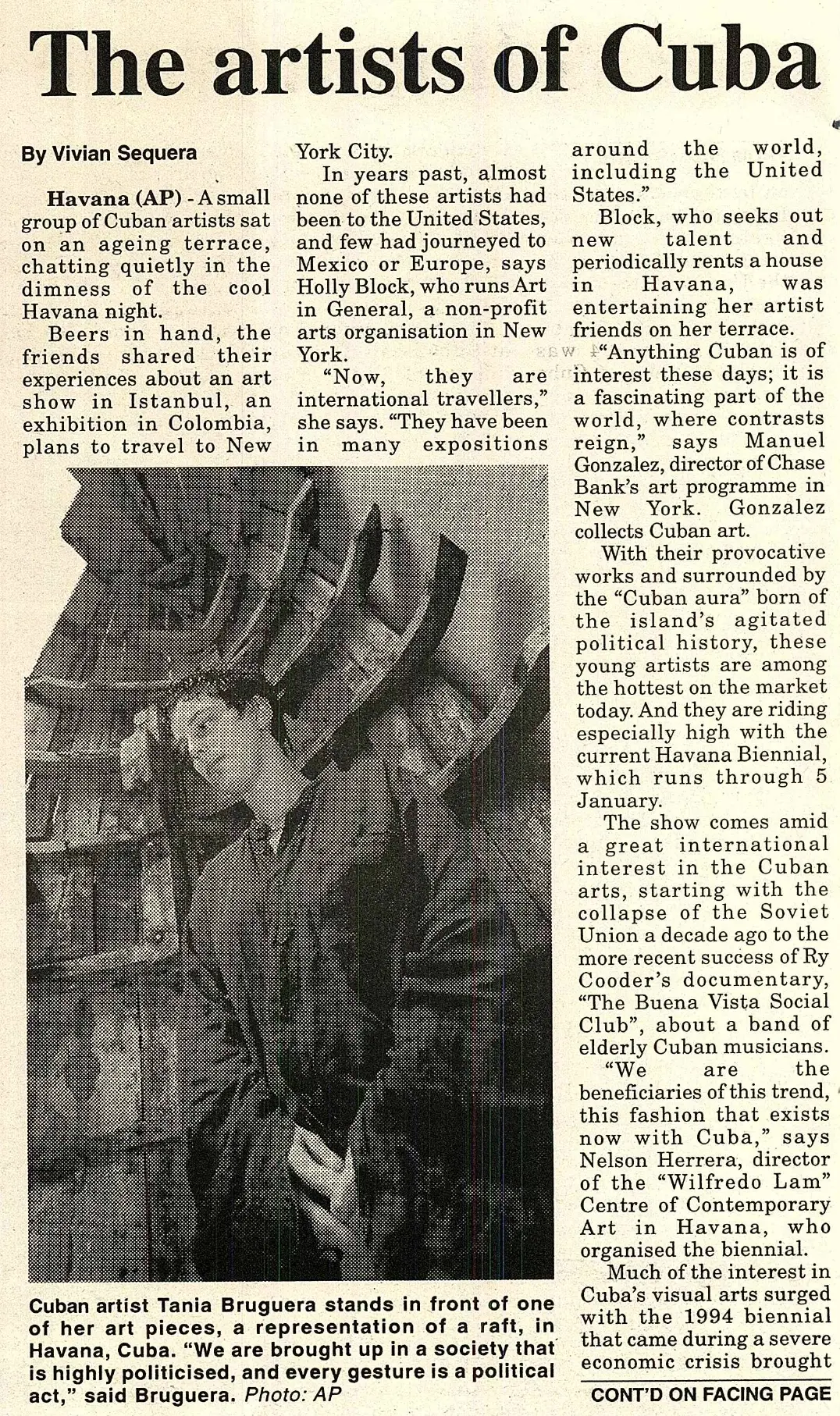
At the time, Cuba was suffering through some of the worst years of the so-called "Special Period" the economic crisis caused by the loss of Cuba's former socialist allies. During that biennial, some artists used scraps of wood from small boats and other simple rafts to create works focusing on the rafters an exodus of more than 30,000 people across the Florida Straits, with hundreds of people leaving daily.
"We are brought up in a society that is highly politicised and every gesture is a political act," says Tania Bruguera, who was in the first group of Cuban artists to travel to the United States with Block's programme. Bruguera's drawing and sculpture installation was sponsored by The School of the Art Institute of Chicago.
Bruguera studied art at Cuba's San Alejandro School of Visual Arts (1980-1983) and the Higher Institute of Art (1992). She has taught at the Higher Institute of Art in Cuba since 1992.
Begun in 1983, the biennial was created to promote Third World and Cuban art. After that first Havana biennial, similar celebrations were organised by other cities, including Johannesburg, South Africa; Istanbul, Turkey; and Lima, Peru. The Havana biennial was initially aimed at presenting the work just of Latin American and Caribbean artists. It later expanded to include works from Asia, Africa and the Middle East.
This year's show includes more than 170 artists whose works will be shown at 20 sites throughout Havana. The biennial gives local artists incredible promotion, Bruguera says, because there is not a huge market here for their work average Cubans do not have the cash necessary to buy art. But foreigners who visit Havana curators, gallery owners and tourists - buy the art.
Photographer Miguel Pina, who is known for his images of the famous Malecon seawall and a series of buildings throughout the city, agrees. Among his best-known work is a black and white photograph showing the back of a boy jumping from the Malecon's wall into Havana Bay. Like so much of Cuban art, it is an allusion to Cuban migration.
Pina was a mechanical engineer who studied in Vladimir, Russia, in 1983. He enjoyed photography, and, in 1997, he did a printmaking residency at Vinalhaven Press in Maine. Pina won an Andrew Fellowship from University of British Columbia, Vancouver, in 1996.
For now, he and the other young artists have privileges that few on the island enjoy: They can travel abroad; they can sell their art in American dollars. But they say they know that future fame is not a given.
This popularity "is an ephemeral thing," Pina acknowledges. At the beginning of the 1990s, "there wasn't an art magazine without expositions by three or four Russian artists.... Now you can count on your fingers the number that are still getting attention.
"The same is going to happen here, I am sure," Pina says. "Two or three people with talent, and a bit of luck, will succeed in establishing themselves."