Cruise ships may be target for attacks
About the article
This is a digitised version of an article from The Cayman Compass's print archive. Occasionally, the digitisation process introduces transcription errors, or other problems.
See the article in its original context from December 2001.
Brought to you by

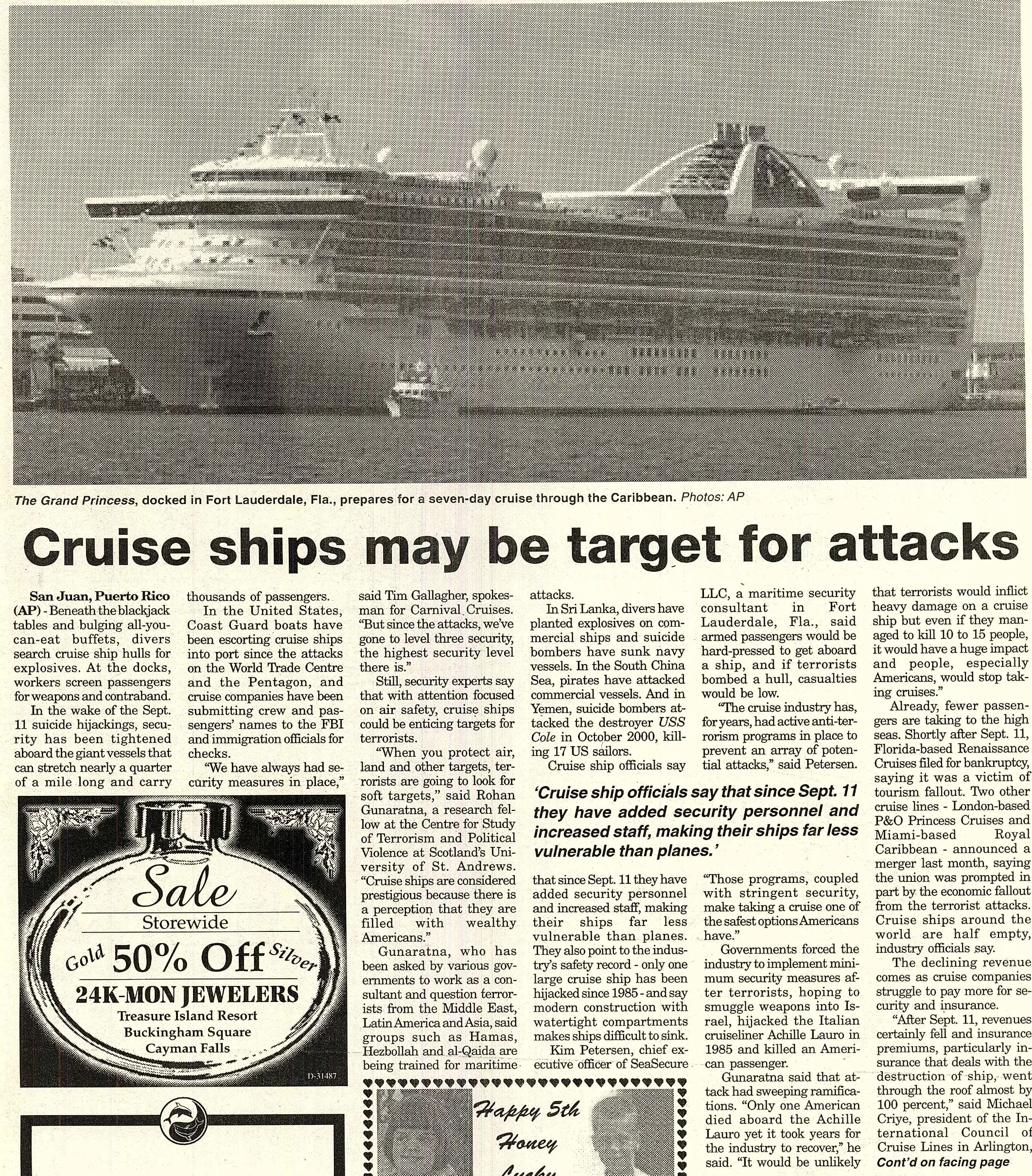
In the wake of the Sept. 11 suicide hijackings, security has been tightened aboard the giant vessels that can stretch nearly a quarter of a mile long and carry thousands of passengers. In the United States, Coast Guard boats have been escorting cruise ships into port since the attacks on the World Trade Centre and the Pentagon, and cruise companies have been submitting crew and passengers' names to the FBI and immigration officials for checks.
"We have always had security measures in place," said Tim Gallagher, spokesman for Carnival Cruises. "But since the attacks, we've gone to level three security, the highest security level there is."
Still, security experts say that with attention focused on air safety, cruise ships could be enticing targets for terrorists.
"When you protect air, land and other targets, terrorists are going to look for soft targets," said Rohan Gunaratna, a research fellow at the Centre for Study of Terrorism and Political Violence at Scotland's University of St. Andrews. "Cruise ships are considered prestigious because there is a perception that they are filled with wealthy Americans."
Gunaratna, who has been asked by various governments to work as a consultant and question terrorists from the Middle East, Latin America and Asia, said groups such as Hamas, Hezbollah and al-Qaida are being trained for maritime. attacks.
In Sri Lanka, divers have planted explosives on commercial ships and suicide bombers have sunk navy vessels. In the South China Sea, pirates have attacked commercial vessels. And in Yemen, suicide bombers attacked the destroyer USS Cole in October 2000, killing 17 US sailors.
Cruise ship officials say LLC, a maritime security consultant in Fort Lauderdale, Fla., said armed passengers would be hard-pressed to get aboard a ship, and if terrorists bombed a hull, casualties would be low.
"The cruise industry has, for years, had active anti-terrorism programs in place to prevent an array of potential attacks," said Petersen. 'Cruise ship officials say that since Sept. 11 they have added security personnel and increased staff, making their ships far less vulnerable than planes.' that since Sept. 11 they have added security personnel and increased staff, making their ships far less vulnerable than planes.
They also point to the industry's safety record - only one large cruise ship has been hijacked since 1985 - and say modern construction with watertight compartments makes ships difficult to sink.
Kim Petersen, chief executive officer of SeaSecure "Those programs, coupled with stringent security, make taking a cruise one of the safest options Americans have."
Governments forced the industry to implement minimum security measures after terrorists, hoping to smuggle weapons into Israel, hijacked the Italian cruiseliner Achille Lauro in 1985 and killed an American passenger.
Gunaratna said that attack had sweeping ramifications. "Only one American died aboard the Achille Lauro yet it took years for the industry to recover," he said. "It would be unlikely that terrorists would inflict heavy damage on a cruise ship but even if they managed to kill 10 to 15 people, it would have a huge impact and people, especially Americans, would stop taking cruises."
Already, fewer passengers are taking to the high seas. Shortly after Sept. 11, Florida-based Renaissance Cruises filed for bankruptcy, saying it was a victim of tourism fallout. Two other cruise lines - London-based P&O Princess Cruises and Miami-based Royal Caribbean - announced a merger last month, saying the union was prompted in part by the economic fallout from the terrorist attacks. Cruise ships around the world are half empty, industry officials say.
The declining revenue comes as cruise companies struggle to pay more for security and insurance.
"After Sept. 11, revenues certainly fell and insurance premiums, particularly insurance that deals with the destruction of ship, went through the roof almost by 100 percent," said Michael Criye, president of the International Council of Cruise Lines in Arlington, Cont'd on facing page Cont'd from opposite page Va. He said the premiums might drop again once the initial shock of the attacks is over. "There is ... an impression that cruise ships are more vulnerable, and in some ways they are," said Kenneth Gale Hawkes, a Miami attorney specializing in maritime issues and negligent security.
He believes the ships do not have enough security personnel: "What's important is if you have 1,000 passengers and eight to 10 security people, that's not enough."
While the chances of a terrorist attack against a ship are slim, he said, it was nearly impossible to sweep an entire ship and check all passengers adequately. The only way to claim heavy casualties would be through chemical or biological means, Hawkes said.
Gunaratna offered other scenarios, including terrorists using boats rigged with explosives to ram a ship or dive teams to place bombs under the hulls. An aircraft crashing into a packed passenger deck could cause significant damage and casualties, he said.
"A determined terrorist will always find a way," said Gunaratna.
Petersen, a former captain in the US Army's Special Forces and one-time chief of security operations for former President Bush, said many ships use foreign security watchmen.
He recommended hiring former Nepalese Gurkhas, which Royal Caribbean now uses. "They come out of the British military with 15 to 20 years of experience as security and infantry officers which makes them highly skilled," Petersen said.
Hawkes says Gurkhas are simply cheaper than US Navy SEALS.
Some passengers say they are willing to take whatever risks still exist, despite all the new security. "If it's my time to go, it's my time to go. It may as well be on a cruise ship," said Cheryl Bullen, 46, of Australia. Security officer Larroy Fuentes, left, returns a passport to a passenger boarding the Nordic Empress cruise ship in San Juan, Puerto Rico.