Bob Mankoff and life at The New Yorker magazine
About the article
This is a digitised version of an article from The Cayman Compass's print archive. Occasionally, the digitisation process introduces transcription errors, or other problems.
See the article in its original context from December 2001.
Brought to you by

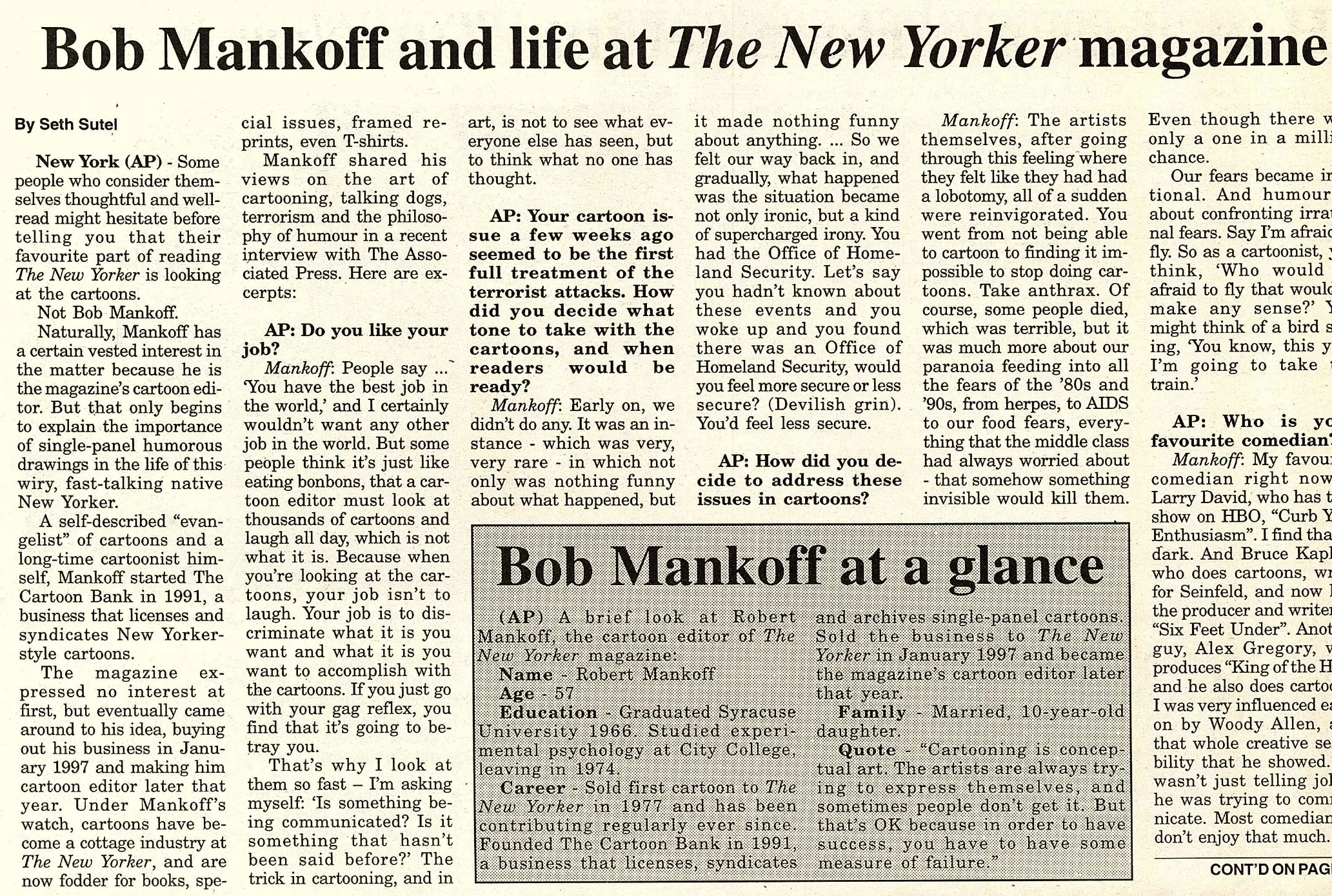
Not Bob Mankoff. Naturally, Mankoff has a certain vested interest in the matter because he is the magazine's cartoon editor. But that only begins to explain the importance of single-panel humorous drawings in the life of this wiry, fast-talking native New Yorker.
A self-described "evangelist" of cartoons and a long-time cartoonist himself, Mankoff started The Cartoon Bank in 1991, a business that licenses and syndicates New Yorker-style cartoons.
The magazine expressed no interest at first, but eventually came around to his idea, buying out his business in January 1997 and making him cartoon editor later that year. Under Mankoff's watch, cartoons have become a cottage industry at The New Yorker, and are now fodder for books, special issues, framed reprints, even T-shirts.
Mankoff shared his views on the art of cartooning, talking dogs, terrorism and the philosophy of humour in a recent interview with The Associated Press. Here are excerpts: AP: Do you like your job?
Mankoff: People say ... 'You have the best job in the world,' and I certainly wouldn't want any other job in the world. But some people think it's just like eating bonbons, that a cartoon editor must look at thousands of cartoons and laugh all day, which is not what it is. Because when you're looking at the cartoons, your job isn't to laugh. Your job is to discriminate what it is you want and what it is you want to accomplish with the cartoons. If you just go with your gag reflex, you find that it's going to betray you.
That's why I look at them so fast - I'm asking myself: 'Is something being communicated? Is it something that hasn't been said before?' The trick in cartooning, and in art, is not to see what everyone else has seen, but to think what no one has thought. AP: Your cartoon issue a few weeks ago seemed to be the first full treatment of the terrorist attacks. How did you decide what tone to take with the cartoons, and when readers would be ready?
Mankoff: Early on, we didn't do any. It was an instance - which was very, very rare - in which not only was nothing funny about what happened, but it made nothing funny about anything. ... So we felt our way back in, and gradually, what happened was the situation became not only ironic, but a kind of supercharged irony. You had the Office of Homeland Security.
Let's say you hadn't known about these events and you woke up and you found there was an Office of Homeland Security, would you feel more secure or less secure? (Devilish grin). You'd feel less secure. AP: How did you decide to address these issues in cartoons? Mankoff: The artists themselves, after going through this feeling where they felt like they had had a lobotomy, all of a sudden were reinvigorated. You went from not being able to cartoon to finding it impossible to stop doing cartoons. Take anthrax. Of course, some people died, which was terrible, but it was much more about our paranoia feeding into all the fears of the '80s and '90s, from herpes, to AIDS to our food fears, everything that the middle class had always worried about - that somehow something invisible would kill them. CONT'D FROM PAGE B3
almost a little bit embarrassed by it. Comedians don't have any buffer. They have to appeal to that audience right in front of them.
David Letterman is funny, but when you look at the show, it's more anthropological, like you watching, 'I am the king of comedy, and I can make you laugh by looking at you.' ... There's also a lot of animosity toward the audience. I have no animosity toward readers of The New Yorker, because there's this whole buffer. It's understood: We're doing the cartoons. Roz Chast is doing her cartoons because she likes them. If you also like the cartoons, that's great. Cartoons are just a wonderful, clear comic form. You're not laughing at them to please me, or because the guy next to you in the audience is laughing. You like it because you like it. AP: Do people have a more personal relationship with cartoons than with other kinds of humour?
Mankoff: No one remembers any jokes from the 1970s that Johnny Carson told, but people remember cartoons. If I email out to the Cartoon Bank people and I say, 'Tell me what your favourite cartoon is,' they'll write pages. From memory! They'll know the whole caption, they'll know the whole picture. It isn't somebody else's joke at that point, it's their joke too. Because they reacted to it, the joke invites you in. Stand-up does not invite you in. With a cartoon, the part that you "get" is the part that you supply.
This is what it's about for me, and this is the only place where cartoons are looked at that way. In this most august of magazines, those cartoons were there. The dignity it imparted to the idea of humour and humorous communications was very important. That this is a way of thinking, a way of dealing with the world, a way of thinking about problems. AP: Do you still take the risk that some of the cartoons will fail?
Mankoff: The only way to prevent that is to ask everybody. And if you ask everybody, then your own opinions will be contaminated.
... I want to get as close as I can to my actual gut feeling. If we make sure that everybody got it, then all of a sudden it's essentially a focus group, and the fear is that it would homogenise it, and eventually it would feed back to the artists, and they would be unwilling to take the risk.
One hundred percent of the people don't have to like the cartoons. It's understood that when you open the magazine, you're going to focus on the ones you like.
I'd rather have a cartoon that 25 percent of the people really loved than a cartoon that 100 percent of the people liked. ... Strangely enough, I think the bond is stronger between the readers and the magazine because there are cartoons in there that people don't like.
I think it makes the enterprise more human. AP: What don't you like about this job?
Mankoff: I don't like rejecting the people, the hardship they go under - sometimes having to be blunt and say, 'I don't like it.' Usually you find ways not to say that, and there are protocols involved, having been on the other side, knowing what happens every week when they don't sell a cartoon.
The other part that is hard for me, from my own creative side, is not having enough time to actually cartoon. It also makes cartooning itself tougher, because I know I can't do the cartoon that everybody else is doing. Just being in a corporate environment is hard for me personally. I'm antsy, and I don't really spend that much time with my wife and daughter. I got what I wished for, and I got it in triplicate, and it takes up a lot of time. The intellectual capital that's necessary for creating stuff needs fallow periods, and you don't have fallow periods here. You're definitely burning the candle at both ends. I'm just hoping the candle's big enough. On the Web: The New Yorker: http://www.newyorker.com
Cartoon Bank: http://www.cartoonbank.com