Easter Island art moves beyond the stone head
About the article
This is a digitised version of an article from The Cayman Compass's print archive. Occasionally, the digitisation process introduces transcription errors, or other problems.
See the article in its original context from January 2002.
Brought to you by

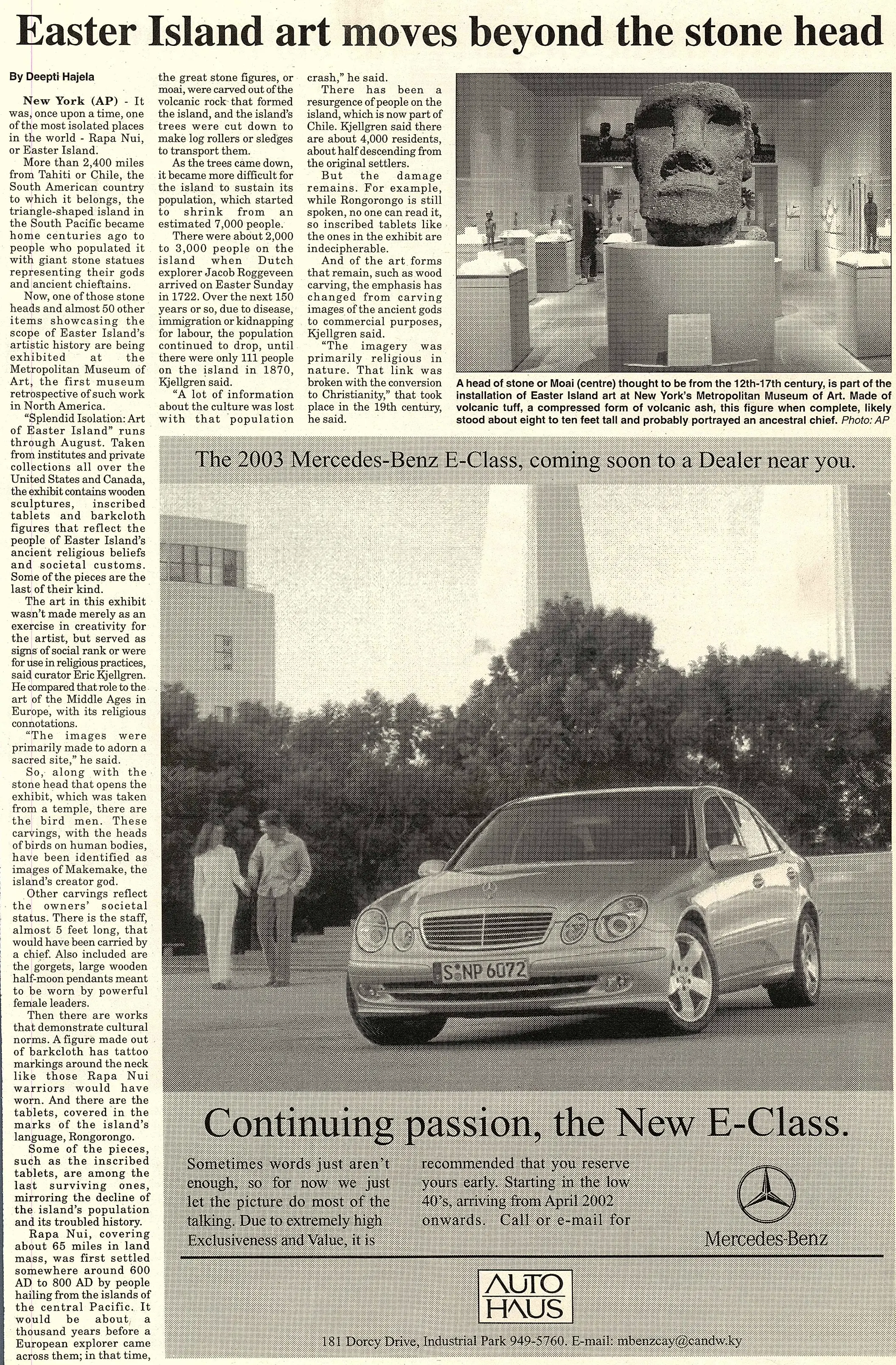
"Splendid Isolation: Art of Easter Island" runs through August. Taken from institutes and private collections all over the United States and Canada, the exhibit contains wooden sculptures, inscribed tablets and barkcloth figures that reflect the people of Easter Island's ancient religious beliefs and societal customs. Some of the pieces are the last of their kind.
The art in this exhibit wasn't made merely as an exercise in creativity for the artist, but served as signs of social rank or were for use in religious practices, said curator Eric Kjellgren. He compared that role to the art of the Middle Ages in Europe, with its religious connotations.
"The images were primarily made to adorn a sacred site," he said. So, along with the stone head that opens the exhibit, which was taken from a temple, there are the bird men. These carvings, with the heads of birds on human bodies, have been identified as images of Makemake, the island's creator god. Other carvings reflect the owners' societal status. There is the staff, almost 5 feet long, that would have been carried by a chief. Also included are the gorgets, large wooden half-moon pendants meant to be worn by powerful female leaders.
Then there are works that demonstrate cultural norms. A figure made out of barkcloth has tattoo markings around the neck like those Rapa Nui warriors would have worn. And there are the tablets, covered in the marks of the island's language, Rongorongo. Some of the pieces, such as the inscribed tablets, are among the last surviving ones, mirroring the decline of the island's population and its troubled history.
Rapa Nui, covering about 65 miles in land mass, was first settled somewhere around 600 AD to 800 AD by people hailing from the islands of the central Pacific. It would be about a thousand years before a European explorer came across them; in that time, the great stone figures, or moai, were carved out of the volcanic rock that formed the island, and the island's trees were cut down to make log rollers or sledges to transport them.
As the trees came down, it became more difficult for the island to sustain its population, which started to shrink from an estimated 7,000 people. There were about 2,000 to 3,000 people on the island when Dutch explorer Jacob Roggeveen arrived on Easter Sunday in 1722. Over the next 150 years or so, due to disease, immigration or kidnapping for labour, the population continued to drop, until there were only 111 people on the island in 1870, Kjellgren said.
"A lot of information about the culture was lost with that population. crash," he said. There has been a resurgence of people on the island, which is now part of Chile. Kjellgren said there are about 4,000 residents, about half descending from the original settlers.
But the damage remains. For example, while Rongorongo is still spoken, no one can read it, so inscribed tablets like the ones in the exhibit are indecipherable.
And of the art forms that remain, such as wood carving, the emphasis has changed from carving images of the ancient gods to commercial purposes, Kjellgren said. "The imagery was primarily religious in nature. That link was broken with the conversion to Christianity," that took place in the 19th century, he said.