Islamic, Transatlantic slavery contrasted by Minister Bodden in Black History Month lecture
About the article
This is a digitised version of an article from The Cayman Compass's print archive. Occasionally, the digitisation process introduces transcription errors, or other problems.
See the article in its original context from March 2002.
Brought to you by

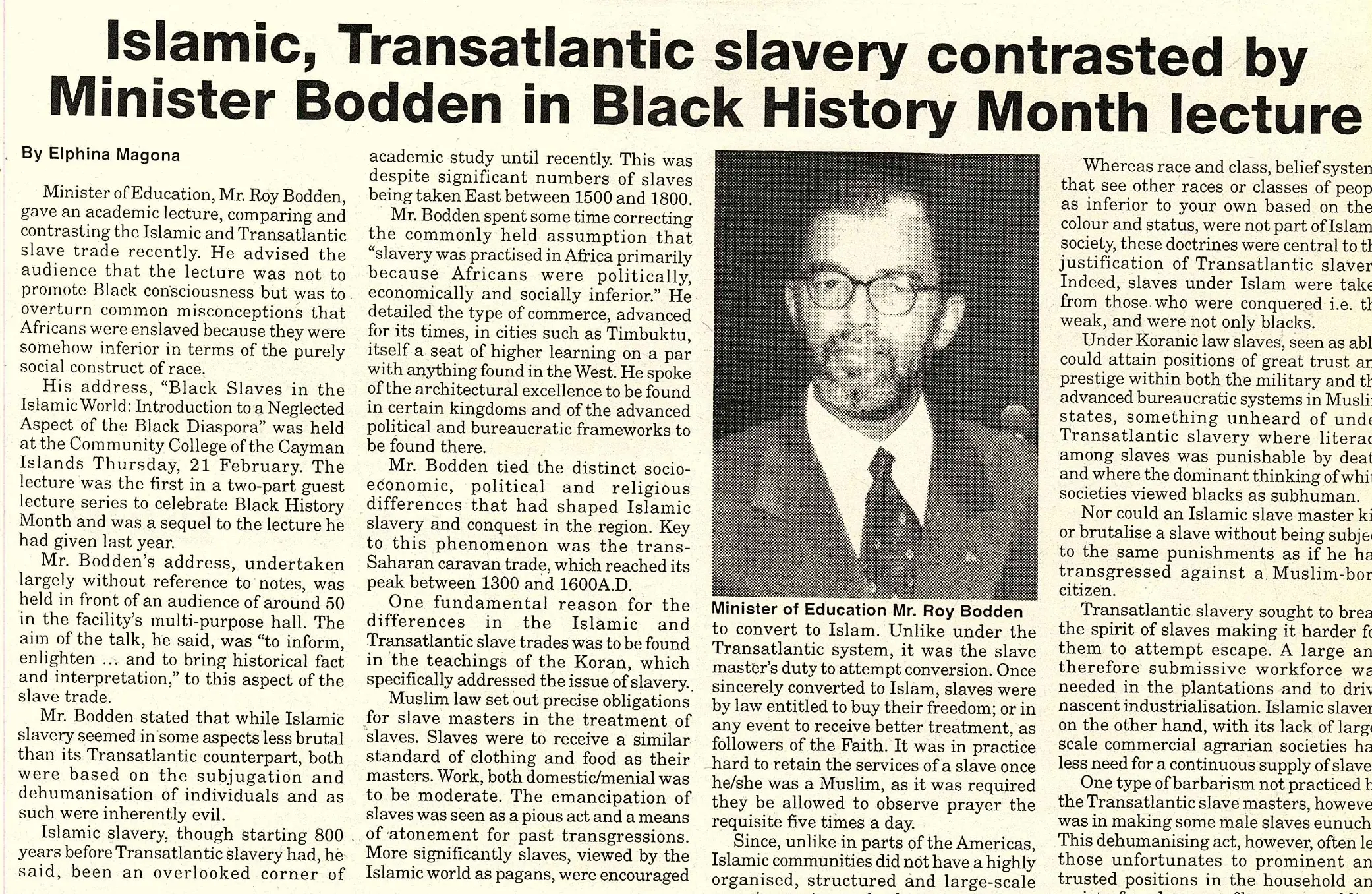
His address, "Black Slaves in the Islamic World: Introduction to a Neglected Aspect of the Black Diaspora" was held at the Community College of the Cayman Islands Thursday, 21 February. The lecture was the first in a two-part guest lecture series to celebrate Black History Month and was a sequel to the lecture he had given last year.
Mr. Bodden's address, undertaken largely without reference to notes, was held in front of an audience of around 50 in the facility's multi-purpose hall. The aim of the talk, he said, was "to inform, enlighten... and to bring historical fact and interpretation," to this aspect of the slave trade.
Mr. Bodden stated that while Islamic slavery seemed in some aspects less brutal than its Transatlantic counterpart, both were based on the subjugation and dehumanisation of individuals and as such were inherently evil.
Islamic slavery, though starting 800 years before Transatlantic slavery had, he said, been an overlooked corner of academic study until recently. This was despite significant numbers of slaves being taken East between 1500 and 1800.
Mr. Bodden spent some time correcting the commonly held assumption that "slavery was practised in Africa primarily because Africans were politically, economically and socially inferior." He detailed the type of commerce, advanced for its times, in cities such as Timbuktu, itself a seat of higher learning on a par with anything found in the West. He spoke of the architectural excellence to be found in certain kingdoms and of the advanced political and bureaucratic frameworks to be found there.
Mr. Bodden tied the distinct socioeconomic, political and religious differences that had shaped Islamic slavery and conquest in the region. Key to this phenomenon was the trans-Saharan caravan trade, which reached its peak between 1300 and 1600A.D.
One fundamental reason for the differences in the Islamic and Transatlantic slave trades was to be found in the teachings of the Koran, which specifically addressed the issue of slavery.
Muslim law set out precise obligations for slave masters in the treatment of slaves. Slaves were to receive a similar standard of clothing and food as their masters. Work, both domestic/menial was to be moderate. The emancipation of slaves was seen as a pious act and a means of atonement for past transgressions. More significantly slaves, viewed by the Islamic world as pagans, were encouraged Minister of Education Mr. Roy Bodden to convert to Islam. Unlike under the Transatlantic system, it was the slave master's duty to attempt conversion. Once sincerely converted to Islam, slaves were by law entitled to buy their freedom; or in any event to receive better treatment, as followers of the Faith. It was in practice hard to retain the services of a slave once he/she was a Muslim, as it was required they be allowed to observe prayer the requisite five times a day.
Since, unlike in parts of the Americas, Islamic communities did not have a highly organised, structured and large-scale agrarian sector, male slaves were not as prized as females or children. The former were generally thought to be easier to convert to Islam and less likely to rebel. In fact there were only a handful of slave rebellions in the Islamic states as opposed to the many in the Americas.
Transatlantic slavery based on kinship, with whole families viewed as chattels to be passed on from generation to generation, sought to subjugate by brutalisation. In contrast conversion was the preferred method of submission in the Muslim world, indeed under Islam, it was a slave master's duty to attempt conversion. Whereas race and class, belief systems that see other races or classes of people as inferior to your own based on their colour and status, were not part of Islamic society, these doctrines were central to the justification of Transatlantic slavery. Indeed, slaves under Islam were taken from those who were conquered i.e. the weak, and were not only blacks.
Under Koranic law slaves, seen as able, could attain positions of great trust and prestige within both the military and the advanced bureaucratic systems in Muslim states, something unheard of under Transatlantic slavery where literacy among slaves was punishable by death and where the dominant thinking of white societies viewed blacks as subhuman.
Nor could an Islamic slave master kill or brutalise a slave without being subject to the same punishments as if he had transgressed against a Muslim-born citizen.
Transatlantic slavery sought to break the spirit of slaves making it harder for them to attempt escape. A large and therefore submissive workforce was needed in the plantations and to drive nascent industrialisation. Islamic slavery on the other hand, with its lack of large-scale commercial agrarian societies had less need for a continuous supply of slaves.
One type of barbarism not practiced by the Transatlantic slave masters, however, was in making some male slaves eunuchs. This dehumanising act, however, often led those unfortunates to prominent and trusted positions in the household and society, from keepers of harems to soldiers and civil servants.
In conclusion, while barbaric in all its guises, Islamic slavery, which continues to this day, appears to have had a greater capacity for emancipation and social progression than its Transatlantic counterpart.
After the lecture, the audience asked questions as to the legacy of slavery. The likelihood of reparations was discussed and parallels were drawn between oppression suffered by the Jews and by blacks. Mr. Bodden advised that his detailed notes were available on request to the general public.