Germany reconciles with author Thomas Mann
About the article
This is a digitised version of an article from The Cayman Compass's print archive. Occasionally, the digitisation process introduces transcription errors, or other problems.
See the article in its original context from March 2002.
Brought to you by

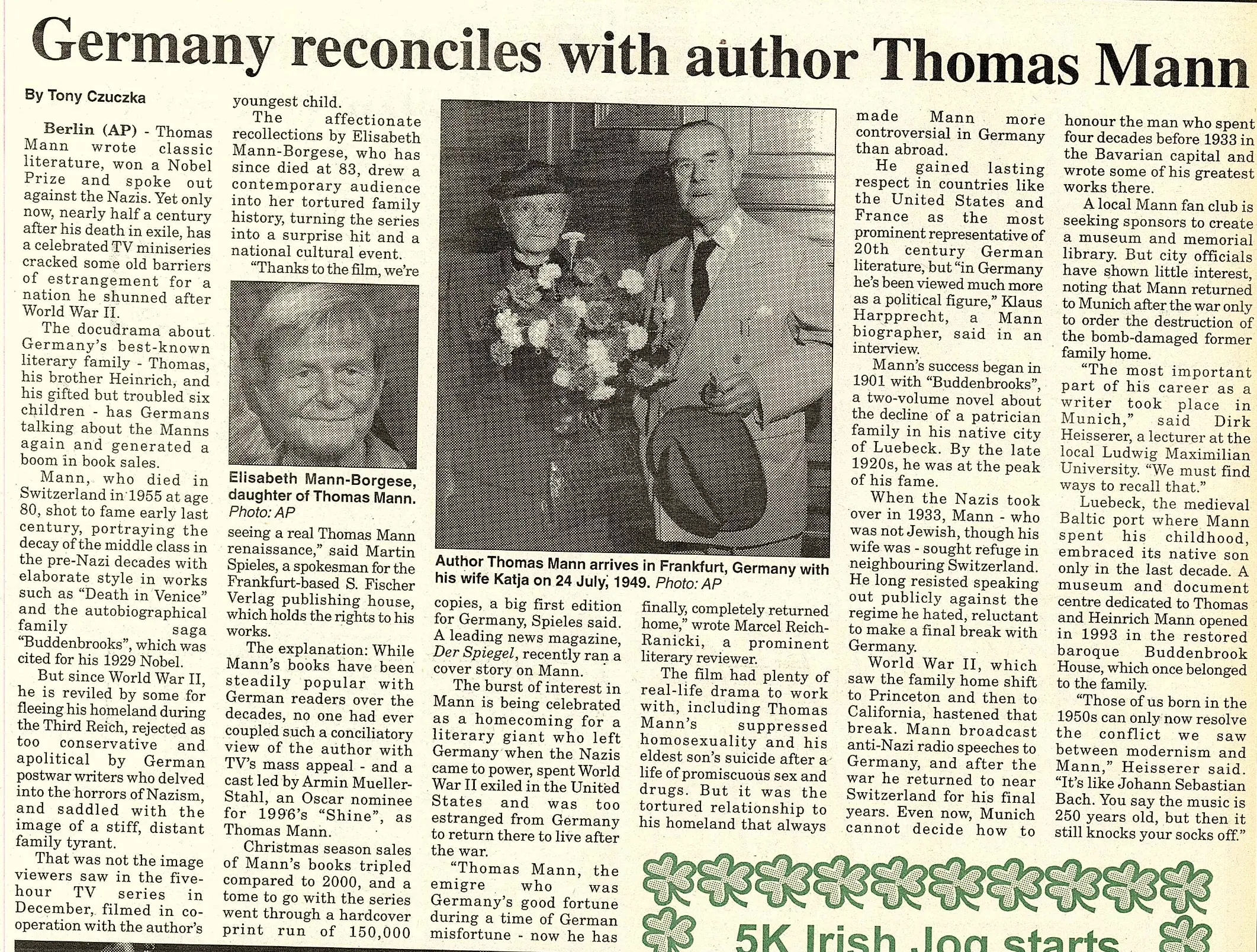
The docudrama about Germany's best-known literary family - Thomas, his brother Heinrich, and his gifted but troubled six children - has Germans talking about the Manns again and generated a boom in book sales.
Mann, who died in Switzerland in 1955 at age 80, shot to fame early last century, portraying the decay of the middle class in the pre-Nazi decades with elaborate style in works such as "Death in Venice" and the autobiographical family saga "Buddenbrooks", which was cited for his 1929 Nobel.
But since World War II, he is reviled by some for fleeing his homeland during the Third Reich, rejected as too conservative and apolitical by German postwar writers who delved into the horrors of Nazism, and saddled with the image of a stiff, distant family tyrant.
That was not the image viewers saw in the five-hour TV series in December, filmed in cooperation with the author's youngest child.
The affectionate recollections by Elisabeth Mann-Borgese, who has since died at 83, drew a contemporary audience into her tortured family history, turning the series into a surprise hit and a national cultural event.
"Thanks to the film, we're seeing a real Thomas Mann renaissance," said Martin Spieles, a spokesman for the Frankfurt-based S. Fischer Verlag publishing house, which holds the rights to his works.
The explanation: While Mann's books have been steadily popular with German readers over the decades, no one had ever coupled such a conciliatory view of the author with TV's mass appeal - and a cast led by Armin Mueller-Stahl, an Oscar nominee for 1996's "Shine", as Thomas Mann.
Christmas season sales of Mann's books tripled compared to 2000, and a tome to go with the series went through a hardcover print run of 150,000 copies, a big first edition for Germany, Spieles said. A leading news magazine, Der Spiegel, recently ran a cover story on Mann.
The burst of interest in Mann is being celebrated as a homecoming for a literary giant who left Germany when the Nazis came to power, spent World War II exiled in the United States and was too estranged from Germany to return there to live after the war.
"Thomas Mann, the emigre who was Germany's good fortune during a time of German misfortune - now he has finally, completely returned home," wrote Marcel Reich-Ranicki, a prominent literary reviewer.
The film had plenty of real-life drama to work with, including Thomas Mann's suppressed homosexuality and his eldest son's suicide after a life of promiscuous sex and drugs. But it was the tortured relationship to his homeland that always made Mann more controversial in Germany than abroad.
He gained lasting respect in countries like the United States and France as the most prominent representative of 20th century German literature, but "in Germany he's been viewed much more as a political figure," Klaus Harpprecht, a Mann biographer, said in an interview.
Mann's success began in 1901 with "Buddenbrooks", a two-volume novel about the decline of a patrician family in his native city of Luebeck. By the late 1920s, he was at the peak of his fame.
When the Nazis took over in 1933, Mann - who was not Jewish, though his wife was - sought refuge in neighbouring Switzerland. He long resisted speaking out publicly against the regime he hated, reluctant to make a final break with Germany.
World War II, which saw the family home shift to Princeton and then to California, hastened that break. Mann broadcast anti-Nazi radio speeches to Germany, and after the war he returned to near Switzerland for his final years. Even now, Munich cannot decide how to honour the man who spent four decades before 1933 in the Bavarian capital and wrote some of his greatest works there.
A local Mann fan club is seeking sponsors to create a museum and memorial library. But city officials have shown little interest, noting that Mann returned to Munich after the war only to order the destruction of the bomb-damaged former family home.
"The most important part of his career as a writer took place in Munich," said Dirk Heisserer, a lecturer at the local Ludwig Maximilian University. "We must find ways to recall that."
Luebeck, the medieval Baltic port where Mann spent his childhood, embraced its native son only in the last decade. A museum and document centre dedicated to Thomas and Heinrich Mann opened in 1993 in the restored baroque Buddenbrook House, which once belonged to the family.
"Those of us born in the 1950s can only now resolve the conflict we saw between modernism and Mann," Heisserer said. "It's like Johann Sebastian Bach. You say the music is 250 years old, but then it still knocks your socks off."