With homemade telescope, 'legendary' astronomer discovers sixth comet
About the article
This is a digitised version of an article from The Cayman Compass's print archive. Occasionally, the digitisation process introduces transcription errors, or other problems.
See the article in its original context from April 2002.
Brought to you by

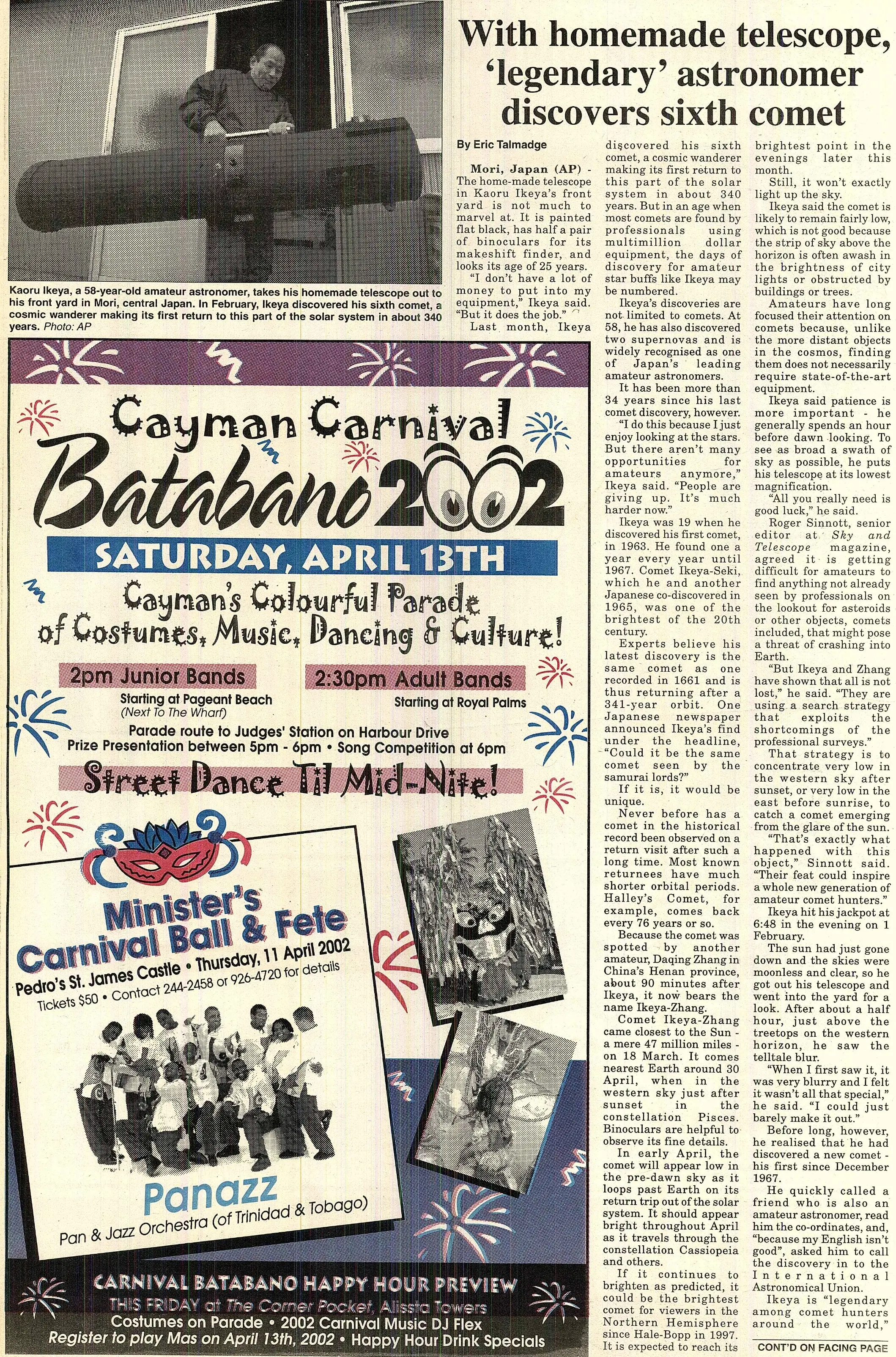
"I don't have a lot of money to put into my equipment," Ikeya said. "But it does the job." Last month, Ikeya discovered his sixth comet, a cosmic wanderer making its first return to this part of the solar system in about 340 years. But in an age when most comets are found by professionals using multimillion dollar equipment, the days of discovery for amateur star buffs like Ikeya may be numbered.
Ikeya's discoveries are not limited to comets. At 58, he has also discovered two supernovas and is widely recognised as one of Japan's leading amateur astronomers. It has been more than 34 years since his last comet discovery, however. "I do this because I just enjoy looking at the stars. But there aren't many opportunities for amateurs anymore," Ikeya said. "People are giving up. It's much harder now."
Ikeya was 19 when he discovered his first comet, in 1963. He found one a year every year until 1967. Comet Ikeya-Seki, which he and another Japanese co-discovered in 1965, was one of the brightest of the 20th century.
Experts believe his latest discovery is the same comet as one recorded in 1661 and is thus returning after a 341-year orbit. One Japanese newspaper announced Ikeya's find under the headline, "Could it be the same comet seen by the samurai lords?" If it is, it would be unique.
Never before has a comet in the historical record been observed on a return visit after such a long time. Most known returnees have much shorter orbital periods. Halley's Comet, for example, comes back every 76 years or so.
Because the comet was spotted by another amateur, Daqing Zhang in China's Henan province, about 90 minutes after Ikeya, it now bears the name Ikeya-Zhang. Comet Ikeya-Zhang came closest to the Sun - a mere 47 million miles on 18 March. It comes nearest Earth around 30 April, when in the western sky just after sunset in the constellation Pisces. Binoculars are helpful to observe its fine details.
In early April, the comet will appear low in the pre-dawn sky as it loops past Earth on its return trip out of the solar system. It should appear bright throughout April as it travels through the constellation Cassiopeia and others.
If it continues to brighten as predicted, it could be the brightest comet for viewers in the Northern Hemisphere since Hale-Bopp in 1997. It is expected to reach its brightest point in the evenings later this month. Still, it won't exactly light up the sky. Ikeya said the comet is likely to remain fairly low, which is not good because the strip of sky above the horizon is often awash in the brightness of city lights or obstructed by buildings or trees.
Amateurs have long focused their attention on comets because, unlike the more distant objects in the cosmos, finding them does not necessarily require state-of-the-art equipment. Ikeya said patience is more important - he generally spends an hour before dawn looking. To see as broad a swath of sky as possible, he puts his telescope at its lowest magnification. "All you really need is good luck," he said. Roger Sinnott, senior editor at Sky and Telescope magazine, agreed it is getting difficult for amateurs to find anything not already seen by professionals on the lookout for asteroids or other objects, comets included, that might pose a threat of crashing into Earth.
"But Ikeya and Zhang have shown that all is not lost," he said. "They are using a search strategy that exploits the shortcomings of the professional surveys." That strategy is to concentrate very low in the western sky after sunset, or very low in the east before sunrise, to catch a comet emerging from the glare of the sun. "That's exactly what happened with this object," Sinnott said. "Their feat could inspire a whole new generation of amateur comet hunters." Ikeya hit his jackpot at 6:48 in the evening on 1 February.
The sun had just gone down and the skies were moonless and clear, so he got out his telescope and went into the yard for a look. After about a half hour, just above the treetops on the western horizon, he saw the telltale blur. "When I first saw it, it was very blurry and I felt it wasn't all that special," he said. "I could just barely make it out." Before long, however, he realised that he had discovered a new comet - his first since December 1967.
He quickly called a friend who is also an amateur astronomer, read him the co-ordinates, and, "because my English isn't good", asked him to call the discovery in to the International Astronomical Union. Ikeya is "legendary among comet hunters around the world," CONT'D ON FACING PAGE FROM FACING PAGE Sinnott said. He is also a bit of a local celebrity - "he's the star guy, right?" is a common reply when his name is mentioned in the nearest town.
But like the comets he chases, finding Ikeya is not easy.
For the past 11 years, he and his family have lived high up on the slopes of a small mountain surrounded by cedar forests and the green tea farms for which this part of central Japan is famous. His front yard offers a stunning vista of the sparsely populated valley below and treecovered hills on the distant horizon.
"It's a good location for viewing the sky," he said. "But we don't have running water up here." Despite the tougher competition from professional observers, Ikeya said he will keep looking.