Political party systems
About the article
This is a digitised version of an article from The Cayman Compass's print archive. Occasionally, the digitisation process introduces transcription errors, or other problems.
See the article in its original context from May 2002.
Brought to you by

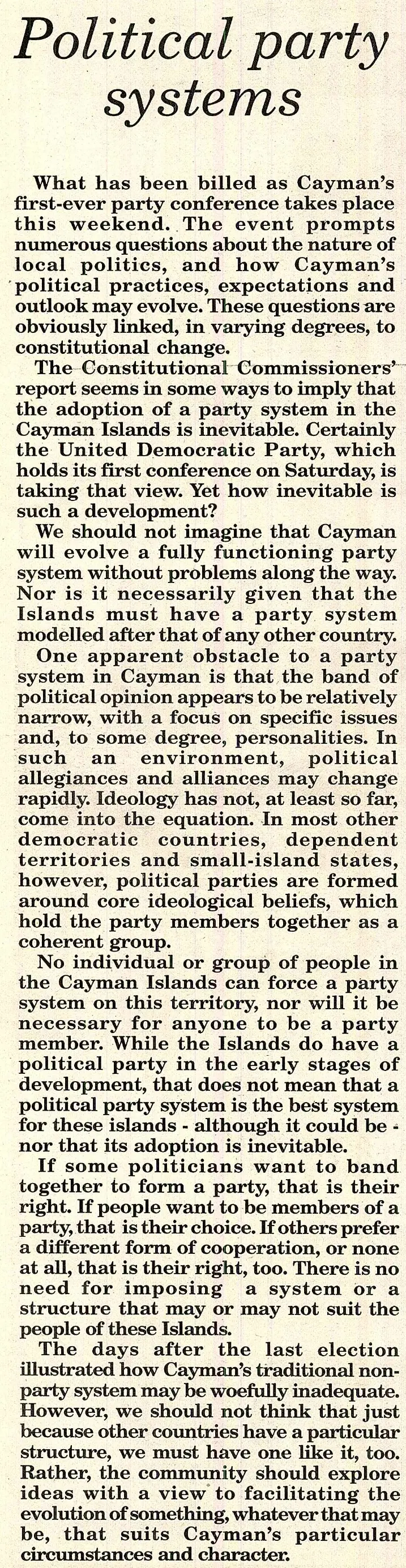
The Constitutional Commissioners' report seems in some ways to imply that the adoption of a party system in the Cayman Islands is inevitable. Certainly the United Democratic Party, which holds its first conference on Saturday, is taking that view. Yet how inevitable is such a development?
We should not imagine that Cayman will evolve a fully functioning party system without problems along the way. Nor is it necessarily given that the Islands must have a party system modelled after that of any other country.
One apparent obstacle to a party system in Cayman is that the band of political opinion appears to be relatively narrow, with a focus on specific issues and, to some degree, personalities. In such an environment, political allegiances and alliances may change rapidly. Ideology has not, at least so far, come into the equation. In most other democratic countries, dependent territories and small-island states, however, political parties are formed around core ideological beliefs, which hold the party members together as a coherent group.
No individual or group of people in the Cayman Islands can force a party system on this territory, nor will it be necessary for anyone to be a party member. While the Islands do have a political party in the early stages of development, that does not mean that a political party system is the best system for these islands - although it could be - nor that its adoption is inevitable.
If some politicians want to band together to form a party, that is their right. If people want to be members of a party, that is their choice. If others prefer a different form of cooperation, or none at all, that is their right, too. There is no need for imposing a system or a structure that may or may not suit the people of these Islands.
The days after the last election illustrated how Cayman's traditional non-party system may be woefully inadequate. However, we should not think that just because other countries have a particular structure, we must have one like it, too. Rather, the community should explore ideas with a view to facilitating the evolution of something, whatever that may be, that suits Cayman's particular circumstances and character.