Natural News
About the article
This is a digitised version of an article from The Cayman Compass's print archive. Occasionally, the digitisation process introduces transcription errors, or other problems.
See the article in its original context from June 2002.
Brought to you by

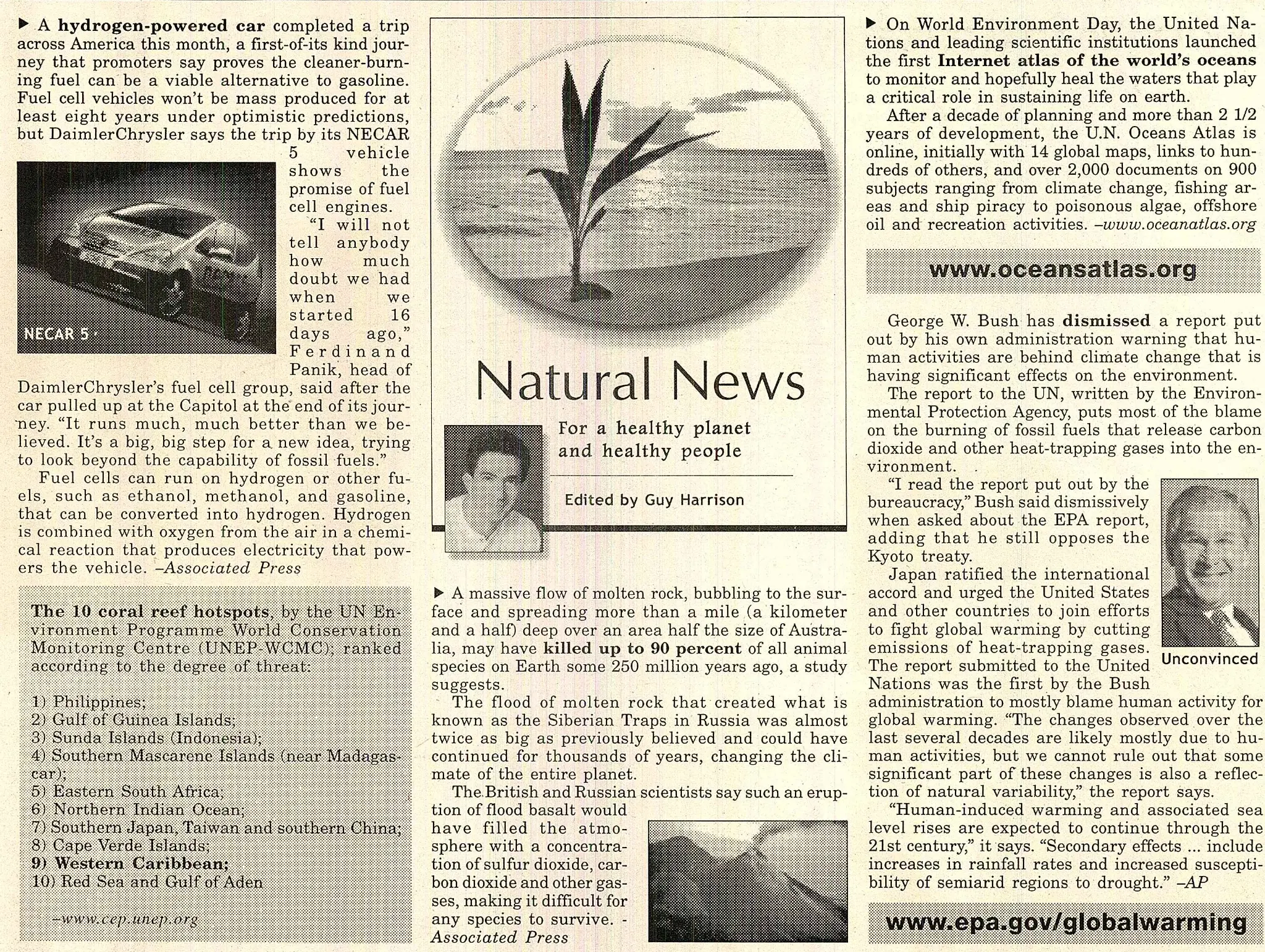
"I will not tell anybody how much doubt we had when we started 16 days ago," Ferdinand Panik, head of DaimlerChrysler's fuel cell group, said after the car pulled up at the Capitol at the end of its journey. "It runs much, much better than we believed. It's a big, big step for a new idea, trying to look beyond the capability of fossil fuels."
Fuel cells can run on hydrogen or other fuels, such as ethanol, methanol, and gasoline, that can be converted into hydrogen. Hydrogen is combined with oxygen from the air in a chemical reaction that produces electricity that powers the vehicle. -Associated Press
The 10 coral reef hotspots, by the UN Environment Programme World Conservation Monitoring Centre (UNEP-WCMC); ranked according to the degree of threat:
1) Philippines;
2) Gulf of Guinea Islands;
3) Sunda Islands (Indonesia);
4) Southern Mascarene Islands (near Madagascar);
5) Eastern South Africa;
6) Northern Indian Ocean;
7) Southern Japan, Taiwan and southern China;
8) Cape Verde Islands;
9) Western Caribbean;
10) Red Sea and Gulf of Aden
www.cepunpg.org
Natural News
A massive flow of molten rock, bubbling to the surface and spreading more than a mile (a kilometer and a half) deep over an area half the size of Australia, may have killed up to 90 percent of all animal species on Earth some 250 million years ago, a study suggests.
The flood of molten rock that created what is known as the Siberian Traps in Russia was almost twice as big as previously believed and could have continued for thousands of years, changing the climate of the entire planet.
The British and Russian scientists say such an eruption of flood basalt would have filled the atmosphere with a concentration of sulfur dioxide, carbon dioxide and other gases, making it difficult for any species to survive. Associated Press
On World Environment Day, the United Nations and leading scientific institutions launched the first Internet atlas of the world's oceans to monitor and hopefully heal the waters that play a critical role in sustaining life on earth.
After a decade of planning and more than 2 1/2 years of development, the U.N. Oceans Atlas is online, initially with 14 global maps, links to hundreds of others, and over 2,000 documents on 900 subjects ranging from climate change, fishing areas and ship piracy to poisonous algae, offshore oil and recreation activities. -www.oceanatlas.org
NEARS
For a healthy planet and healthy people
Edited by Guy Harrison