Father of the Mini
About the article
This is a digitised version of an article from The Cayman Compass's print archive. Occasionally, the digitisation process introduces transcription errors, or other problems.
See the article in its original context from October 2002.
Brought to you by

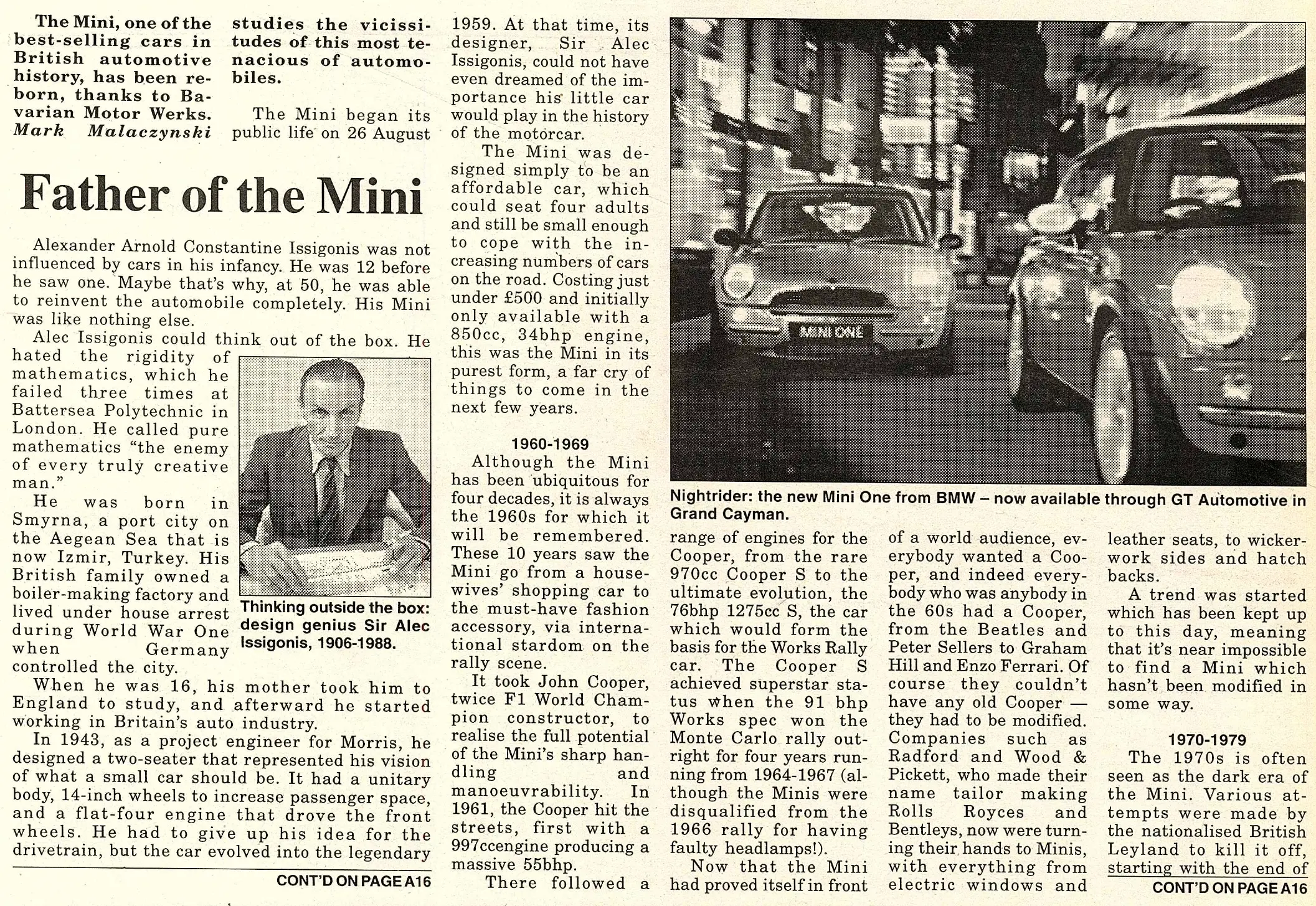
Alec Issigonis could think out of the box. He hated the rigidity of mathematics, which he failed three times at Battersea Polytechnic in London. He called pure mathematics "the enemy of every truly creative man." He was born in Smyrna, a port city on the Aegean Sea that is now Izmir, Turkey. His British family owned a boiler-making factory and lived under house arrest during World War One when Germany controlled the city.
When he was 16, his mother took him to England to study, and afterward he started working in Britain's auto industry.
In 1943, as a project engineer for Morris, he designed a two-seater that represented his vision of what a small car should be. It had a unitary body, 14-inch wheels to increase passenger space, and a flat-four engine that drove the front wheels. He had to give up his idea for the drivetrain, but the car evolved into the legendary 1959. At that time, its designer, Sir Alec Issigonis, could not have even dreamed of the importance his little car would play in the history of the motorcar.
The Mini was designed simply to be an affordable car, which could seat four adults and still be small enough to cope with the increasing numbers of cars on the road. Costing just under £500 and initially only available with a 850cc, 34bhp engine, this was the Mini in its purest form, a far cry of things to come in the next few years.
1960-1969
Although the Mini has been ubiquitous for four decades, it is always the 1960s for which it will be remembered. These 10 years saw the Mini go from a housewives' shopping car to the must-have fashion accessory, via international stardom on the rally scene.
It took John Cooper, twice F1 World Champion constructor, to realise the full potential of the Mini's sharp handling and manoeuvrability. In 1961, the Cooper hit the streets, first with a 997ccengine producing a massive 55bhp. There followed a range of engines for the Cooper, from the rare 970cc Cooper S to the ultimate evolution, the 76bhp 1275cc S, the car which would form the basis for the Works Rally car. The Cooper S achieved superstar status when the 91 bhp Works spec won the Monte Carlo rally outright for four years running from 1964-1967 (although the Minis were disqualified from the 1966 rally for having faulty headlamps!).
Now that the Mini had proved itself in front of a world audience, everybody wanted a Cooper, and indeed everybody who was anybody in the 60s had a Cooper, from the Beatles and Peter Sellers to Graham Hill and Enzo Ferrari. Of course they couldn't have any old Cooper - they had to be modified.
Companies such as Radford and Wood & Pickett, who made their name tailormaking Rolls Royces and Bentleys, now were turning their hands to Minis, with everything from electric windows and leather seats, to wickerwork sides and hatchbacks. A trend was started which has been kept up to this day, meaning that it's near impossible to find a Mini which hasn't been modified in some way. 1970-1979 The 1970s is often seen as the dark era of the Mini. Various attempts were made by the nationalised British Leyland to kill it off, starting with the end of CONT'D ON PAGE A16 CONT'D FROM PAGE A15
Morris Minor, in production from 1948 to 1971. When Austin merged with Morris in 1952, internal squabbles between workers of the two former competitors disenchanted Issigonis. He moved to Alvis and designed V-8 sports sedan. When Alvis decided not to make the car in 1955, he went back to Morris-Austin, now called British Motor Co.
As the chief engineer, he immediately set up a task force to study his ideas for a small car. The time was right. The Suez Crisis in September 1956 led to gasoline rationing, and his bosses asked him to design a car smaller than the Morris Minor that could seat four and use an existing engine.
Issigonis exploded into action. He shrunk the wheels to 10 inches so they didn't intrude in the cabin, and stuck them in the far corners. A compact rubber-cone suspension and a wide track allowed safe, responsive handling that later won races.
He mounted the engine transversely to drive the front wheels, then placed the transmission underneath. Eighty percent of the 10-feet (3-meter) long car was given over to passengers. The car went into production in 1959, and the last original Mini didn't leave the chains until October 2000.
Issigonis, who was knighted by Queen Elizabeth for his success, was arrogant and highly opinionated. He thought market research was inane. He hated interior luxuries, such as radios and comfortable seats, because he thought they distracted the driver.
He thought little of styling. Battista "Pinin" Farina, who admired the lines of the Mini, asked him if he was a stylist.
Issigonis was offended: "I am an engineer," he said.
But he was a creator. The Mini, the Minor and the Austin 1100 he designed are among the five top-selling cars in British history. And his packaging ideas are the foundation of modern small-car design, living on in every front-wheel-drive passenger vehicle with a sideways-mounted engine on the road.