Magna Carta rates ‘A’ for Ambition and.
About the article
This is a digitised version of an article from The Cayman Compass's print archive. Occasionally, the digitisation process introduces transcription errors, or other problems.
See the article in its original context from April 2003.
Brought to you by

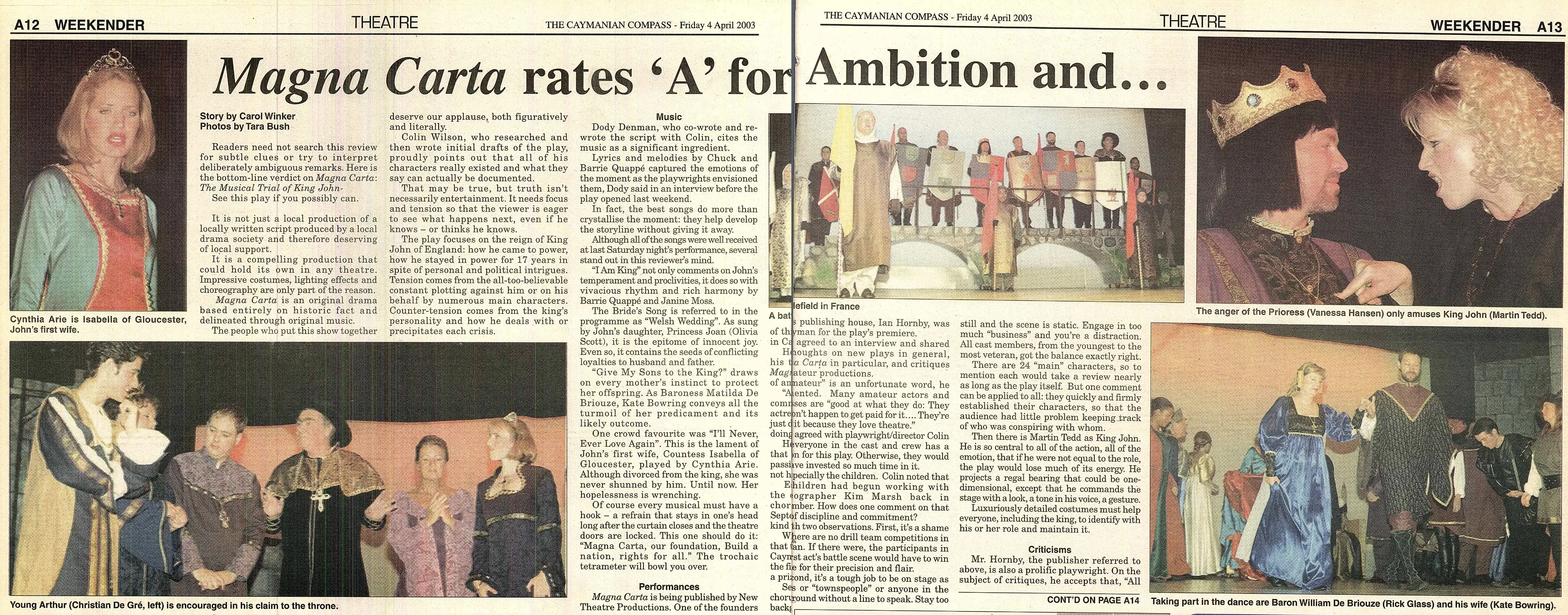
See this play if you possibly can. It is not just a local production of a locally written script produced by a local drama society and therefore deserving of local support.
It is a compelling production that could hold its own in any theatre. Impressive costumes, lighting effects and choreography are only part of the reason.
Magna Carta is an original drama based entirely on historic fact and delineated through original music.
The people who put this show together deserve our applause, both figuratively and literally.
Colin Wilson, who researched and then wrote initial drafts of the play, proudly points out that all of his characters really existed and what they say can actually be documented.
That may be true, but truth isn't necessarily entertainment. It needs focus and tension so that the viewer is eager to see what happens next, even if he knows - or thinks he knows.
The play focuses on the reign of King John of England: how he came to power, how he stayed in power for 17 years in spite of personal and political intrigues. Tension comes from the all-too-believable constant plotting against him or on his behalf by numerous main characters. Counter-tension comes from the king's personality and how he deals with or precipitates each crisis. Music
Dody Denman, who co-wrote and rewrote the script with Colin, cites the music as a significant ingredient.
Lyrics and melodies by Chuck and Barrie Quappé captured the emotions of the moment as the playwrights envisioned them, Dody said in an interview before the play opened last weekend.
In fact, the best songs do more than crystallise the moment: they help develop the storyline without giving it away.
Although all of the songs were well received at last Saturday night's performance, several stand out in this reviewer's mind.
"I Am King" not only comments on John's temperament and proclivities, it does so with vivacious rhythm and rich harmony by Barrie Quappé and Janine Moss.
The Bride's Song is referred to in the programme as "Welsh Wedding". As sung by John's daughter, Princess Joan (Olivia Scott), it is the epitome of innocent joy. Even so, it contains the seeds of conflicting loyalties to husband and father.
"Give My Sons to the King?" draws on every mother's instinct to protect her offspring. As Baroness Matilda De Briouze, Kate Bowring conveys all the turmoil of her predicament and its likely outcome.
One crowd favourite was "I'll Never, Ever Love Again". This is the lament of John's first wife, Countess Isabella of Gloucester, played by Cynthia Arie. Although divorced from the king, she was never shunned by him. Until now. Her hopelessness is wrenching.
Of course every musical must have a hook a refrain that stays in one's head long after the curtain closes and the theatre doors are locked. This one should do it: "Magna Carta, our foundation, Build a nation, rights for all." The trochaic tetrameter will bowl you over. Performances
Magna Carta is being published by New Theatre Productions. One of the founders A bat of the a publishing house, Ian Hornby, was of thyman for the play's premiere. in Ca agreed to an interview and shared Hhoughts on new plays in general, his ta Carta in particular, and critiques Magnateur productions.
of "amateur" is an unfortunate word, he "Alented. Many amateur actors and commsses are "good at what they do: They actreon't happen to get paid for it.... They're just dit because they love theatre."
doing agreed with playwright/director Colin Heveryone in the cast and crew has a that on for this play. Otherwise, they would passive invested so much time in it. not hpecially the children. Colin noted that Ehildren had begun working with the eographer Kim Marsh back in chormber. How does one comment on that Septof discipline and commitment?
kind th two observations. First, it's a shame Where are no drill team competitions in that fan. If there were, the participants in Caynst act's battle scene would have to win the fie for their precision and flair. a prizond, it's a tough job to be on stage as Ses or "townspeople" or anyone in the choruround without a line to speak. Stay too back still and the scene is static. Engage in too much "business" and you're a distraction. All cast members, from the youngest to the most veteran, got the balance exactly right.
There are 24 "main" characters, so to mention each would take a review nearly as long as the play itself. But one comment can be applied to all: they quickly and firmly established their characters, so that the audience had little problem keeping track of who was conspiring with whom.
Then there is Martin Tedd as King John. He is so central to all of the action, all of the emotion, that if he were not equal to the role, the play would lose much of its energy. He projects a regal bearing that could be one-dimensional, except that he commands the stage with a look, a tone in his voice, a gesture. Luxuriously detailed costumes must help everyone, including the king, to identify with his or her role and maintain it. Criticisms
Mr. Hornby, the publisher referred to above, is also a prolific playwright. On the subject of critiques, he accepts that, "All CONT'D ON PAGE A14 LEFT: King John acknowledges his illegitimate daughter Joan (Olivia Scott). FROM PAGE A12 criticism is valid. It's a question of whether you do anything about it." By criticism, he means evaluation: something doesn't work because and give a reason. "To say it's 'very good' or 'rubbish' doesn't help."
One of his criticisms was that the play was too long for professional productions. After opening night, he made suggestions and "steps were being taken" to do a little tightening up, a little cutting.
On Saturday night, with a scheduled 7.30 curtain, the play ended just after 11.00 pm. It is understood that more is being done in an effort to bring total running time closer to three hours including intermission. Thankfully, no song is being cut.
To be frank, I became aware of the time only after the play was over. But I accept that other people may feel differently.
My criticisms have nothing to do with the length of the play. Here they are in no particular order. I'm curious as to why one of the main characters would wear shoes with heels in the first act. My amateur understanding of history is that high heels for women did not come into vogue until a couple of centuries later. She later switched to ballet-type slippers, which seemed more appropriate.
The barons marching to battle come through the audience, which then sees more of the backs of their shields than the fronts. A little grey or brown paint would have helped. One would like to appreciate the intricate artwork on the heraldic insignia; could there be just a little more light during the battle scene? Also in the battle scene, I assume the barons relate what is happening. I assume because I couldn't hear. Either these important lines need to be shouted or else there should be a strategic microphone somewhere. I'm intrigued by the casting of Tony Rowlands and Peter Riley in their particular roles. Perhaps I have seen them so often that I associate them with specific types of characters. They seemed to be playing against those types. I would have switched them around, but maybe they wanted a challenge.
I was not prepared for Joan's change of allegiance. This is so significant I wish I could have seen it instead of being told about it afterwards.
Most serious, I think, is what happened at the end of the performance I saw. The audience was asked for its verdict - Was John a good king or a bad king? Cast members on stage were so vociferous in expressing their opinions that the initiative was taken away from the people in the seats below. I already knew what the characters thought. I genuinely wanted to know what other playgoers thought.
King John had a delightful exit line after the verdict was announced. Is there an alternate line for an alternate verdict? There should be.
I can't imagine people not finding something to praise about the show itself. The device of the verdict should be one way of encouraging them to think about the play's subject matter long after the show is over.