The skinny on ephedra
About the article
This is a digitised version of an article from The Cayman Compass's print archive. Occasionally, the digitisation process introduces transcription errors, or other problems.
See the article in its original context from April 2003.
Brought to you by

"There is no good reason for anyone to take ephedra," stated local MD John Madden.
"It converts to psudoephedrine, which is a stimulant that can make blood vessels in any part of the body stretch. This may lead to heart attacks or strokes," he explained. Dr. Madden said that there are no control studies to suggest how ephedra is released and how it will affect the person.
"Because of this no one is going to write a prescription for ephedra to lose weight when there are safer alternatives on the market," he added. Dr. Madden admitted that he has seen otherwise healthy people who have taken ephedra come into his office with very highblood pressure.
The Chinese desert herb known as Ma Huang is the herb from which scientists have extracted ephedrine, which was at one time the most effective treatment known for symptoms of asthma, allergies and sinus problems. However, since the 1930s doctors stopped prescribing it in favour of safer medications.
Herbalists in the West discovered a new use for ephedra recently as a metabolic booster giving it a themogenic effect. This increases the metabolic rate, raising body temperature and causes calories to be burned at a faster rate. One of the side effects of themogenesis is slight increase in pulse rate and an elevation of blood pressure.
After people began using ephedra for this new purpose it became a lightning rod for controversy. Researchers at the University of Michigan in Ann Arbor compared data from more than 700 young to middle-aged hemorrhagic stroke patients to 1,400 controls who had not experienced a stroke. They concluded that the odds of having a hemorrhagic stroke tripled for those who reported taking 32mg or more of ephedra within three days of their stroke. US poison control centres also reported 1,178 adverse reactions to ephedra dietary supplements in 2001 according to the Annuals of Internal Medicine.
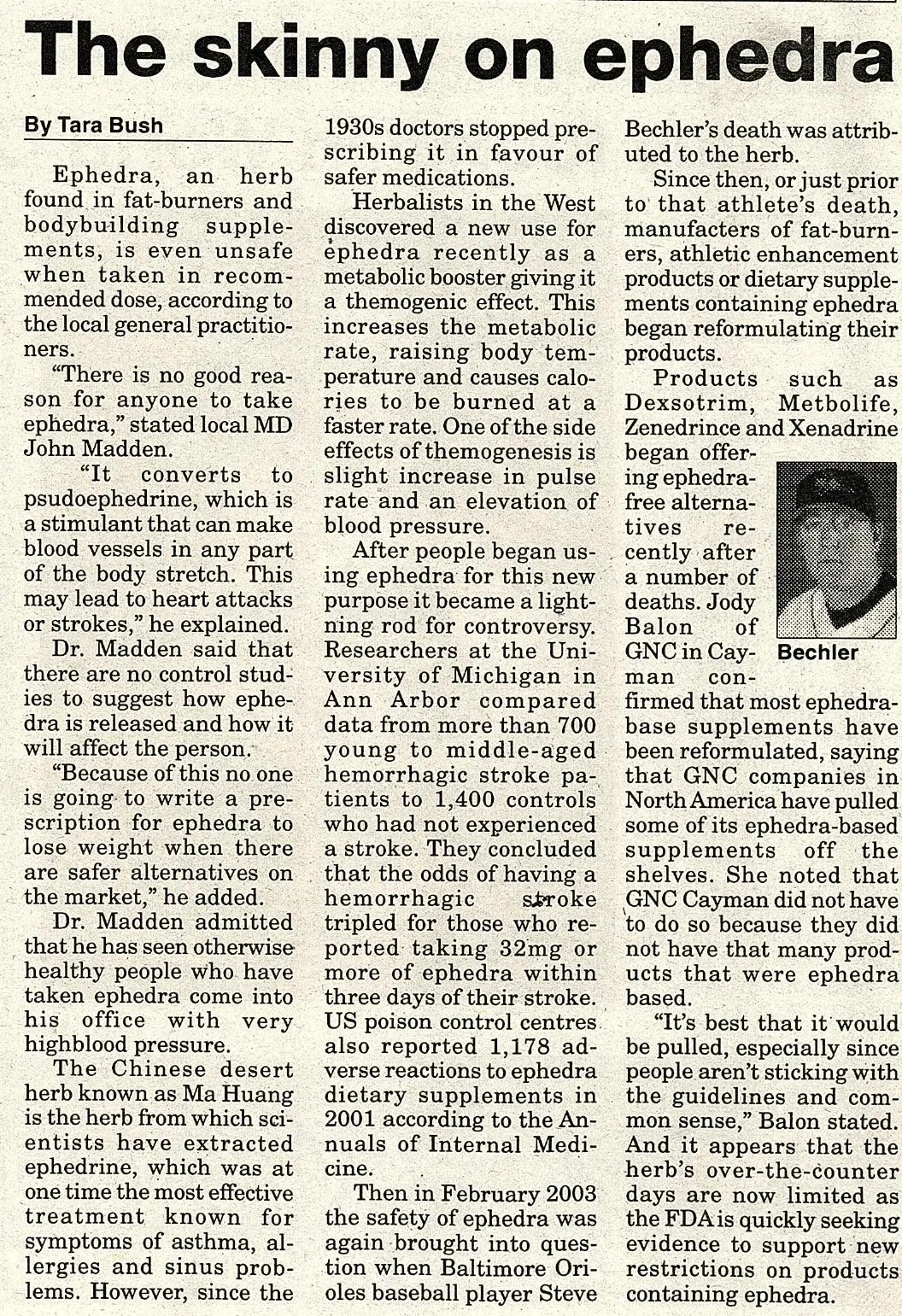
Then in February 2003 the safety of ephedra was again brought into question when Baltimore Orioles baseball player Steve Bechler's death was attributed to the herb.
Since then, or just prior to that athlete's death, manufacters of fat-burners, athletic enhancement products or dietary supplements containing ephedra began reformulating their products.
Products such as Dexsotrim, Metbolife, Zenedrince and Xenadrine began offering ephedra-free alternatives recently after a number of deaths. Jody Balon of GNC in Cayman confirmed that most ephedra-base supplements have been reformulated, saying that GNC companies in North America have pulled some of its ephedra-based supplements off the shelves. She noted that GNC Cayman did not have to do so because they did not have that many products that were ephedra based.
"It's best that it would be pulled, especially since people aren't sticking with the guidelines and common sense," Balon stated. And it appears that the herb's over-the-counter days are now limited as the FDA is quickly seeking evidence to support new restrictions on products containing ephedra.