Italians are unsettled over the sight of their flag
About the article
This is a digitised version of an article from The Cayman Compass's print archive. Occasionally, the digitisation process introduces transcription errors, or other problems.
See the article in its original context from May 2003.
Brought to you by

Somehow, the red wasn't quite red, and the slight shift in shade transformed what should have been Italy's banner into the green-white-and-orange of Ireland. The politician's distress led the government to take up a peculiar task: figuring out precisely what shades the 206-year-old national flag should be.
After long study, officials recently issued a flag colour code, prompting reflections on patriotism in a country where some identify more with their region, city, or preferred soccer team than with the nation itself. History also plays a part, with many Italians wary of patriotic displays due to memories of overblown nationalism during Fascism.
"For many long years, the flag was a little abandoned," said the government's chief of ceremony, Massimo Sgrelli.
It wasn't just the flag. A telling sign of how faint patriotism has been occurred at last year's World Cup, when most of the Italian soccer team failed to sing the anthem at games, sparking controversy, then the acknowledgment that many Italians simply don't know the words.
Besides patriotic indifference, active hostility to national symbols springs from some parts. The Northern League, a political movement that once advocated the secession of affluent northern Italy, has in the past disparaged the country's symbols. Its leader once referred to the Italian flag as toilet paper. However, that sort of talk may have helped boost Italy's Tricolor.
Ceremony chief Sgrelli says he's noticed a gradual rehabilitation of the flag in recent years, and he attributes this to a backlash against the Northern League. "The flag was reborn as a symbol of national unity," Sgrelli said.
Its most visible promoter has been President Carlo Azeglio Ciampi, a much-loved and grandfatherly representative of the state who is preoccupied with patriotism. He admires the anthem, has tried with mixed results to interest his fellow citizens in a Flag Day and extols all the values that the Italian banner represents.
But what, after all, does the Italian flag represent? Ciampi said this year that the green, white and red were chosen to symbolize “civil liberties, the hope of independence and brotherhood among citizens.”
The 19th-century patriotic poet Francesco Dall’Ongaro saw the colours as a visual description of Italian territory. As he put it: “White the Alps, red two volcanoes “Green the plains of Lombardy.”
As it happens, the first Italian Tricolor was born under the French. In 1797, lawmakers in a French-controlled republic in northern Italy chose a banner with horizontal green, white and red bands, likely inspired by France's three-striped flag. Another such republic in Italian territory took a similar flag and turned the bars vertical.
Soon, the three colours became a symbol of Italian independence, and when Italy was unified in 1861, it adopted the striped flag, with the king's crest in the middle. After World War II, the king was booted out of Italy for having supported Mussolini, and the crest was dropped.
Everyone knew the new flag was green, white and red. But no one specified what shades, and for years competing tones popped up. Sgrelli said the government decided to act after hearing the politician's account of the Irish-Italian flag in Brussels.
A team of experts was assigned to research art and historic flags from the 1800s to the present, said Angela Targusi of the official flagmaker, Mib Bandiere. Finally, they chose the precise colours from a guide of almost 2,000 textile shades.
"The white is no longer the cold ice-white like before," Targusi said. "It's a softer shade that leans slightly toward ivory. For the green and red, no one would even notice a difference from afar."
The Italian press jumped on the issue.
"Brilliant field green," "milk white," and "tomato red," is how the leading Corriere della Sera newspaper described the new tones in a front-page article. Il Foglio daily suggested Italy was tidying its flag ahead of taking the rotating sixmonth EU presidency this summer.
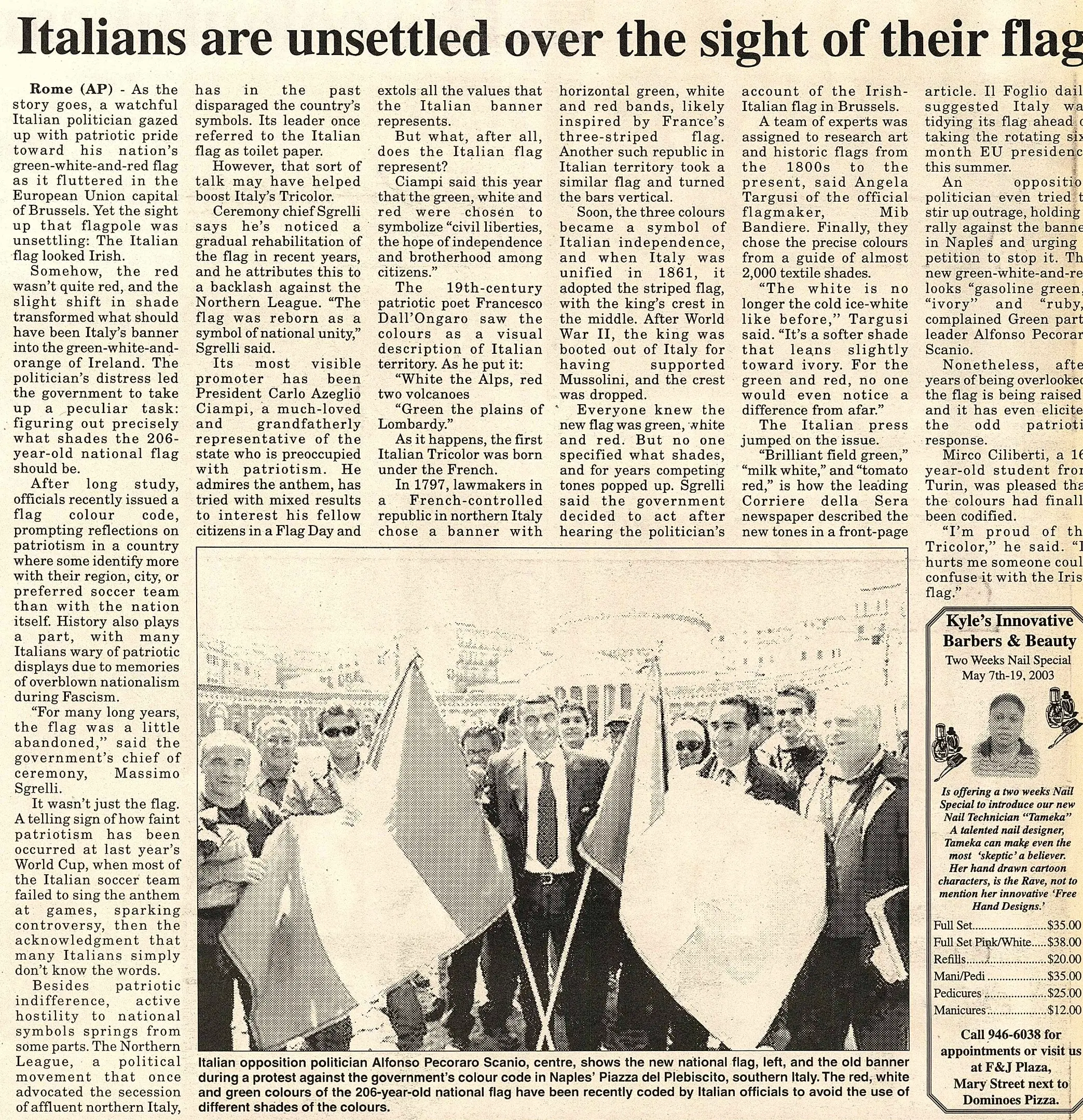
An opposition politician even tried to stir up outrage, holding a rally against the banner in Naples and urging a petition to stop it. The new green-white-and-red looks "gasoline green," "ivory" and "ruby," complained Green party leader Alfonso Pecoraro Scanio.
Nonetheless, after years of being overlooked, the flag is being raised and it has even elicited the odd patriotic response.
Mirco Ciliberti, a 16-year-old student from Turin, was pleased that the colours had finally been codified.
"I'm proud of the Tricolor," he said. "It hurts me someone could confuse it with the Irish flag."