A layperson's guide to rugby sevens
About the article
This is a digitised version of an article from The Cayman Compass's print archive. Occasionally, the digitisation process introduces transcription errors, or other problems.
See the article in its original context from June 2003.
Brought to you by

Weekend passes are priced $25 and include entry into a prize draw with some excellent prizes such as Cayman Airways tickets, Maxi Priest concert tickets, a sunset sail for four on Cockatoo, a lunch sail on Safir (a 98ft round the world racing yacht) and various dinner prizes at local fine dining establishments. Day passes cost $15 including entry to the prize draw and $10 without.
About Rugby Sevens
To clarify one misconception, rugby is not like American football. However, there are some similarities and for those who are unfamiliar with the game of rugby, the basic principals behind the game are: The Basics:
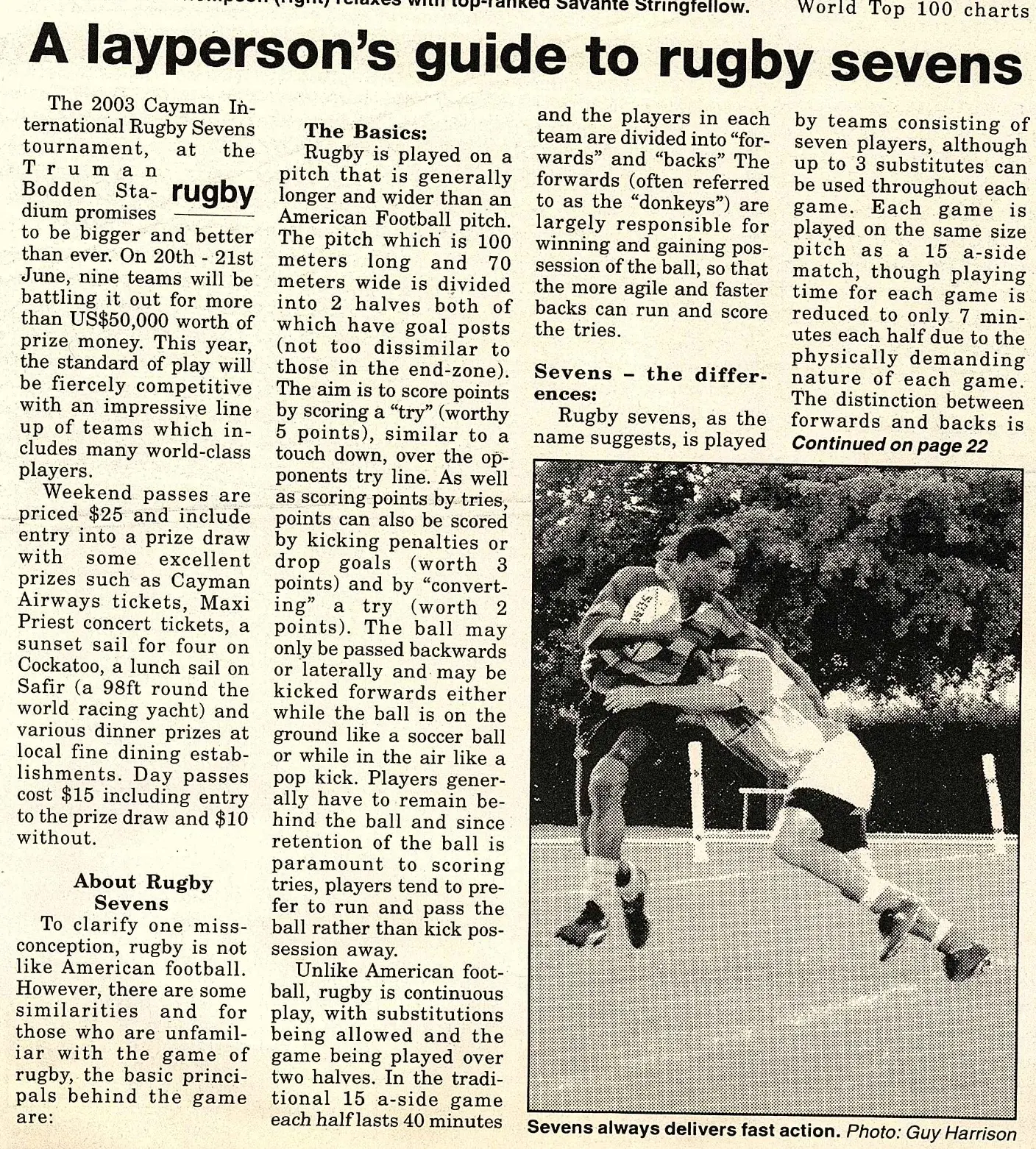
Rugby is played on a pitch that is generally longer and wider than an American Football pitch. The pitch which is 100 meters long and 70 meters wide is divided into 2 halves both of which have goal posts (not too dissimilar to those in the end-zone). The aim is to score points by scoring a "try" (worthy 5 points), similar to a touch down, over the opponents try line. As well as scoring points by tries, points can also be scored by kicking penalties or drop goals (worth 3 points) and by "converting" a try (worth 2 points). The ball may only be passed backwards or laterally and may be kicked forwards either while the ball is on the ground like a soccer ball or while in the air like a pop kick. Players generally have to remain behind the ball and since retention of the ball is paramount to scoring tries, players tend to prefer to run and pass the ball rather than kick possession away.
Unlike American football, rugby is continuous play, with substitutions being allowed and the game being played over two halves. In the traditional 15 a-side game each half lasts 40 minutes. and the players in each team are divided into "forwards" and "backs" The forwards (often referred to as the "donkeys") are largely responsible for winning and gaining possession of the ball, so that the more agile and faster backs can run and score the tries. Sevens - the differences: Rugby sevens, as the name suggests, is played by teams consisting of seven players, although up to 3 substitutes can be used throughout each game. Each game is played on the same size pitch as a 15 a-side match, though playing time for each game is reduced to only 7 minutes each half due to the physically demanding nature of each game.
The distinction between forwards and backs is Continued on page 22 Continued from page 21 more "blurred" in sevens since there are fewer stoppages and set plays with all seven players in each team tending to possess similar fitness and skill levels. Seven a-side rugby is fast flowing, highly skillful, physically challenging and highly entertaining. With fewer players on the pitch, there is more space to run with the ball and to avoid being tackled. This together with the impact fitness levels make, ensures more try scoring opportunities, compared with the 15 a-side game. So why not come and check out the Cayman International Sevens and see for yourself? See you there 4pm Friday 20th June.
History of Seven A-Side Rugby: Seven a-side rugby was born in 1883 in Melrose, Scotland, a little town in the south of Scotland, an area also known as the Scottish Borders. The Melrose club, had a fine rugby side, in which the star players were the local butcher David Sanderson and his apprentice Ned Haig. The club was experiencing serious financial shortages and the committee, in an attempt to raise the much needed funds, decided to organize an athletics meeting or sports day, at the end of the 1883 season. The idea struck them that a rugby football tournament may prove attractive. However, it was felt that the numbers involved would render the tournament un-workable.
Both Sanderson and Haig had played in some sort of reduced numbers rugby tournament while working on the English side of the border. The solution became obvious; to cut down the size of the team to seven and the playing time to 15 minutes. The Melrose Committee decided to hold the tournament, unaware of the historic significance of their decision. Seven local clubs competed on the now famous Greenyards fields. Sevens spread quickly in the Scottish Borders and then later overseas. In 1921, the first International tournaments took off in both England and Argentina and in 1926 the Middlesex Sevens was played for the first time and quickly became a favourite end of season event: World Sevens Rugby: The abridged (seven a-side) game of rugby has only come of age in the last decade. Traditionally, only Middlesex, Hong Kong (which attracts over 40,000 each day) and the Dubai sevens, all of which started off as fledgling tournaments, captured the public (and media's) attention.
"It is said that the novelty, the skill, the thrill and flow of the game inspired two eager and dynamic officials from Hong Kong to try and replicate the event in the colony - nothing too dissimilar to Cayman in 2001, when the inaugural Cayman Sevens was launched" Thanks to the International Rugby Board's ("IRB") foresight in organising a world sevens tournament in 1993 amongst all the major rugby playing nations and thereafter, every four years, the abridged game has grown in popularity both from a playing and viewing perspective. The popularity of seven a-side rugby was further enhanced in 1998 at the Commonwealth Games in Kuala Lumpur, Malaysia where the majority of the world's leading rugby nations and players completed in front of sell out crowds. This was repeated in 2002 in Manchester, England where the sevens rugby was one of the show piece events.
The decision in 1999 by the IRB to join forces with the top ten rugby unions in the world and present a series of linked seven a-side tournaments, has dramatically raised the profile of the sport to a new level. The IRB Sevens Series forms part of the IRB's initiative to establish rugby as a global sport, one with widespread visibility and steadily improving standards of excellence. It is interesting in so far as to date; the only region in the world not to host a tournament is North America and the Caribbean. It will only be a matter of time before this is rectified. Who knows, with the ongoing success and development of the Cayman International Sevens, the Cayman Islands could be well positioned to be the first in the Caribbean to be awarded a leg of the series.
So why not come and check out the Cayman International Sevens and see for yourself? See you there 4pm Friday 20th June The Teams
This year one of the organisers' aims is to support the development of the junior/schools rugby programme in the Cayman Island. With this in mind, the visiting teams have been twinned with local schools and over 600 tickets have been distributed to school children. The junior rugby program will also receive $5 from every weekend pass sold for the event. The British Army, winners of the 2001 Middlesex Sevens, twinned with Cayman Prep and High School, Walkers Road
Samurai, winners of the 2002 Cayman International Sevens, twinned with Red Bay
Cayman Invitational Cayman's home team Rugby Ecosse, winners of the 2002 Trinidad Sevens, twinned with St Ignatius Prep Marauders, 2002 Dubai Plate winners twinned with St Ignatius Red Rock Qauia, Fijian National Sevens Champions, twinned with John Gray
OMBAC, 2002 USA National Champions twinned with Triple C
The Aardvarks based in Edinburgh, Scotland, twinned with Cayman Prep and High School, Smith Road