DECOLONISATION PROCESS 'Education is paramount'
About the article
This is a digitised version of an article from The Cayman Compass's print archive. Occasionally, the digitisation process introduces transcription errors, or other problems.
See the article in its original context from June 2003.
Brought to you by

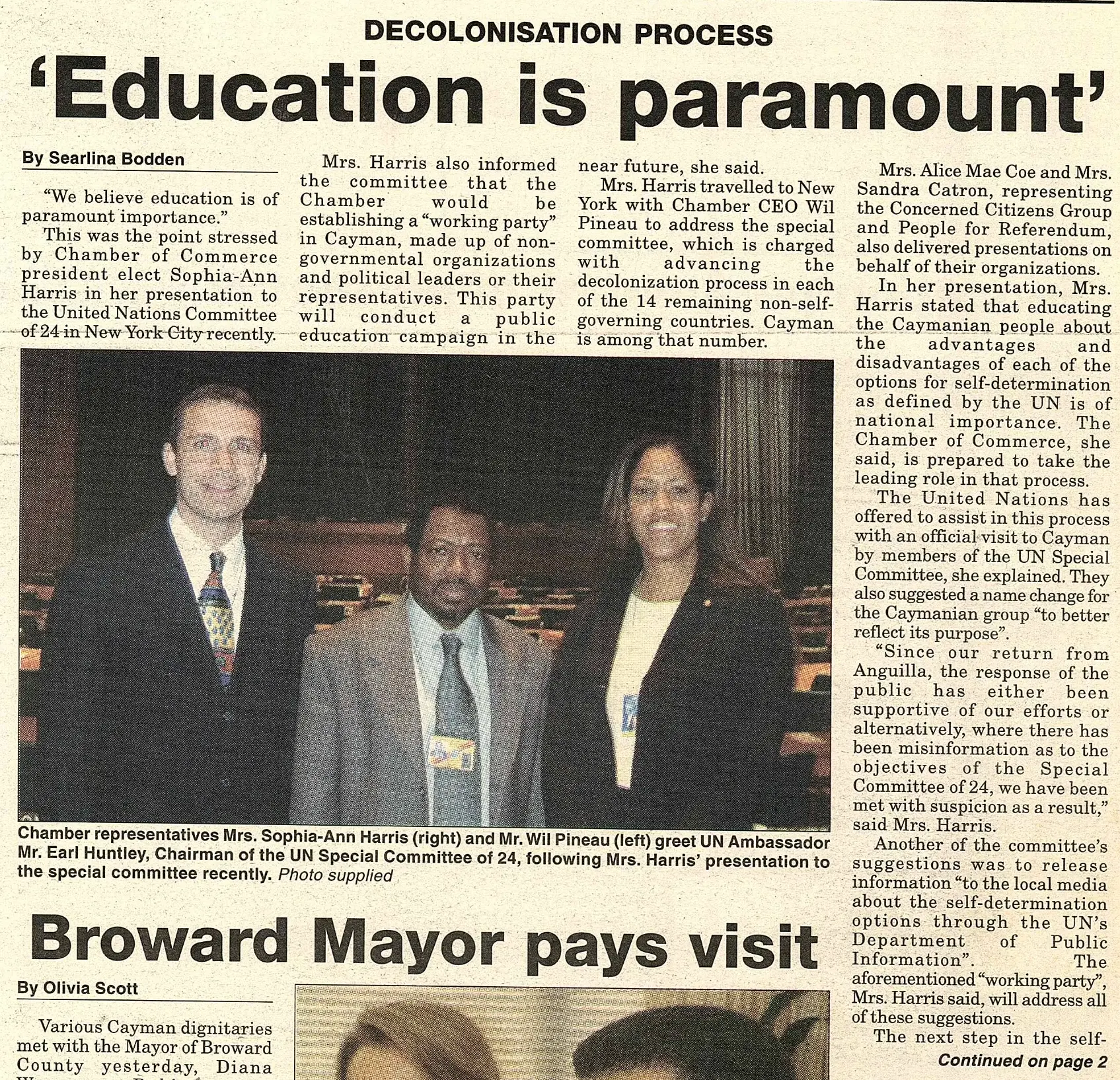
This was the point stressed by Chamber of Commerce president elect Sophia-Ann Harris in her presentation to the United Nations Committee of 24 in New York City recently. Mrs. Harris also informed the committee that the Chamber would be establishing a "working party" in Cayman, made up of nongovernmental organizations and political leaders or their representatives.
This party will conduct a public education campaign in the near future, she said.
Mrs. Harris travelled to New York with Chamber CEO Wil Pineau to address the special committee, which is charged with advancing the decolonization process in each of the 14 remaining non-selfgoverning countries. Cayman is among that number. Mrs. Alice Mae Coe and Mrs. Sandra Catron, representing the Concerned Citizens Group and People for Referendum, also delivered presentations on behalf of their organizations.
In her presentation, Mrs. Harris stated that educating the Caymanian people about the advantages and disadvantages of each of the options for self-determination as defined by the UN is of national importance. The Chamber of Commerce, she said, is prepared to take the leading role in that process. The United Nations has offered to assist in this process with an official visit to Cayman by members of the UN Special Committee, she explained. They also suggested a name change for the Caymanian group "to better reflect its purpose".
"Since our return from Anguilla, the response of the public has either been supportive of our efforts or alternatively, where there has been misinformation as to the objectives of the Special Committee of 24, we have been met with suspicion as a result," said Mrs. Harris.
Another of the committee's suggestions was to release information "to the local media about the self-determination options through the UN's Department of Public Information". The aforementioned "working party", Mrs. Harris said, will address all of these suggestions. The next step in the self-Continued on page 2 from page 1 determination process would be referendum, Mrs. Harris said. In what form, though, is uncertain as yet.
Mrs. Catron addressed the issue of referendum extensively in her speech. "The position of the PFR remains unchanged - we would like to see a people initiated referendum embedded into the Cayman Islands constitution," she said.
Mrs. Harris remarked that the working party would also explore the four options provided by the United Nations in the selfdetermination process. They are: independence, free association, integration and "whatever the country in question can negotiate with the United Kingdom directly". This fourth option, Mrs. Harris said, was only brought to the attention of she and Mr. Pineau at the presentation.
A delegate from Papua New Guinea stated that he believed the fourth option was really "an amended version" of free association, she remarked.
Mrs. Harris also stated at the presentation that she, Mr. Pineau and the representatives of the other non-governmental organizations (NGOs) have taken issue with the fact that the UK has presented no clear definition of the word "free". "This is a problem for us. We all need to be on the same page from the onset," she said.
The Chamber's 15-minute presentation was similar to one given at a UN-sponsored seminar in Anguilla in May and was reviewed and supported by four NGOs - the Chamber of Commerce, Cayman Ministers' Association, Concerned Citizens Group and People for Referendum.